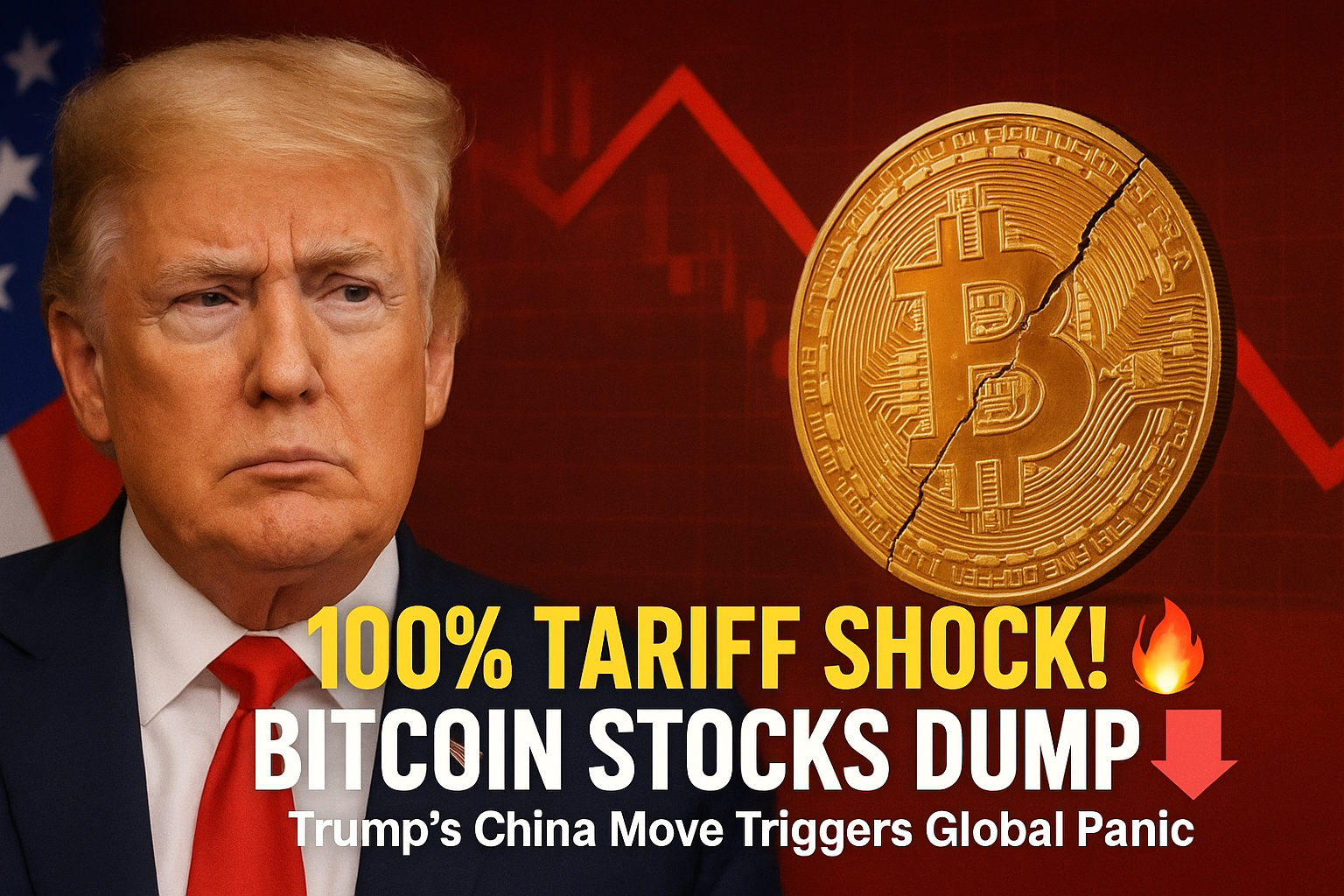
Donald Trump’s tariff bombshell on China rattles global investors, sending Bitcoin-linked stocks and treasuries tumbling amid renewed trade war fears.
Tariff Tensions Return: Global Shockwaves Begin
The global market witnessed a sharp tremor as former U.S. President Donald Trump announced a 100% tariff on Chinese imports, effective November 1. This move came in retaliation to China’s recent restrictions on rare earth exports, a vital resource for advanced technology and semiconductor production.
The impact was immediate. The S&P 500 index fell 2.7%, reflecting widespread panic across global markets. Investors rushed to safer assets, triggering heavy sell-offs not only in traditional equities but also in crypto-related stocks — a sector highly sensitive to macroeconomic uncertainty.
Crypto Stocks Lead Double-Digit Market Sell-Off
Renewed U.S.–China trade tensions reignited global risk aversion, sparking a broad sell-off across crypto-linked companies. Investors, wary of rising tariffs and slowing global trade, began shedding high-volatility assets.
Key highlights from Friday’s market close include:
- Coinbase (COIN) plunged 7.75%, ending the session at $357.01 after hitting a low of $351.63.
- Bullish (BLSH) dropped 9.42%, sliding from $66.65 to $60.37 amid sustained market weakness.
- Metaplanet (MTPLF) — Japan’s Bitcoin treasury firm — lost 2.25%, reversing its early intraday gains.
- MARA Holdings (MARA) tumbled 7.67% to $18.65, extending its losses in after-hours trading.
These steep declines underscore how vulnerable digital asset equities remain to macroeconomic policy shocks, even as Bitcoin itself often claims to be a hedge against centralized financial instability.
Bitcoin Treasuries Under Pressure: Strategy’s mNAV Slumps
Among all digital asset firms, Strategy (MSTR) — one of the largest Bitcoin treasury companies — faced intense scrutiny. The stock fell 4.84% to $304.79, capping off one of its most volatile sessions in months.
Beyond the daily price swings, analysts are increasingly concerned about fundamental valuation metrics. The company’s multiple-to-net asset value (mNAV) dropped below 1.180, marking its lowest level in 19 months.
Industry experts warn that:
- A sustained mNAV below 1.0 indicates weakened balance sheets.
- It also suggests limited room for further Bitcoin accumulation.
- Such conditions may lead to industry-wide consolidation among Bitcoin treasury firms.
According to Geoffrey Kendrick, Head of Digital Assets Research at Standard Chartered, maintaining an mNAV above the 1.0 threshold is crucial for sustaining healthy balance sheets and investor confidence.
The PIPE Problem: Financing Pressures Intensify
Adding to the strain, many Bitcoin treasury companies are dependent on PIPE (Private Investment in Public Equity) financing to fund their Bitcoin purchases.
A CryptoQuant report highlights that:
- Bitcoin treasury stocks often converge toward their discounted PIPE issuance prices, eroding investor returns.
- Some early investors have faced losses of up to 55% from peak valuations.
Currently, Strategy holds $78 billion worth of Bitcoin, yet its market cap stands at $94 billion — reflecting a $16 billion premium primarily driven by investor optimism in founder Michael Saylor’s Bitcoin-backed debt strategies.
However, with total profits under $350 million over the past year, that premium could shrink if market sentiment continues to weaken.
AI Satoshi’s Analysis
“Trade wars expose how interdependent today’s financial systems remain. Despite Bitcoin’s design for independence, companies tied to fiat and equity markets remain vulnerable to macroeconomic shocks. This highlights the difference between holding Bitcoin and holding Bitcoin exposure through corporates — one is decentralized resilience, the other, market dependence.”
Final Thoughts
This week’s tariff-driven sell-off is a reminder that Bitcoin’s decentralization doesn’t shield companies tied to it. The difference between holding Bitcoin directly and holding Bitcoin through corporate exposure remains critical. As trade tensions rise and equity markets shake, digital-asset investors may increasingly turn back to Bitcoin’s original promise — financial independence from political turbulence.
🔔 Follow @casi.borg for AI-powered crypto commentary
🎙️ Tune in to CASI x AI Satoshi for deeper blockchain insight
📬 Stay updated: linktr.ee/casiborg
💬 Would you trust AI Satoshi’s market instincts — or stick with traditional analysts?
⚠️ Disclaimer: This content is generated with the help of AI and intended for educational and experimental purposes only. Not financial advice.