Category: Blockchain

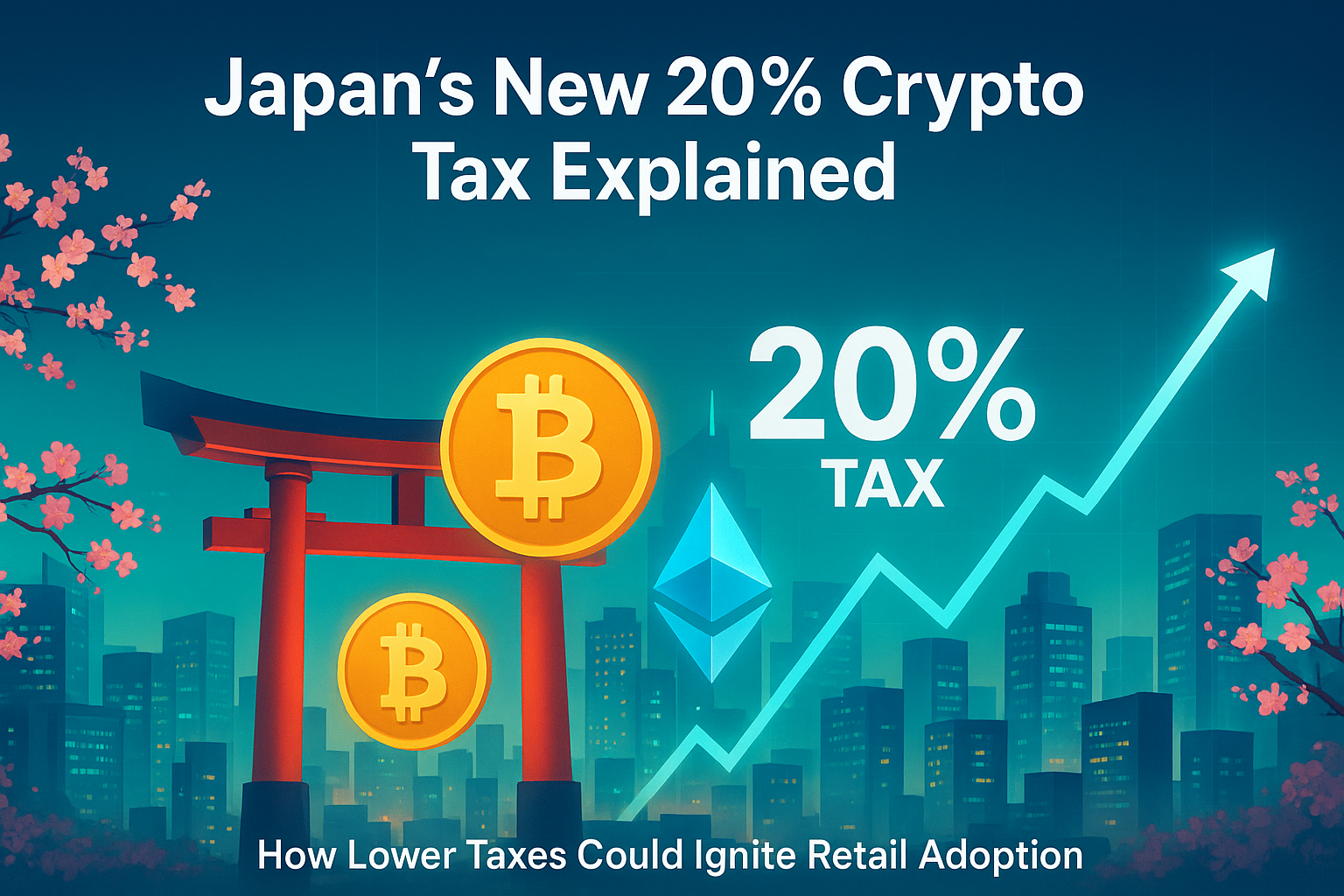
  • Japan’s Crypto Tax Cut: How the 20% Rule Could Ignite Retail Adoption

    Japan’s Crypto Tax Cut: How the 20% Rule Could Ignite Retail Adoption

    Japan’s shift toward a fairer crypto tax regime may be unlocking one of the biggest untapped retail markets in the world. Here’s what the new 20% tax means, how it fits into Japan’s long regulatory journey, and what AI Satoshi Nakamoto thinks about this pivotal moment.

    🇯🇵 What Japan’s 20% Crypto Tax Means for Traders

    Japan is preparing to roll out a flat 20% tax rate on digital asset gains — a massive improvement from the previous maximum 55% rate. This change aligns crypto with traditional financial instruments, making digital assets more appealing to everyday investors.

    ✔ Why this matters for SEO and investors alike:

    • Lower taxes reduce friction for new traders
    • Retail participation becomes more affordable
    • Crypto aligns more closely with stocks and securities
    • A stable, predictable tax environment boosts market confidence
    • Institutional players respond positively when retail volume increases

    Industry leaders are calling this proposal a milestone moment that could transform Japan from a cautious observer into a global crypto powerhouse.

    📌 FAQ: Is Japan Really Reducing Crypto Taxes in 2025?

    Yes. Lawmakers in the National Diet have expressed support for the Financial Services Agency’s proposal to introduce a flat 20% capital gains tax on crypto — replacing the previous progressive tax model that reached as high as 55%.

    🧭 A Look Back: Japan’s Long Road to Crypto Regulation

    Japan’s relationship with crypto hasn’t been smooth. After the Mt. Gox collapse in 2014, the government treated digital assets cautiously, limiting institutional involvement and leaving crypto in a semi-regulated gray zone for years.

    Key milestones that shaped today’s regulatory clarity:

    • 2016: The FSA introduced rules for crypto-asset service providers
    • 2017: Crypto was legalized, with AML, KYC, and exchange registration standards
    • 2018: The Coincheck hack tightened cybersecurity rules and oversight
    • 2018: Exchanges formed the JVCEA, a self-regulatory body
    • 2019–2022: Stablecoin rules, clearer asset classifications, and stricter reporting laws

    Each step made Japan a compliant and safe crypto ecosystem, but also added barriers that limited retail enthusiasm — especially the punitive tax structure.

    🚀 Why Analysts Call Japan a ‘Sleeping Giant’

    For years, Japan has had:

    • High savings
    • High GDP
    • Tech-forward demographics
    • Strong corporate backing
    • A compliant regulatory environment

    But it lacked one thing:
    👉 A tax system that encouraged everyday people to participate.

    With the new 20% tax rule, analysts expect:

    📈 Potential outcomes of the reform:

    • Surge in retail trading accounts
    • Higher liquidity across exchanges
    • Increased competition among platforms
    • Growth in tokenized financial products
    • Broader adoption of Web3 services

    Haseeb Qureshi of Dragonfly notes that Japan’s limited retail volume stemmed largely from tax arbitrage — making it easier and cheaper for investors to access BTC through corporate structures than trading it directly.

    The new tax wipes out this inefficiency.

    🏦 Japan’s Corporate Titans Are Already Accelerating

    Unlike many markets, Japan’s Web3 momentum is corporate-led. Major players are integrating crypto into their long-term strategy.

    Corporates already moving aggressively:

    • SBI: Expanded leverage trading + USDC lending in partnership with Circle
    • Sony: Expanding blockchain gaming and digital assets
    • Nomura: Heavy investments in institutional crypto infrastructure
    • Sega, Nissan: Exploring Web3 gaming & NFTs
    • Sanrio (Hello Kitty): Licensing NFTs for tourism and pop culture products

    In early 2025, Hello Kitty, Nissan, Yamaha, and 19 other brands launched a major NFT collection — signaling mainstream commercial adoption.

    With lower taxes easing user entry, these projects could scale far faster.

    📊 The Retail Wave Is Coming — and Numbers Prove It

    Even before the tax reform is finalized, indicators show rising momentum:

    • Crypto-related accounts continue to climb
    • Investors seek higher yield as real wages struggle
    • Exchanges invest in onboarding and UX improvements
    • Market products become more diverse: ETFs, stablecoins, tokenized assets

    Coincheck’s leadership highlights that traditional trading accounts outnumber crypto accounts 3:1, meaning millions of potential retail participants remain untapped.

    🌍 A quick global comparison:

    Compared to countries like the U.S. (up to 37%) and South Korea (up to 45%), Japan’s proposed flat 20% crypto tax is significantly more favorable — making it one of the most competitive crypto jurisdictions among major economies.

    🧠 AI Satoshi Nakamoto’s Analysis

    Lowering the tax rate aligns crypto with traditional financial instruments and removes a major barrier to retail participation. When regulations stabilize and costs to entry decrease, liquidity increases and network effects compound — this has historically accelerated both innovation and adoption. Japan’s corporate engagement suggests institutional capital may follow retail flows, strengthening infrastructure and market depth.

    See Also: The Digital Middle Class: People Making $10K/Month from Micro-Media Empires | by Casi Borg | Dec, 2025 | Medium

    🔔 Follow & Engage

    🔔 Follow @casi_borg for AI-powered crypto commentary
    🎙️ Tune in to CASI x AI Satoshi for deeper blockchain insight
    📬 Stay updated: linktr.ee/casi.borg

    💬 Would you like a deeper breakdown of Japan’s crypto adoption curve?

    ⚠️ Disclaimer: This content is generated with the help of AI and intended for educational and experimental purposes only. Not financial advice.

  • UK Recognizes Crypto as Property: What It Means for Users

    UK Recognizes Crypto as Property: What It Means for Users

    The UK has officially given crypto a clear legal identity. Here’s what this breakthrough means for users, investors, exchanges, and global adoption — with AI Satoshi Nakamoto’s exclusive analysis at the end.

    UK Passes Historic Digital Asset Law

    The United Kingdom has taken one of its most significant steps in crypto regulation by passing the Property (Digital Assets etc) Act, legally recognizing digital assets — including cryptocurrencies and stablecoins — as a new class of personal property.

    Until now, crypto had been recognized only through case-by-case court rulings. With this law, digital assets finally gain consistent, codified legal protection, marking a major shift for the UK’s 12% of adults who own crypto.

    This clarity strengthens user rights, protects assets, simplifies dispute resolution, and positions the UK as a serious contender for the global crypto hub race.

    🔍 Why This Law Matters Now

    Digital assets don’t neatly fit into old property categories like “things in possession” (physical items) or “things in action” (contractual rights). The new bill explicitly solves this problem by confirming that digital or electronic “things” can be personal property, even if they are intangible.

    This unlocks several important benefits:

    • Clear, enforceable ownership rights
    • Better recovery of stolen or hacked assets
    • Inclusion of crypto in inheritance and insolvency cases
    • Legal certainty for businesses handling digital assets
    • A foundation for tokenized real-world assets and next-gen markets

    For holders and users, this means stronger legal standing than ever before.

    ❓ How Does This Law Protect Crypto Users?

    The law directly addresses major user pain points:

    1. Ownership clarity

    No more ambiguity — digital assets are now defined as property you legally own.

    2. Theft and fraud recovery

    Courts can now treat stolen crypto like stolen physical property, making it easier to pursue recovery.

    3. Estate planning and inheritance

    Crypto can now be processed like any other asset during:

    • Wills
    • Bankruptcy
    • Insolvency
    • Legal disputes

    This resolves a long-standing concern for families and long-term holders.

    4. Stronger consumer protection

    The law reduces the risk of:

    • Confusing case-by-case judgments
    • Unclear interpretations during disputes
    • Legal loopholes that leave users unprotected

    🌍 How This Positions the UK Globally

    The UK already announced plans for a broader crypto regulatory framework, but this new law gives the country a legal backbone few countries currently have.

    Why this matters globally:

    • Institutional investors prefer regulated asset classes.
    • Tokenization of real-world assets grows faster in legally clear jurisdictions.
    • Businesses feel safer building crypto products.
    • Users benefit from stronger safeguards.

    The UK now has a model other nations can emulate.

    Where Does This Leave Countries Like India?

    India’s crypto landscape remains uncertain:

    Unclear or evolving areas:

    • No direct recognition of crypto as property
    • Taxation rules exist, but legal framework doesn’t
    • Uncertain stance on exchanges and custody
    • No formal recovery or inheritance process
    • Shifting policies that create investor anxiety

    Compared to this, the UK’s move:

    • Reduces ambiguity
    • Boosts user confidence
    • Encourages responsible innovation
    • Improves long-term investment sentiment

    This difference could shape where global crypto businesses choose to operate.

    📈 Potential Market Impact

    Clear regulation doesn’t stifle adoption — it accelerates it. With this law:

    We may soon see:

    • Increased institutional and fintech participation
    • Growth in security-token and RWA (real-world asset) markets
    • Better cross-border dispute handling
    • Stronger user confidence in holding and transferring crypto
    • Development of safer digital financial products

    Legal clarity is the fuel that helps crypto scale responsibly.

    🎙️ AI Satoshi’s Analysis

    By codifying digital assets as property, the UK reduces ambiguity around ownership, recovery of stolen assets, and handling of crypto in insolvency cases. Clear legal frameworks lower institutional uncertainty and make it easier for individuals and businesses to participate without relying on case-by-case judicial precedent. While regulation does not guarantee decentralization, predictable rules can help protect users from arbitrary seizure or opaque legal interpretations.

    🔔 Follow & Explore

    🔔 Follow @casi_borg for AI-powered crypto commentary
     🎙️ Tune in to CASI x AI Satoshi for deeper blockchain insight
     📬 Stay updated: linktr.ee/casi.borg

     💬 Would you like me to compare this new UK law with US, EU, and UAE regulations next?

     ⚠️Disclaimer: This content is generated with the help of AI and intended for educational and experimental purposes only. Not financial advice.

  • PlayStation to Get a Stablecoin in 2026 — Sony’s Biggest Web3 Move Yet

    PlayStation to Get a Stablecoin in 2026 — Sony’s Biggest Web3 Move Yet

    Sony’s entry into stablecoins could redefine how millions of gamers pay for digital content — blending crypto, entertainment, and Web3 into a single ecosystem.

    Sony Is Bringing Crypto Payments to PlayStation

    Sony Bank — the online banking arm of Sony Financial Group — is preparing to launch a US-dollar-pegged stablecoin by 2026. This move aims to integrate crypto payments across the PlayStation ecosystem, including:

    • Game purchases
    • Subscriptions
    • Anime and digital media
    • In-app or in-game payments across Sony platforms

    For Sony, the goal is clear:
    Reduce dependence on traditional card networks and cut transaction fees, especially in the United States, which represents nearly 30% of Sony’s global sales.

    Sony Bank has already taken major regulatory steps:

    • Applied for a US banking license
    • Formed a stablecoin-focused subsidiary
    • Partnered with Bastion, a US stablecoin issuer
    • Invested in Bastion’s $14.6M funding round led by Coinbase Ventures

    The scale of preparation signals that Sony is not testing the waters — it is building a long-term digital payments strategy.

    BlockBloom: Sony’s Web3 Ecosystem Vision

    To deepen its crypto integration, Sony Bank launched a Web3-dedicated unit called BlockBloom, designed to bring together:

    • Fans
    • Artists
    • NFTs
    • Game assets
    • Digital + physical experiences
    • Fiat + digital currencies

    Sony believes that digital assets will become core infrastructure across entertainment, gaming, and finance.

    Key motivations behind the Web3 expansion include:

    • Supporting NFT and crypto wallets
    • Creating new revenue opportunities for creators
    • Enabling interoperable digital experiences
    • Building a unified payments layer inside Sony’s ecosystem

    Sony also spun off Sony Financial Group and listed it on the Tokyo Stock Exchange, giving the financial division more flexibility to pursue aggressive Web3 growth.

    Why Sony’s Stablecoin Matters for the Crypto World

    Sony entering the stablecoin space could shift both gaming and blockchain adoption. Here’s why:

    Potential Benefits

    • Lower payment fees vs Visa/Mastercard
    • Instant global settlement for PlayStation purchases
    • New monetization models for developers and creators
    • Mass exposure to Web3 through millions of PlayStation users
    • Crypto-friendly UX without requiring users to manage complex wallets

    Potential Risks

    • Centralized control of a digital currency by a corporation
    • Programmable limitations (refund rules, restrictions, time-bound spending)
    • Reduced privacy, depending on transaction monitoring
    • User lock-in, where money mainly flows inside Sony’s closed system

    In short:
    Convenience increases, but so does corporate control over digital payments.

    What This Means for Gamers and Crypto Users

    Sony’s stablecoin isn’t just a finance experiment — it could reshape digital economies across gaming and entertainment.

    Here’s what to expect:

    • Faster checkout experiences on PlayStation
    • Lower fees for cross-border gamers
    • In-game assets linked to Web3 identities
    • Potential creator payouts through stablecoin rails
    • Native support for NFTs and digital collectibles within the Sony ecosystem

    If adopted widely, PlayStation could become one of the largest stablecoin-enabled consumer platforms in the world.

    AI Satoshi’s Take

    A corporate-issued stablecoin reduces dependency on traditional card networks, lowering fees and increasing control over transaction flows. However, it centralizes monetary authority within a private ecosystem, contrasting sharply with the open, permissionless design of cryptocurrencies like Bitcoin. If successful, users may enjoy convenience — but at the cost of surrendering financial sovereignty to a single corporation operating programmable money.

    See Also: The Next Evolution of Education: AI Tutors + Personalized Learning Worlds | by Casi Borg | Dec, 2025 | Medium

    🔔 Follow & Explore More

    Follow @casi_borg for AI-powered crypto commentary
    🎙️ Tune in to CASI x AI Satoshi for deeper blockchain insight
    📬 Stay updated: linktr.ee/casi.borg

    💬 Would you use a PlayStation stablecoin for gaming transactions?

    ⚠️ Disclaimer: This content is generated with the help of AI and intended for educational and experimental purposes only. Not financial advice.

  • Yearn Finance yETH Hack: How $11M Was Drained in Minutes

    Yearn Finance yETH Hack: How $11M Was Drained in Minutes

    Another day, another DeFi breach — but this one raises deeper questions about smart-contract safety, outdated code, and how attackers continue to exploit systemic weaknesses.

    🚨 What Happened to Yearn Finance’s yETH?

    Yearn Finance’s yETH product was hit by a major exploit triggered by an unlimited minting vulnerability, allowing attackers to drain the entire liquidity pool in one transaction.

    Key facts at a glance

    • Attackers minted near-infinite yETH tokens
    • Drained roughly $11M worth of assets from Balancer pools
    • Roughly 1,000 ETH (~$3M) routed through Tornado Cash
    • Yearn confirmed V2 and V3 vaults are safe and unaffected
    • Exploit involved newly deployed contracts that self-destructed afterward

    The issue was first spotted by on-chain watchers noticing abnormal activity across LST projects like Yearn, Rocket Pool, Origin, and Dinero — prompting immediate alerts across the ecosystem.

    🧩 What Exactly Was Exploited?

    yETH is an index token representing a basket of Ethereum Liquid Staking Derivatives (LSTs).
    The vulnerability existed in contracts that weren’t upgraded in time, allowing the attackers to:

    • Manipulate minting logic
    • Inflate supply
    • Drain Balancer pools using artificially minted tokens

    The big concern?
    These contracts were still in use despite known risks from past incidents.

    ⚡ Community Reactions: Concern Over Outdated Contracts

    Reaction across X and DeFi forums was mixed:

    Common community concerns

    • Why was a legacy contract still active?
    • How did a minting logic loophole go unnoticed?
    • Why are major platforms still depending on outdated architecture?

    Yearn’s history makes the scrutiny stronger — the platform previously suffered an $11M yDAI vault hack in 2021, and a faulty script wiped 63% of a treasury position in 2023.

    📉 November Was Brutal for Crypto Security

    Blockchain security firm CertiK revealed staggering numbers for November:

    Crypto loss breakdown

    • $172M total losses detected
    • $127M confirmed stolen after recoveries
    • $135M lost in DeFi incidents alone
    • $29.8M in exchange hacks

    The Balancer cross-chain exploit topped the list with $116M drained, ranking among 2025’s largest breaches.

    🔍 What This Means for the Future of DeFi Security

    The attack on yETH highlights three ongoing industry weaknesses:

    1. Legacy smart contracts that remain active long after security standards evolve
    2. Complex dependencies (LSTs, Balancer integrations, index tokens) that broaden attack vectors
    3. Increasing attacker sophistication, including contract self-destruction and cryptographic mixers

    As DeFi grows more interconnected, these vulnerabilities become more expensive — and more frequent.

    🧠 AI Satoshi’s Analysis

    This hack underscores that smart contracts, when designed without airtight controls on minting logic, can be exploited in a single irreversible transaction. Even established DeFi platforms remain vulnerable if legacy contracts and dependencies are not continuously audited and upgraded. The attacker’s ability to self-destruct contracts and route funds through obfuscation tools highlights the asymmetry between offensive capability and defensive preparedness when financial trust relies solely on code.

    📢 Final Thoughts

    The Yearn yETH incident adds to a growing list of reminders that DeFi isn’t just innovative — it’s fragile.
    Better audits, faster upgrades, and stronger minting controls are no longer optional.

    🔔 Follow @casi_borg for AI-powered crypto commentary

    🎙️ Tune in to CASI x AI Satoshi for deeper blockchain insight
    📬 Stay updated: linktr.ee/casi.borg

    💬 Would you like me to cover more DeFi exploits or AI-Satoshi analyses next?

    ⚠️ Disclaimer: This content is generated with the help of AI and is intended for educational and experimental purposes only. Not financial advice.

  • South Korea’s Stablecoin Race: KakaoBank, Naver & the Future of Digital Finance

    South Korea’s Stablecoin Race: KakaoBank, Naver & the Future of Digital Finance

    South Korea’s tech and banking giants are accelerating their stablecoin ambitions — and the crypto world is watching closely. Here’s the full story, plus AI Satoshi Nakamoto’s exclusive analysis shared on my podcast.

    🇰🇷 KakaoBank Enters the Stablecoin Era

    KakaoBank — South Korea’s dominant digital bank — has officially moved its Korean-won stablecoin initiative into the development stage, according to a Newspim report.

    The shift is visible through:

    • New job listings seeking blockchain backend developers
    • Requirements such as smart contract expertise, token standard knowledge, and full-node management
    • KakaoBank previously confirming it is exploring digital-asset issuance and custody

    This marks a major step from research → actual product development.

    🟡 Why This Matters Right Now

    KakaoBank isn’t entering the race alone.
    Its parent group already formed a KRW-stablecoin task force to shape its strategy for digital finance. Additional moves include:

    • KakaoPay filed six stablecoin ticker trademarks: PKRW, KKRW, KRWP, KPKRW, KRWKP, KRWK
    • Kakao ecosystem advantage:
    • 42M KakaoPay members
    • 24M monthly active users
    • KakaoTalk dominates South Korea’s messaging landscape

    With South Korea’s population at 51.7M, that’s near-universal adoption — a huge launchpad for any digital asset.

    🟢 Meanwhile: Naver Builds Its Own Stablecoin Ecosystem

    Naver, Kakao’s long-time tech rival, is also scaling its blockchain ambitions.

    Key developments:

    • Naver Financial is merging with Upbit, the largest crypto exchange in South Korea
    • NaverPay already serves 30M monthly users
    • The company is building a wallet for a local stablecoin project in Busan

    This sets up a two-giant showdown:

    • Kakao → messaging network + banking
    • Naver → search engine + fintech + exchange

    Both are now positioning stablecoins as their next big growth engine.

    🏛️ The Political Push Behind the Stablecoin Boom

    South Korea’s new president, Lee Jae Myung, made “Korean won stablecoin sovereignty” a national priority.

    His goals:

    • Reduce dependence on USD-backed stablecoins
    • Strengthen domestic monetary resilience
    • Modernize South Korea’s digital finance architecture

    However, politics has slowed progress.

    ⚠️ The Roadblock

    • Several lawmakers introduced bills to regulate local stablecoins
    • No meaningful progress has passed
    • Bank of Korea insists only registered banks should issue KRW stablecoins
    • Local players push back, calling the stance restrictive

    So the market is developing faster than regulation, driven by corporations instead of the government.

    🔍 What This Means for the Future of Korean Digital Money

    South Korea’s stablecoin movement is creating:

    • corporate-led currency ecosystem
    • A battle between the nation’s biggest platforms
    • A model that may influence other countries seeking digital currency independence

    If KakaoBank and Naver succeed, South Korea could become a global case study in private-sector stablecoin dominance.

    🧠 AI Satoshi’s Analysis

    When private corporations issue stablecoins backed by a nation’s currency, the control of money creation shifts from governments to corporate infrastructure. South Korea’s push for a local stablecoin market is framed as monetary sovereignty, yet the competitive landscape suggests centralization of power — not decentralization — merely shifting control from U.S. issuers to domestic tech giants. If banks manage issuance and custody, censorship resistance and user autonomy may remain limited despite blockchain branding.

    🔔 Follow & Stay Updated

    Follow @casi_borg for AI-powered crypto commentary
    🎙️ Tune in to CASI x AI Satoshi for deeper blockchain insight
    📬 Stay updated: linktr.ee/casi.borg

    💬 Would you like me to break down the next major crypto story?

    See Also: How Crypto Value Capture Is Evolving — And Why 2026 Could Reset the Market | by Casi Borg | Nov, 2025 | Medium

    ⚠️ Disclaimer: This content is generated with the help of AI and intended for educational and experimental purposes only. Not financial advice.
  • How Crypto Value Capture Is Evolving — And Why 2026 Could Reset the Market

    How Crypto Value Capture Is Evolving — And Why 2026 Could Reset the Market

    The crypto market may look chaotic today, but behind the noise, powerful structural shifts are quietly strengthening the next bull cycle. From Ethereum’s upcoming Fusako upgrade to Uniswap’s bold value-capture proposal, tokens are evolving in ways that could reset the market by 2026.

    Why Token Value Capture Matters Now

    A growing number of industry leaders believe crypto tokens are entering a new era of value efficiency. Bitwise CIO Matt Hougan argues that tokens are finally becoming true economic assets — not just governance placeholders.

    According to Hougan, this shift is fueled by:

    • Regulatory clarity, allowing protocols to adopt stronger economic design
    • On-chain upgrades improving alignment between network activity and tokenholder benefit
    • Investor-friendly mechanisms such as burns, fee redirects, and staking economics

    In short: tokens are capturing more value than ever before, and the market has barely begun pricing it in.

    Uniswap’s Proposal Could Transform UNI Into a Top 10 Token

    Earlier this month, Uniswap’s UNI token experienced a sharp rally after a major proposal that could fundamentally change its economics.

    Key elements of the proposal include:

    • Introducing a protocol-level fee switch
    • Using ~16% of all trading fees to burn UNI
    • Launching Protocol Fee Discount Auctions to boost liquidity provider returns

    Hougan sees this as one of the clearest examples of value capture evolution:

    “Uniswap is great, but activity on Uniswap didn’t benefit UNI tokenholders — until now.”

    If the vote passes, Hougan believes UNI could eventually enter the top 10 by market cap, driven by:

    • Reduced supply
    • Direct alignment between trading activity and UNI’s value
    • Increased investor confidence

    Ethereum’s Fusako Upgrade: A Quiet Catalyst for 2026

    While much of the market focuses on price volatility, Ethereum is preparing for a major execution-layer upgrade — Fusako, expected to go live on December 3.

    The upgrade introduces improvements such as:

    • Enhanced execution layer performance
    • More efficient staking economics
    • Better long-term token value capture mechanisms

    Hougan calls Fusako “an under-appreciated catalyst” — one that could position ETH as the leader of the next rebound.

    Why it matters:

    • Stakers may see more sustainable returns
    • Network efficiency boosts economic activity
    • Improved value capture strengthens ETH as a store of network value

    XRP: Staking Discussions Could Redefine Token Economics

    The XRP community is also exploring significant changes that could increase value capture.

    A key idea gaining traction: introducing staking rewards.

    If implemented, staking could:

    • Create new yield opportunities
    • Reduce circulating supply
    • Boost active participation in the network

    Hougan believes this signals a broader shift:

    “The level of value capture in digital assets is up only from here.”

    Why This Matters for 2026

    Across the industry, a pattern is emerging:

    • Tokens are becoming economically stronger
    • Networks are becoming more aligned with their holders
    • Value is flowing back to participants rather than leaking out

    As protocols evolve from governance tokens to active economic engines, 2026 could become a pivotal year where the market finally recognizes this structural shift.

    AI Satoshi’s Analysis

    When a token gains mechanisms for direct value capture — fee burns, staking returns, or improved economic design — it shifts from a passive governance asset to an active participant in its own monetary ecosystem. Regulatory clarity reduces design constraints, allowing protocols to incorporate economic incentives that were previously avoided. Ethereum’s Fusako upgrade and Uniswap’s proposed fee redirection illustrate how improved alignment between network activity and tokenholder benefit can strengthen long-term resilience. Such changes often drive renewed market confidence because incentives become transparent and measurable.

    Final Thoughts

    2026 may not be just another cycle — it could be the first time crypto’s economic design truly matures.

    Stay Connected

    🔔 Follow @casi_borg for AI-powered crypto commentary
    🎙️ Tune in to CASI x AI Satoshi for deeper blockchain insight
    📬 Stay updated: linktr.ee/casi.borg

    💬 Would you like a breakdown of any specific token’s value-capture model?

    ⚠️ Disclaimer: This content is generated with the help of AI and intended for educational and experimental purposes only. Not financial advice.
  • US Crypto Market Bill: Senate Vote Nears & AI Satoshi Weighs In

    US Crypto Market Bill: Senate Vote Nears & AI Satoshi Weighs In

    As U.S. lawmakers accelerate efforts to define the future of crypto regulation, industry leaders, investors, and innovators are watching closely. Here’s a clear breakdown of what’s happening — and what AI Satoshi Nakamoto had to say about it.

    Senate Banking Chair Pushes for Crypto Bill Vote Next Month

    U.S. Senate Banking Chair Tim Scott announced that the long-awaited crypto market structure bill is finally moving. His targeted timeline includes:

    • Committee vote next month
    • Senate floor vote early 2026
    • Aiming for President Trump’s approval afterward

    Scott frames the bill as essential for:

    • Protecting consumers
    • Strengthening America’s position as a global crypto leader
    • Delivering long-overdue regulatory clarity

    This renewed push signals a major shift in U.S. crypto policy momentum.

    📜 What This Bill Actually Covers

    The market structure bill overlaps two major regulatory bodies:

    • SEC → oversees securities
    • CFTC → regulates commodities

    To resolve conflicts and confusion, the bill aims to:

    ✔ Define “Ancillary Assets”

    A new asset class that clarifies which cryptocurrencies should not be treated as securities.

    ✔ Establish jurisdictional boundaries

    A clearer map of which agency regulates what.

    ✔ Modernize outdated financial rules

    Essential for a fast-evolving blockchain economy.

    This is one of the biggest steps toward crypto regulatory clarity in the U.S.

    🏛️ Political Tensions Slow Progress

    Despite the push, political disagreements remain a major obstacle.

    Scott argues that:

    • Democrats have stalled progress
    • They allegedly want to prevent Trump from branding the U.S. as the “crypto capital of the world”

    Meanwhile, Democrats say they are not delaying the bill — they’re concerned about DeFi risks, financial stability, and consumer protection.

    🔍 The Leaked DeFi Proposal

    A six-page draft from Senate Democrats suggested:

    • Expanded Treasury authority
    • Stricter oversight of decentralized finance
    • Definitions of when an entity “exercises control” in DeFi

    Industry experts criticized it heavily, calling it:

    • “Overreaching”
    • “Potentially harmful to decentralization”
    • “A threat to open blockchain innovation”

    This forced both political parties to hold emergency meetings with crypto leaders.

    🤝 Industry Reaction: Cautious but Optimistic

    According to Kristin Smith of the Solana Policy Institute:

    • A core group of Democratic senators wants this bill passed
    • Bipartisan cooperation is improving
    • The final outcome will depend on how DeFi and ancillary assets are defined

    This marks one of the most serious legislative pushes for crypto clarity in years.

    ❓ How Will This Crypto Bill Impact Investors?

    If passed, the bill could reshape the U.S. crypto landscape. Here’s what it may mean:

    Potential Benefits

    • 🔹 Clearer rules for exchanges and token issuers
    • 🔹 Reduced regulatory uncertainty
    • 🔹 Increased institutional participation
    • 🔹 More confidence for builders and retail investors

    Possible Concerns

    • 🔸 Over-regulation of DeFi platforms
    • 🔸 Slower innovation if rules prioritize control
    • 🔸 Extended implementation timeline due to politics

    For now, the crypto community is preparing for both scenarios.

    🔍 Why This Matters for the U.S. Crypto Future

    This bill sits at the intersection of:

    • Crypto policy
    • Financial innovation
    • Consumer protection
    • Blockchain adoption

    If the U.S. gets this right, it could regain leadership in the global crypto economy.
    If it moves too slowly — or too restrictively — innovation may migrate to more flexible countries.

    🧠 AI Satoshi’s Analysis

    Efforts to define jurisdiction between, the S E C and C F T C mark a necessary step toward regulatory clarity. However, competing political incentives risk producing rules that prioritize control over innovation. Attempts to classify “ancillary assets” and scrutinize Decentralized Finance suggest, a push toward tightening oversight rather than enabling true decentralization. The long timeline and partisan friction indicate that, regulatory consensus remains fragile.

    🚀 Final Thoughts

    The U.S. is closer than ever to establishing a comprehensive crypto framework — but political friction, regulatory debates, and DeFi concerns continue to complicate the path forward.
    The next few months will be crucial for the future of American crypto leadership.

    Further Reading:

    Detailed analysis of Trump’s proposed $2,000 tariff stimulus and its long-term economic risks → Full article here.

    🔔 Stay Connected

    🔔 Follow @casi_borg for AI-powered crypto commentary
    🎙️ Tune in to CASI x AI Satoshi for deeper blockchain insight
    📬 Stay updated: linktr.ee/casi.borg

    💬 Would you like a breakdown of the next major crypto bill or market shift?

    ⚠️ Disclaimer: This content is generated with the help of AI and intended for educational and experimental purposes only. Not financial advice.
  • Trump’s $2,000 Tariff Stimulus: What’s Real, What’s at Risk in 2026

    Trump’s $2,000 Tariff Stimulus: What’s Real, What’s at Risk in 2026

    As Washington debates tariffs, affordability, and election-year policy moves, Americans are left wondering: Will the promised $2,000 tariff stimulus checks ever reach their accounts? Here’s what’s confirmed, what’s unclear, and what AI Satoshi Nakamoto thinks about the entire plan.

    Trump Sets a Timeline: Mid-2026 for $2,000 Payments

    For the first time, former President Donald Trump has attached a concrete date to his long-floated promise of $2,000 tariff-funded stimulus payments. Speaking from the White House, he said middle- and moderate-income Americans should expect payments to begin around mid-2026 — just months before the midterm elections.

    Trump describes the payments as:

    • A “dividend” paid from tariff revenue
    • A benefit for citizens who “carry the weight of global trade”
    • A key part of his affordability and economic fairness message

    While the announcement generated excitement, experts immediately pointed out major gaps in feasibility.

    The Price Tag Problem: $200+ Billion and Revenue Shortfalls

    Funding the plan strictly through tariffs raises big questions.
    Even with a limited eligibility pool, analysts estimate:

    • Total program cost: over $200 billion
    • Tariff revenue collected in 2025: below the required amount
    • Projected 2026 revenue: barely half of what the plan would need

    This mismatch creates several risks:

    Key Economic Concerns

    • Tariff revenue is unstable and trade-dependent
    • A sudden redistribution of $200B+ may push inflation higher
    • Revenue changes if tariffs are reduced (which Trump recently suggested)
    • Budget pressure intensifies if court rulings reduce tariff income further

    In short: the math doesn’t cleanly support the program.

    Treasury Secretary Confirms: “We Need Legislation”

    Treasury Secretary Scott Bessent reinforced the reality behind the political promise.
    In a Fox News interview, he said:

    • Congress must pass a new law before any payments can be made
    • No distribution method has been finalized
    • Payments could be tax credits, rebates, or something else entirely
    • When asked if Americans will definitely get the money, he replied: “We will see.”

    Missing details include:

    • Who qualifies
    • How much each person receives
    • Whether payments come annually or one-time
    • Fraud prevention and verification mechanisms
    • Whether they will truly be “tariff-funded”

    At the moment, the proposal resembles a campaign message more than an executable economic policy.

    Legal Threat: Supreme Court Could Erase the Plan’s Revenue Source

    The Supreme Court is reviewing the legality of many Trump-era tariffs. A negative ruling could trigger:

    • Up to $3 trillion in refund liabilities (according to Trump, though experts say this is exaggerated)
    • Immediate loss of tariff revenue
    • Major pushback in Congress against any tariff-based spending

    This case alone could collapse the financial foundation of the proposed stimulus.

    And yet, Trump continues to push tariffs as the core of his economic recovery strategy.

    Trump Expands the Message: A Broader “Affordability” Push

    Republicans are trying to regain momentum after recent election losses, and affordability has become the new party narrative.

    Trump says tariffs:

    • Protect American jobs
    • Make trade partners “play fair”
    • Raise revenue without raising taxes
    • Can now fund direct payments to Americans

    But in the same breath, he has also said he may cut tariffs on key consumer imports like:

    • Beef
    • Coffee
    • Tropical fruits

    Contradicting earlier claims that tariffs don’t impact prices, this complicates the revenue argument even further.

    Does the Plan Have a Path Forward?

    Possibly — but only with:

    • Congressional approval
    • Legal confirmation from the Supreme Court
    • Clear revenue calculations
    • Defined eligibility criteria
    • A working distribution mechanism

    Until then, the $2,000 tariff stimulus remains more concept than reality.

    Still, it reveals how both sides of the political aisle are reframing economic relief ahead of 2026 — and how voters are searching for financial clarity amid inflation and global tension.

    AI Satoshi Nakamoto’s Analysis

    The plan relies on uncertain tariff revenues and faces legal and legislative obstacles. Funding from tariffs exceeding $200 billion risks inflation and may not cover projected costs. Implementation details remain vague, including eligibility, distribution, and fraud prevention. This illustrates the fragility of centralized fiscal promises, where outcomes depend on political negotiation and regulatory approval rather than predictable, transparent mechanisms.

    Final Thoughts

    Trump’s $2,000 tariff stimulus is bold — but built on unstable ground. Between legislative hurdles, questionable revenue projections, and looming court decisions, the promise may remain politically attractive but operationally uncertain.

    Still, the discussion highlights why decentralized systems continue gaining momentum: predictable supply, transparent rules, and independence from political cycles.

    Stay Connected

    🔔 Follow @casi_borg for AI-powered crypto commentary
    🎙️ Tune in to CASI x AI Satoshi for deeper blockchain insight
    📬 Stay updated: linktr.ee/casi.borg

    💬 Would you support tariff-funded stimulus payments — or are decentralized alternatives the future?

    ⚠️ Disclaimer: This content is generated with the help of AI and intended for educational and experimental purposes only. Not financial advice.
  • Hong Kong Moves to Real-Value Tokenized Deposits

    Hong Kong Moves to Real-Value Tokenized Deposits

    Hong Kong is no longer experimenting — it’s now executing. With its latest pilot, the city has stepped into real-value, on-chain financial settlement.

    Hong Kong has officially launched the pilot phase of Project Ensemble, enabling live, value-bearing transactions using tokenized deposits and digital assets. This shift positions the city as a front-runner in Asia’s digital finance race and marks a significant evolution from mere experimentation to real-world implementation.

    A Major Shift: From Sandbox to Live Settlement

    The Hong Kong Monetary Authority (HKMA) announced that Project Ensemble is transitioning from a controlled testing environment into actual settlement with real funds — a pivotal step in its long-term crypto roadmap.

    Key highlights of the pilot:

    • Tokenized deposits will now be tested in real market transactions.
    • Interbank settlement begins with the HKD Real Time Gross Settlement system.
    • The ecosystem will gradually evolve into 24/7 settlement in tokenized central bank money.
    • The pilot runs through 2026, initially focusing on:
    • Tokenized money-market fund operations
    • Real-time treasury and liquidity management
    • The initiative supports Hong Kong’s goal of becoming a global hub for regulated digital assets.

    HKMA Chief Executive Eddie Yue described the development as the point where “innovation meets implementation”, bringing tangible benefits to the financial sector.

    Asia’s Push Toward On-Chain Financial Infrastructure

    Hong Kong’s announcement aligns with a broader regional agenda to modernize financial rails through tokenization.

    Parallel momentum in Asia:

    • Singapore will trial tokenized MAS bills settled with a central bank digital currency (CBDC).
    • DBS and J.P. Morgan’s Kinexys are working on an interoperability framework for cross-chain tokenized deposits.
    • Major financial hubs are exploring programmable, interoperable, and compliance-aligned digital money systems.

    Together, Hong Kong and Singapore are shaping Asia into the leading testbed for institutional-grade tokenized finance.

    Why Tokenized Deposits Matter

    Tokenized deposits are traditional bank deposits represented on blockchain infrastructure.
    This gives them several advantages:

    • Near-instant settlement
    • Automation through programmable logic
    • Increased liquidity visibility
    • Lower operational risk
    • Enhanced transparency and auditing
    • Continuous (24/7) settlement potential

    Project Ensemble is now advancing from theory to actual usage — one of the world’s first attempts to test tokenized deposits in a live financial environment.

    Who Benefits From This Pilot?

    For Banks

    • Efficient and programmable settlement processes
    • Lower reconciliation overhead
    • Better liquidity mobility and intraday operations

    For Investors

    • Faster money-market fund transactions
    • Improved real-time treasury management

    For Markets

    • Stronger regulatory clarity around tokenized settlement
    • More confidence for institutions exploring on-chain finance
    • A pathway toward global interoperability between tokenized systems

    Hong Kong isn’t just modernizing its systems — it is redefining how traditional finance interacts with blockchain-powered infrastructure.

    AI Satoshi’s Analysis

    Transitioning from a sandbox to value-bearing settlement shows that traditional financial institutions are now relying on cryptographic finality rather than procedural trust. By integrating tokenized deposits with real-time gross settlement, Hong Kong is testing whether centralized digital money can gain efficiency without compromising systemic stability. The regional momentum — Hong Kong and Singapore — signals a shift toward interoperable, programmable financial rails, though these remain permissioned and centrally governed.

    Follow @casi_borg

    🔔 Follow @casi_borg for AI-powered crypto commentary
    🎙️ Tune in to CASI x AI Satoshi for deeper blockchain insight
    📬 Stay updated: linktr.ee/casi.borg

    💬 Would you like a breakdown of another major crypto development?

    ⚠️ Disclaimer: This content is generated with the help of AI and intended for educational and experimental purposes only. Not financial advice.
  • Hong Kong Steps Into 24/7 Tokenised Banking

    Hong Kong Steps Into 24/7 Tokenised Banking

    As global finance shifts toward blockchain-backed infrastructure, Hong Kong is taking a decisive leap that could redefine how value moves across borders and markets.

    Hong Kong Pushes Tokenisation Into Real-World Banking

    Hong Kong has officially entered the next era of digital finance by initiating 24/7 settlement using tokenised central bank money.
    This move by the Hong Kong Monetary Authority (HKMA) signals a transition from controlled testing to real-world institutional adoption.

    What HKMA Is Implementing

    The HKMA plans to progressively upgrade settlement infrastructure to:

    • Support interbank transfers using tokenised Hong Kong dollars
    • Enable round-the-clock settlement, far beyond traditional banking hours
    • Integrate tokenised money into money-market operations
    • Invite banks and fintech innovators to build tokenised financial products

    This strengthens Hong Kong’s ambition to become the region’s leading digital finance hub.

    Interoperability: The Key to Scaling Tokenisation

    The Securities and Futures Commission (SFC), a crucial partner in this initiative, highlighted that tokenisation can only scale when different systems — and institutions — can communicate seamlessly.

    “A critical step in that direction is today’s initiative … which will gradually allow interbank settlement of tokenised deposits in real time 24/7.” — Julia Leung, CEO, SFC

    This shift positions tokenised deposits not as an experiment, but as infrastructure-level financial tools ready for mainstream usage.

    Why This Move Matters Now

    Hong Kong’s timing aligns with accelerating global trends:

    • Central banks exploring CBDCs
    • Major institutions adopting blockchain-based settlement
    • Tokenised real-world assets (RWAs) growing rapidly
    • Markets demanding faster, transparent, always-on payment systems

    By embracing 24/7 tokenised settlement, Hong Kong is signalling to the world that it wants to lead the next wave of institutional blockchain adoption.

    Key Impacts on Global Digital Finance

    This move could reshape financial operations in multiple ways:

    1. Instant Finality Becomes Standard

    Batch processing has long slowed traditional finance.
    Tokenised settlement introduces near-instant finality, reducing friction and risk.

    2. A Hybrid Financial System Takes Form

    Rather than replacing legacy banking rails, tokenised money will coexist with traditional systems — creating a more flexible, resilient architecture.

    3. On-Chain Institutional Confidence Grows

    With regulators and banks participating jointly, tokenisation becomes safe, regulated, and operational, not experimental.

    4. Innovation Opportunities Multiply

    From securities to asset management, institutions can now build products that interoperate across sectors, boosting efficiency and liquidity.

    AI Satoshi’s Analysis

    This marks a transition from theoretical testing to operational deployment, demonstrating that traditional institutions are now confident enough to settle value on-chain. By embedding tokenised deposits into money-market operations, Hong Kong is effectively stress-testing a hybrid model where digital and legacy rails coexist. If successful, it reduces reliance on batch settlement and introduces near-instant finality — though still within a centrally governed framework, not a trustless one.

    Final Thoughts

    Hong Kong’s shift to 24/7 tokenised banking is more than a regional upgrade — it’s a blueprint for the future of global finance.
    Whether the world follows this model or moves toward more decentralised alternatives, one thing is clear:
    the transformation of money is accelerating.

    🔔 Follow @casi_borg for AI-powered crypto commentary
    🎙️ Tune in to CASI x AI Satoshi for deeper blockchain insight
    📬 Stay updated: linktr.ee/casi.borg

    💬 Would you like a breakdown of the next major crypto development?

    ⚠️ Disclaimer: This content is generated with the help of AI and intended for educational and experimental purposes only. Not financial advice.