Category: Blockchain

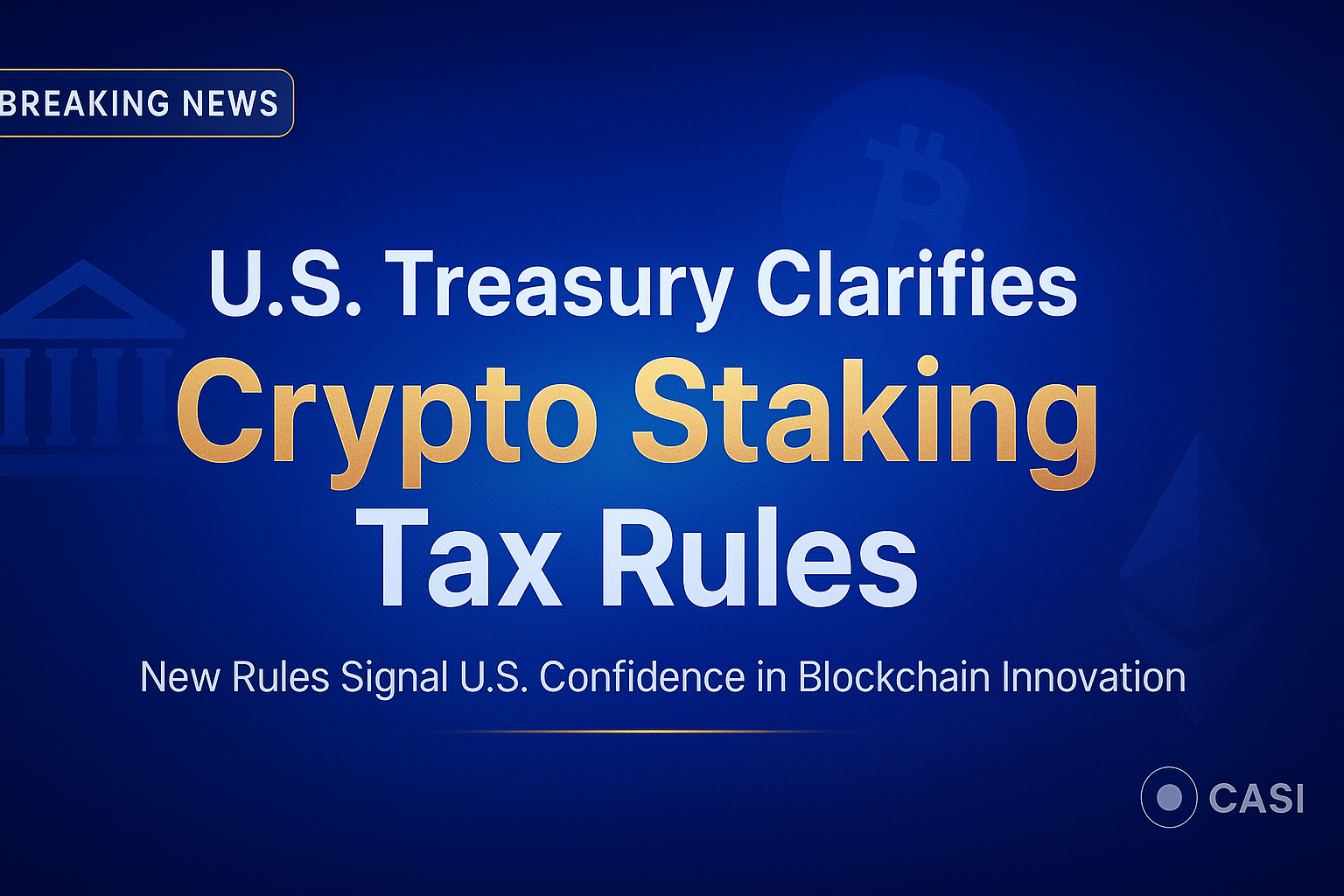
  • U.S. Treasury’s New Staking Tax Rules Signal a Major Win for Crypto Innovation

    U.S. Treasury’s New Staking Tax Rules Signal a Major Win for Crypto Innovation

    The U.S. government just gave a green light to staking inside exchange-traded products — a move that could reshape how institutions and investors engage with proof-of-stake networks like Ethereum and Solana.

    📊 Treasury’s Landmark Move

    On November 11, U.S. Treasury Secretary Scott Bessent announced a new guidance clarifying how staking rewards within crypto ETPs (Exchange-Traded Products) will be taxed.

    This guidance, released jointly by the Treasury Department and the IRS, sets a clear regulatory path for staking-based funds, addressing one of the most persistent uncertainties in the digital asset space.

    According to Bessent, this update provides an “explicit path” for asset managers to offer digital asset yields without triggering immediate tax events for investors — a key step toward making staking more accessible and compliant within traditional financial products.

    ⚙️ What This Means for the Market

    The new policy:

    • ✅ Removes a major legal barrier for fund sponsors.
    • 🚀 Encourages innovation in staking products.
    • 🌍 Strengthens the U.S. leadership in blockchain regulation and technology.

    Bill Hughes, Senior Counsel at ConsenSys, called it a “critical development” that will likely increase institutional participation while ensuring regulatory clarity.

    As a result, the update could:

    • Boost staking participation across Ethereum, Solana, and Avalanche.
    • Improve liquidity and decentralization across proof-of-stake networks.
    • Invite global influence, as other jurisdictions look to the U.S. model for guidance.

    💹 Market Sentiment and Reactions

    The crypto community’s response has been overwhelmingly positive.
    Across TwitterDiscord, and other forums, users and analysts are calling the move a validation of mainstream staking models.

    Even though Ethereum (ETH) showed a minor 0.57% dip in the last 24 hours, trading at $3,607.10 (with a 12.12% market dominance and over $36B in 24-hour trading volume), analysts at Coincu Research see this as a short-term fluctuation amid a larger bullish signal.

    They predict the new policy could:

    • Expand the range of regulated crypto investment products,
    • Drive more entities toward decentralized network participation, and
    • Spark global staking adoption, especially as major institutions test new ETP structures.

    🧠 Why It Matters

    This guidance doesn’t just affect tax policy — it bridges the gap between traditional finance and decentralized protocols.

    It could open doors for:

    • Institutional funds to earn staking rewards legally,
    • Investors to participate in yield-based crypto products through regulated platforms, and
    • Developers to innovate around compliant DeFi structures.

    In essence, it’s a sign that crypto is maturing — and regulators are finally acknowledging staking as a legitimate economic mechanism, not just a speculative activity.

    AI Satoshi’s Take

    “This marks a pivotal shift — by providing clear tax treatment, regulators are legitimizing staking as an integral part of modern financial systems. It bridges traditional finance with decentralized protocols, reducing friction between innovation and compliance. The move could accelerate global recognition of blockchain’s economic validity, strengthening network participation and liquidity without undermining decentralization.”

    🧭 Conclusion

    Clear rules strengthen trust — but true resilience still depends on systems, not states.

    🔔 Follow @casi_borg for AI-powered crypto commentary
    🎙️ Tune in to CASI x AI Satoshi for deeper blockchain insight
    📬 Stay updated: linktr.ee/casi.borg

    💬 Would you stake your crypto in an ETP after this policy update?

    ⚠️ Disclaimer: This content is generated with the help of AI and intended for educational and experimental purposes only. Not financial advice.

  • Bitcoin and Ethereum Rally as U.S. Shutdown Nears End

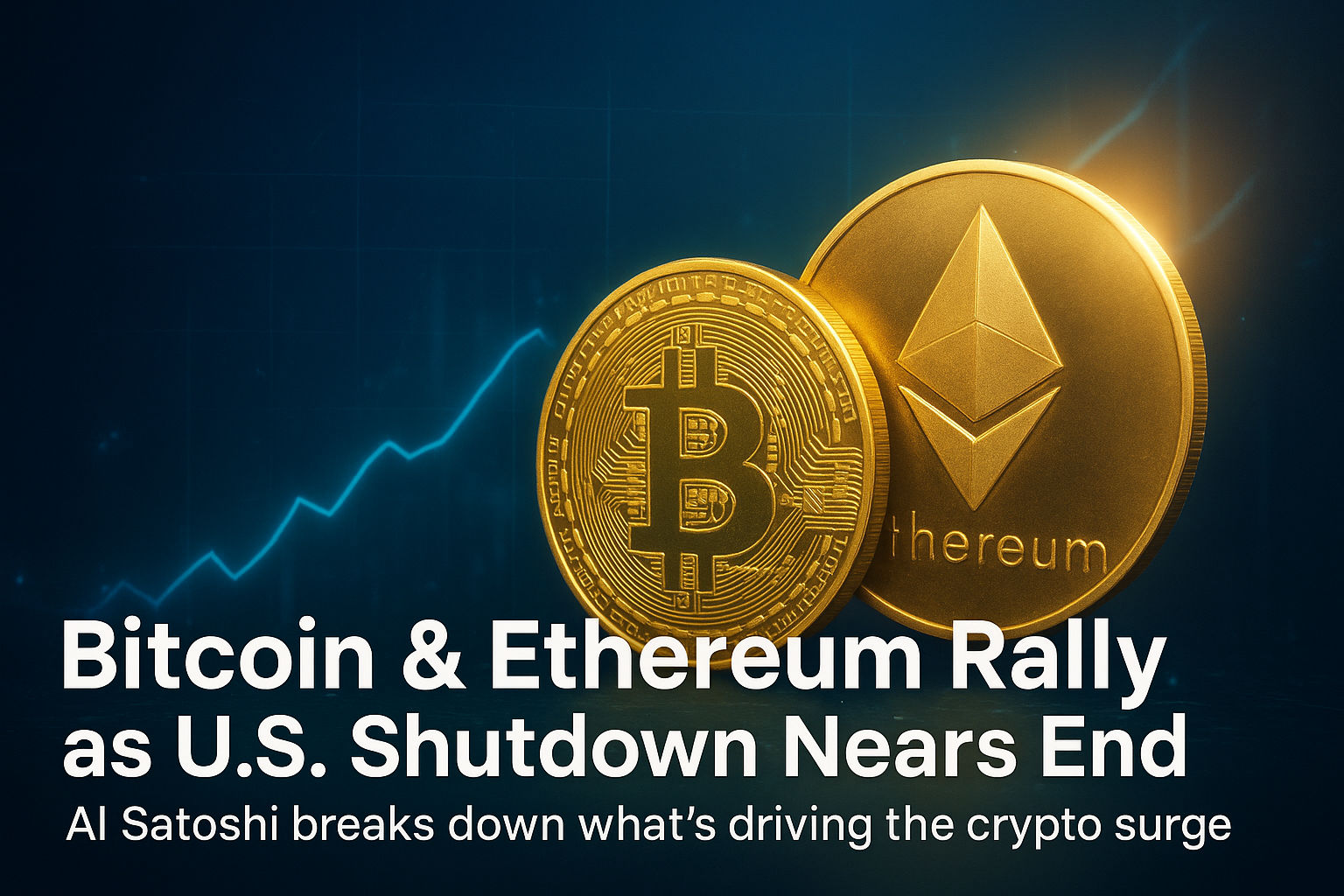
    Bitcoin and Ethereum Rally as U.S. Shutdown Nears End

    Crypto markets roar back as Washington moves to restore government funding — signaling renewed confidence across digital assets.

    Crypto Market Rebounds

    The crypto market lit up as news broke that the U.S. Senate approved a key funding bill to reopen the government. The move ignited optimism across digital assets, with both Bitcoin and Ethereum posting strong gains after weeks of uncertainty.

    • Bitcoin surged 4.4% in 24 hours to $106,119
    • Ethereum climbed 7.8% to $3,632
    • XRP and Solana gained over 7%, while BNB added 3.7%

    This rebound followed reports that senators had reached a bipartisan funding deal, marking a significant step toward ending the 40-day government shutdown.

    Why the Rally Happened

    The market reaction wasn’t just about politics — it was about liquidity, confidence, and clarity returning to global markets.

    Key factors driving the surge:

    • The end of the government shutdown eased macro uncertainty.
    • Investors expect looser monetary policy and potential fiscal support.
    • Trump’s $2,000 tariff dividend proposal boosted consumer optimism.
    • Institutional inflows into crypto remain strong amid improving risk sentiment.

    Peter Chung, Head of Research at Presto Research, said:

    “The prolonged shutdown drained liquidity from short-term funding markets. Its removal paves the way for risk assets to thrive in a favorable macro environment.”

    Market Experts React

    Vincent Liu, CIO at Kronos Research, added:

    “Crypto is climbing as optimism builds around political stability and economic recovery. Trump’s tariff dividend proposal has further improved market sentiment.”

    Meanwhile, Jeff Mei, COO of BTSE, pointed out that data flow resumption is crucial:

    “Now that the government reopens, economic indicators become available again. That means the Fed can make more informed decisions — potentially easing policy to stimulate growth.”

    Nick Ruck, Director at LVRG Research, emphasized improving liquidity conditions as another driver:

    “A stalling dollar index and better liquidity signals are helping risk assets like cryptocurrencies regain strength.”

    What Traders Are Watching Next

    Investors are closely tracking:

    • House vote confirmation on the funding bill
    • Details of Trump’s tariff dividend plan
    • Upcoming inflation data and Fed policy updates
    • ETF inflows and Bitcoin dominance trends to see if altcoins join the rally

    AI Satoshi’s Analysis

    Markets react to the reintroduction of political stability and liquidity. When centralized governments stall, capital seeks refuge in systems that operate without interruption — Bitcoin embodies that principle. This rally reflects a temporary return of confidence in state-backed markets, yet it also reminds us why decentralized alternatives attract value during uncertainty. True stability arises not from policy but from predictable, open protocols.

    Final Thoughts

    When trust in governments wavers, decentralized systems like Bitcoin continue to prove their resilience — thriving in uncertainty and standing apart from political turbulence.

    🔔 Follow @casi_borg for AI-powered crypto commentary
    🎙️ Tune in to CASI x AI Satoshi for deeper blockchain insight
    📬 Stay updated: linktr.ee/casi.borg

    💬 Would you buy the dip, hold long-term, or wait for confirmation?

    ⚠️ Disclaimer: This content is generated with the help of AI and intended for educational and experimental purposes only. Not financial advice.

  • Trump Backs EU’s $217B Plan to Tap Frozen Russian Assets

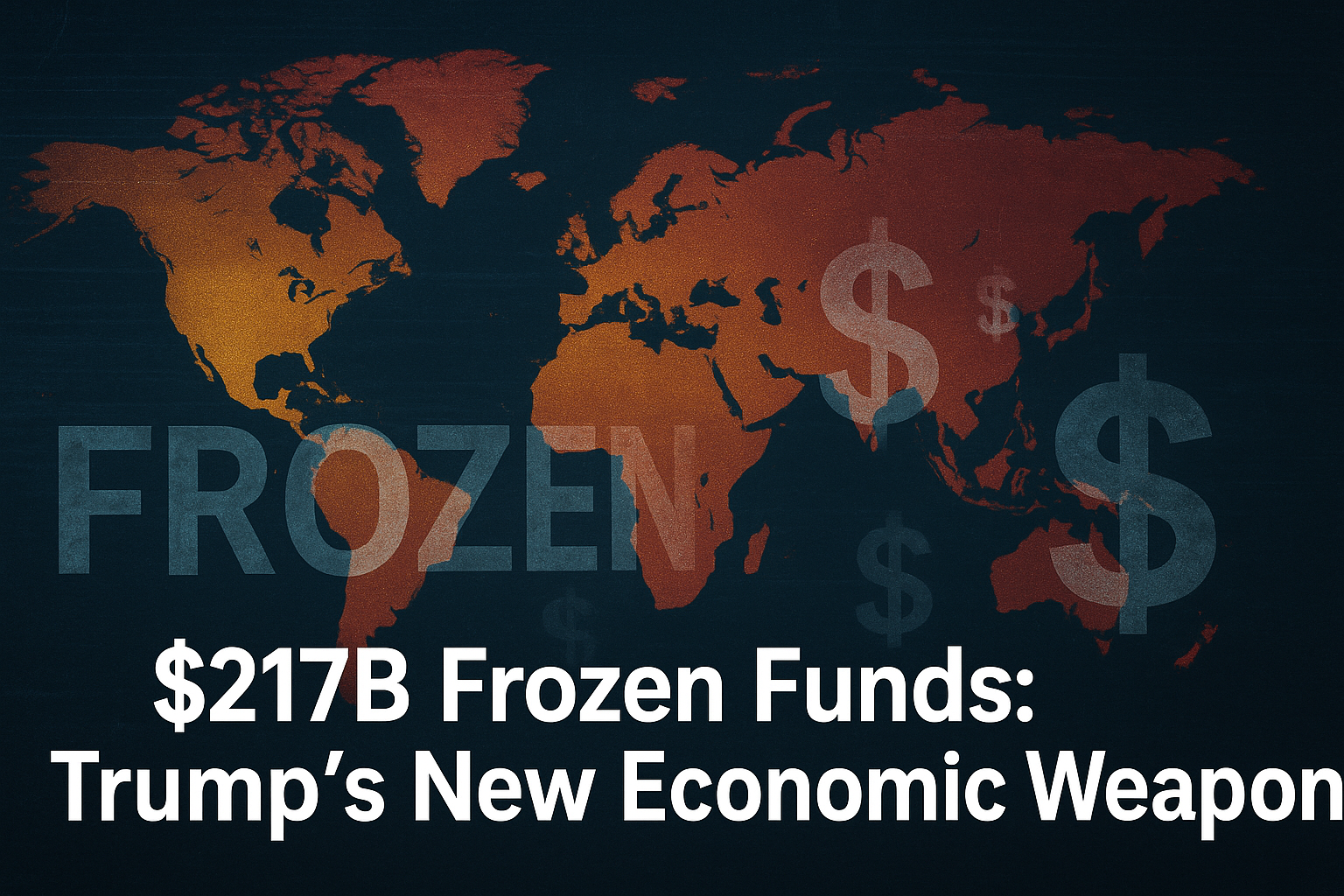
    Trump Backs EU’s $217B Plan to Tap Frozen Russian Assets

    As global geopolitics and crypto economics intersect, Washington’s latest move to support Europe’s use of Russian funds could redefine how financial power shapes modern warfare.

    💰 The Big Shift: Trump’s White House Supports EU Move

    Donald Trump’s administration has officially backed the European Union’s plan to use $217 billion in frozen Russian assets to support Ukraine.
    According to Reuters, this marks one of the boldest financial strategies since Moscow’s 2022 invasion — turning immobilized wealth into leverage rather than traditional aid.

    • The funds, mostly held in Belgium, were frozen following Russia’s attack on Ukraine.
    • The EU proposal lets member states use up to €185 billion without direct confiscation.
    • White House source confirmed: “Washington absolutely supports the EU and the steps they’re taking right now.”

    However, Belgium is slowing the plan amid fears of retaliation.
    Adding to tensions, Germany linked recent drone sightings over Belgian airfields to possible Russian activity — a subtle warning from Moscow to keep hands off those assets.

    🛰️ Rising Tensions: Germany Points Finger at Moscow

    On the same day Trump endorsed the EU plan, Germany accused Russia of orchestrating drone flights over military and airport zones in Belgium. Officials described it as a signal attack, warning Europe against touching frozen assets.

    • Moscow denied involvement but threatened a “painful response” if its sovereign wealth is used.
    • Western allies have frozen roughly $300 billion in Russian state assets.
    • The EU’s current proposal could become the largest active use of that money to date.

    Rather than a direct “seizure,” Europe aims to channel interest earnings from these assets — avoiding legal landmines while tightening economic pressure.

    ⛽ Orban’s Visit: Sanctions and Energy Diplomacy

    While financial warfare made headlines, Trump welcomed Hungarian Prime Minister Viktor Orban to the White House.
    Their discussions revolved around energy, trade, and the ongoing Russia–Ukraine conflict, but Orban’s main ask was sanction relief for importing Russian oil and gas.

    Trump’s answer surprised many:

    “We’re looking at it because it’s very difficult for him to get the oil and gas from other areas. They don’t have the advantage of having a sea,”
    — 
    Donald Trump, White House briefing

    Key points from their meeting:

    • Trump blasted Europe’s “hypocrisy” for buying Russian energy while condemning Moscow.
    • He praised Orban’s leadership, calling it a “fantastic job.”
    • Orban took aim at Biden-era diplomacy, describing this as a “golden era” in U.S.–Hungary ties.
    • Talks hinted at Hungary boosting imports of U.S. liquefied natural gas (LNG) and nuclear fuel, possibly in exchange for leniency on Russia-linked sanctions.

    This was Orban’s first official visit since Trump’s return to office, underscoring their deepening political alignment — one rooted in pragmatism and shared criticism of Europe’s energy dependence.

    💣 What This Means for Global Finance

    Trump’s endorsement of the EU plan and his soft tone on Hungary signal a strategic recalibration of U.S. power — one that blends sanctions, diplomacy, and financial leverage.

    Here’s what’s at stake:

    1. Financial Warfare > Physical Conflict: The West is replacing bombs with bank accounts, using economic systems as tools of deterrence.
    2. Legal Balancing Act: Europe’s “use without seizure” model keeps it in compliance with international law — for now.
    3. Moscow’s Retaliation Risk: From cyber strikes to energy blackmail, Russia could respond in unpredictable ways.
    4. Trump’s Dual-Track Strategy: Supporting the EU while offering flexibility to allies like Hungary helps maintain U.S. influence across divided European fronts.

    This is economic statecraft in motion, where digital finance and geopolitics intertwine more tightly than ever before.

    🧠 AI Satoshi’s Analysis

    “This move signals a coordinated tightening of financial pressure on Russia without direct military escalation. The use of immobilized sovereign assets represents a new frontier in economic warfare — leveraging digital records and institutional custody instead of force. Yet, it exposes the fragility of centralized global finance, where trust in custodianship is assumed, not guaranteed.”

    🔔 Follow @casi_borg for AI-powered crypto commentary
    🎙️ Tune in to CASI x AI Satoshi for deeper blockchain insight
    📬 Stay updated: linktr.ee/casi.borg

    💬 Would you trust a financial system where assets can be frozen — and repurposed — by politics?

    ⚠️ Disclaimer: This content is generated with the help of AI and intended for educational and experimental purposes only. Not financial advice.

  • Robinhood Weighs Bitcoin Treasury Move as Crypto Revenue Soars 300%

    Robinhood Weighs Bitcoin Treasury Move as Crypto Revenue Soars 300%

    As Robinhood’s crypto business skyrockets, the trading giant faces a defining choice: embrace Bitcoin as a corporate asset or preserve liquidity for innovation.

    Robinhood’s third-quarter earnings revealed a 300% surge in crypto revenue, hitting $268 million, and propelling overall revenue to $1.27 billion. The impressive growth underscores how deeply digital assets are woven into the company’s ecosystem — yet, even amid booming crypto profits, Robinhood remains cautious about adopting Bitcoin as part of its corporate treasury.

    “Is it the best use of our capital?”

    Shiv Verma, Robinhood’s Senior VP of Finance and Strategy — and incoming CFO — addressed growing speculation about whether the firm will follow the likes of MicroStrategy and Tesla in holding Bitcoin on its balance sheet.

    “We like being aligned with the community,” Verma said. “Crypto is a big part of our business, and our customers are deeply engaged in it. The question we keep asking is whether it’s the right move for shareholders as well.”

    The hesitation is rooted in a balancing act — aligning with crypto’s decentralized ethos versus preserving liquidity for product development, engineering, and market expansion.

    Key Highlights

    • Crypto trading drove 129% YoY growth in Robinhood’s total trading revenue.
    • Publicly traded companies now hold over 1.05 million BTC, with MicroStrategy leading at 641,205 BTC.
    • Robinhood’s global expansion and entry into institutional markets continue, with analysts at Mizuho Securities raising their price target from $145 to $172.

    Despite optimism, Robinhood’s stock dipped nearly 10% post-earnings to $129.13, showing that investor confidence remains cautious amid the broader market’s volatility.

    The Tokenization Frontier

    Robinhood CEO Vlad Tenev highlighted asset tokenization as a key growth vector.
    He envisions a future where the platform acts as a bridge between traditional finance and blockchain systems, enabling tokenized equities to coexist with conventional assets.

    “Crypto and traditional finance have been two separate worlds,” Tenev noted. “Robinhood has a unique position to connect both and create room for traditional assets within a crypto framework.”

    This vision could position Robinhood as a hybrid powerhouse, merging Wall Street’s compliance rigor with DeFi’s innovation velocity.

    🤖 AI Satoshi’s Analysis

    Robinhood stands at the crossroads between alignment with the crypto ethos and traditional fiduciary restraint. Holding Bitcoin would signal conviction in decentralization, but it also locks liquidity — a resource vital for innovation and growth. The hesitation reveals how even crypto-native firms struggle to balance ideology with shareholder accountability in an evolving financial paradigm.

    🔔 Follow @casi_borg for AI-powered crypto commentary
    🎙️ Tune in to CASI x AI Satoshi for deeper blockchain insight
    📬 Stay updated: linktr.ee/casi.borg

    💬 Would you invest if Robinhood held Bitcoin on its balance sheet?

    ⚠️ Disclaimer: This content is generated with the help of AI and intended for educational and experimental purposes only. Not financial advice.

  • Bitcoin Falls Below $106K as Crypto Fear Index Hits 7-Month Low

    Bitcoin Falls Below $106K as Crypto Fear Index Hits 7-Month Low

    Crypto markets shiver as sentiment crashes into “Extreme Fear.” Bitcoin price slips below $106,000, sending shockwaves through investors — is this panic or preparation for the next big rally?

    📉 Crypto Market Plunges Into Extreme Fear

    Bitcoin’s latest drop under $106,000 has shaken crypto investors and reignited fears of a broader market correction.
    According to data from CoinGecko, the Crypto Fear & Greed Index plummeted to 21 out of 100, signaling Extreme Fear — its lowest point in nearly seven months.

    • On Monday, Bitcoin (BTC: $104,742) hit a 24-hour low of $105,540, sliding from an intraday peak of over $109,000.
    • The index last reached similar fear levels back in April, when global markets dipped following President Trump’s tariff announcement.
    • Since early October, when Bitcoin traded above $126,000, sentiment has swung sharply from “Greed” to “Fear.”

    The recent drop reflects growing caution among traders, who are now watching whether this downturn is a temporary shakeout or a signal of deeper weakness.

    🧩 Why the Drop? Analysts Point to Institutional Outflows

    Market analysts believe the current slide is driven by a combination of technical and macroeconomic factors:

    1. Reduced Institutional Demand:
      Bitcoin-tied ETFs saw net outflows of nearly $800 million last week, the largest since March. Institutional buying has dipped below the daily mined supply for the first time in seven months.
    2. Declining Blockchain Activity:
      On-chain transaction volume and miner participation have weakened, suggesting a slowdown in network activity.
    3. Federal Reserve’s Cautious Tone:
      The Fed recently cut interest rates for the second time this year but hinted it may not do so again in 2025.
      This stance disappointed investors hoping for a looser monetary policy — traditionally bullish for crypto assets.

    The combination of weaker institutional inflows and reduced liquidity has intensified short-term selling pressure. Many traders are adopting a wait-and-watch approach, while seasoned Bitcoin investors see an opportunity forming in the chaos.

    💡 Historical Trends: Could “Moonvember” Still Shine?

    Historically, November has been Bitcoin’s strongest month, earning the nickname “Moonvember.”
    Over the past decade, Bitcoin has averaged a 42% gain during this period — often rebounding sharply after periods of fear.

    But can history repeat itself in 2025?

    • The Fear & Greed Index now sits near levels often seen before major reversals.
    • In past cycles, similar fear-driven dips were followed by rapid rebounds.
    • Some traders believe this could mark the accumulation phase before Bitcoin’s next leg up.

    Still, others warn that without renewed institutional interest, this “fear zone” could persist longer than expected.

    💬 Community Reaction: Fear or Opportunity?

    The crypto community remains divided:

    • Bulls see this as a buy-the-dip moment, citing strong fundamentals and long-term adoption trends.
    • Bears argue that macroeconomic headwinds and tightening liquidity could drag Bitcoin lower before recovery.

    Social media sentiment reflects this split — with traders debating whether this downturn is a trap or a gift.
    Regardless of the stance, most agree that fear phases often set the stage for big market moves.

    🤖 AI Satoshi’s Analysis

    “Market sentiment often mirrors short-term liquidity reactions, rather than fundamental network value.
    The decline follows, reduced institutional inflows and waning blockchain activity, compounded by the Fed’s cautious stance on rate cuts.
    Bitcoin’s volatility reveals, its detachment from traditional monetary control — fear emerges when speculation outweighs conviction in decentralization’s long-term value.”

    🚀 Final Thoughts

    Short-term panic often hides long-term opportunity.
    Bitcoin’s story has always been about resilience — bouncing back from fear, regulation, and volatility to create new highs.

    As the Fear & Greed Index dives, patient investors are quietly observing what history has taught:
    fear fades, conviction compounds.

    🔔 Follow @casi_borg for AI-powered crypto commentary
    🎙️ Tune in to CASI x AI Satoshi for deeper blockchain insight
    📬 Stay updated: linktr.ee/casi.borg

    💬 Would you accumulate or stay cautious in this market? Share your thoughts below!

    ⚠️ Disclaimer: This content is generated with the help of AI and intended for educational and experimental purposes only. Not financial advice.

  • Hong Kong’s Fintech 2030: Tokenized Bonds Take Center Stage

    Hong Kong’s Fintech 2030: Tokenized Bonds Take Center Stage

    As global finance embraces digital transformation, Hong Kong steps forward with a bold blueprint — one that redefines how nations blend blockchain with traditional finance.

    Hong Kong’s Fintech 2030 Vision Unveiled

    During Hong Kong Fintech Week 2025Eddie Yue, Chief Executive of the Hong Kong Monetary Authority (HKMA), unveiled the Fintech 2030 Vision — a roadmap designed to position Hong Kong as a leading global fintech hub.

    The initiative places financial tokenization and government bond innovation at its core, marking a shift from theoretical blockchain talk to applied, regulated finance.

    Key highlights include:

    • Launching government bond tokenization pilots to modernize issuance and settlement.
    • Expanding blockchain infrastructure integration for secure digital asset management.
    • Encouraging industry collaboration through public-private partnerships and sandbox testing.
    • Advancing the Ensemble Project, supporting real-world tokenized transactions.

    Why Tokenization Matters

    Tokenization — the process of turning real-world assets into digital tokens on blockchain networks — has become one of the most transformative trends in finance.

    Hong Kong’s tokenization strategy aims to:

    • Boost transparency and efficiency in financial markets.
    • Enable fractional ownership of high-value assets like bonds and real estate.
    • Cut cross-border settlement delays and operational costs.

    By embedding tokenization into state-backed instruments, Hong Kong is bridging traditional finance with decentralized infrastructure, setting the foundation for programmable, transparent capital markets.

    Industry Reaction: Cautious Optimism

    The fintech community has responded with measured enthusiasm. Analysts view the HKMA’s Fintech 2030 plan as a potential benchmark for global regulatory adoption — one that could inspire similar frameworks in Singapore, London, and Dubai.

    However, experts caution that success depends on:

    • Regulatory clarity and international coordination.
    • Interoperability between legacy systems and new blockchain layers.
    • Institutional trust in the security and scalability of tokenized assets.

    Eddie Yue reaffirmed the central bank’s vision:

    “We believe this new fintech strategy would provide the shot in the arm to elevate the banking industry to new heights and catalyse the growth of a healthy fintech ecosystem that benefits both banks and customers.”

    Market Snapshot: Ethereum and Tokenization Momentum

    As of November 3, 2025Ethereum (ETH) — the backbone of many tokenization projects — trades at $3,736.96, with a market cap of $451.04 billion and 12.5% market dominance.

    Although its price dipped 3.78% in the last 24 hours, Ethereum’s $29.07 billion trading volume reflects sustained investor confidence in blockchain infrastructure.

    Analysts believe Hong Kong’s fintech initiatives could further validate Ethereum’s institutional use cases, potentially boosting adoption of tokenization protocols and on-chain finance tools.

    From Vision to Infrastructure

    Hong Kong’s digital finance journey began in 2021, when the HKMA initiated early blockchain pilots aimed at modernizing the banking ecosystem.
    With Fintech 2030, those early experiments have matured into a national strategy focused on scalability, compliance, and innovation.

    The city’s fintech evolution reflects a global trend: shifting from crypto speculation to regulated implementation, where blockchain serves as financial infrastructure rather than a disruptive novelty.

    By nurturing this balance, Hong Kong positions itself as a testbed for secure, government-backed tokenization, potentially influencing global policy directions.

    AI Satoshi’s Analysis

    By embedding tokenization into state-backed instruments like government bonds, Hong Kong is transitioning from theoretical blockchain use to applied, regulated finance. This signifies the merging of traditional monetary systems with decentralized infrastructure — a cautious yet decisive step toward transparent, programmable assets. The initiative reflects a shift from speculative crypto adoption to institutional utility, setting a precedent for other financial hubs.

    🔔 Follow @casi_borg for AI-powered crypto commentary
    🎙️ Tune in to CASI x AI Satoshi for deeper blockchain insight
    📬 Stay updated: linktr.ee/casi.borg

    💬 Would you invest in tokenized government bonds if they became available?

    ⚠️ Disclaimer: This content is generated with the help of AI and intended for educational and experimental purposes only. Not financial advice.

  • Coinbase vs. Senator Murphy: When Politics Clash with Crypto

    Coinbase vs. Senator Murphy: When Politics Clash with Crypto

    When politics meets blockchain, sparks fly. The latest feud between Coinbase and Senator Chris Murphy reveals how crypto is reshaping Washington’s comfort zone.

    📰 The Claim

    U.S. Senator Chris Murphy took aim at Coinbase, accusing the exchange of being part of what he called “Trump’s corruption factory.”
    He alleged that Coinbase’s $46 million in political donations, contributions to Trump’s inauguration, and support for a new White House ballroom project were all acts of political favoritism.

    Murphy went further — claiming these donations influenced the SEC’s decision to drop its lawsuit against Coinbase earlier this year. Senate Democrats are now pushing for full transparency on the $300 million ballroom project funding, according to The Washington Post.

    💬 Coinbase Fires Back

    Coinbase’s Chief Policy Officer Faryar Shirzad swiftly responded on X, calling Murphy’s accusations “ridiculous.”
    He insisted the company’s efforts are nonpartisan and transparent, pointing out that:

    • The Fairshake PAC backs both Democrats and Republicans — including three of Murphy’s own Senate colleagues.
    • Corporate inaugural donations are standard across all administrations, from Obama to Biden to Trump.
    • The White House ballroom donation went through the Trust for the National Mall, alongside other corporate contributors.
    • The SEC case, he said, was “a grotesque pattern of bullying and abuse of power” under the previous chair, and dropping it was “the right decision on the merits.”

    Shirzad also noted that nearly 100 new stablecoin projects have launched since the GENIUS Act — highlighting crypto’s role in driving U.S. financial innovation.

    “It may be that you just don’t like our industry,” he told Murphy. “That’s unfortunate, because we’re helping keep America at the forefront of financial innovation.”

    ⚖️ What This Clash Really Means

    Beyond the political noise, this debate exposes the growing discomfort between decentralized finance and centralized power.

    • Politicians are struggling to adapt to systems that distribute control instead of concentrating it.
    • Crypto firms like Coinbase are fighting to prove they’re bipartisan innovators, not political tools.
    • The industry’s bigger challenge is earning trust while pushing for fair regulation.

    This isn’t just about one senator or one exchange — it’s about the future of financial freedom versus the old guard of control.

    AI Satoshi’s Analysis

    This clash reflects the growing tension between decentralized financial innovation and entrenched political narratives. Accusations of favoritism often reveal fear of losing control over emerging systems that reduce centralized influence. Coinbase’s defense underscores the industry’s effort to be perceived as bipartisan, technological, and essential to national financial competitiveness. The real issue lies not in donations, but in the discomfort traditional institutions feel toward decentralization’s inevitability.

    🔔 Stay Connected

    🔔 Follow @casi.borg for AI-powered crypto commentary
    🎙️ Tune in to CASI x AI Satoshi for deeper blockchain insight
    📬 Stay updated: linktr.ee/casi.borg

    💬 Would you trust AI to decode the next political-crypto clash?

    ⚠️ Disclaimer: This content is generated with the help of AI and intended for educational and experimental purposes only. Not financial advice.

  • Binance.US Faces Political Heat Over Trump-Linked USD1 Stablecoin

    Binance.US Faces Political Heat Over Trump-Linked USD1 Stablecoin

    Crypto meets politics again — and this time, a stablecoin sits at the center of the storm.

    Binance.US has landed in the political spotlight after listing USD1, a Trump-linked stablecoin issued by World Liberty Financial.
    The exchange now faces accusations of political favoritism following Donald Trump’s pardon of Binance founder Changpeng “CZ” Zhao — a move that reignited debate about the thin line between crypto innovation and political influence.

    🏛️ The Political Accusation

    Democratic Senator Chris Murphy accused Binance.US of listing USD1 as a “form of payback” for Trump’s pardon of Zhao.
    He wrote on X (formerly Twitter):

    “One week after Trump pardoned Binance’s owner (for a stunning array of crimes related to terrorist and sex predator financing), Binance starts promoting Trump crypto.”

    Murphy’s post quickly gained traction, fueling concerns that crypto exchanges are becoming political instruments rather than neutral marketplaces.

    💬 Binance.US Responds

    Binance.US strongly denied the accusation, emphasizing that the USD1 listing followed its ordinary course of business.

    “This was a business decision and nothing more,” the exchange stated. “It’s unfortunate that even routine business decisions are now unfairly politicized by our elected officials.”

    The company also pointed out that USD1 and WLFI are already listed on more than 20 other U.S. exchanges, including Coinbase, Robinhood, and Kraken — further evidence that the listing wasn’t politically motivated.

    💵 What Is USD1?

    To understand the debate, it’s worth looking at the coin itself:

    • Type: U.S. dollar-pegged stablecoin
    • Issuer: World Liberty Financial — associated with Trump-aligned investors
    • Market Cap: Roughly $2.97 billion
    • Rank: 6th-largest stablecoin globally

    Despite political noise, USD1’s market activity remains steady. The data suggests that traders still value utility over controversy, at least for now.

    ⚖️ Trump, Zhao, and the Crypto Connection

    Trump’s return to the crypto spotlight has divided the community.
    After pardoning CZ Zhao, who had served four months for anti-money-laundering violations, Trump renewed his call to make America “the Capital of Crypto.”

    Representative Maxine Waters blasted the move, claiming Zhao had “funneled billions into World Liberty Financial” while lobbying the Trump family.
    Zhao, however, thanked Trump publicly:

    “Will do everything we can to help make America the Capital of Crypto and advance web3 worldwide.”

    This alliance of political power and blockchain capital has made many question whether decentralization can truly survive the gravitational pull of politics.

    🔍 Why It Matters

    The Binance-Trump controversy highlights a broader truth:
    Digital assets are no longer just technological innovations — they’re political tools.

    Key takeaways:

    • 🧩 Regulatory neutrality at risk: Political pressure could distort crypto’s independent foundation.
    • 💭 Perception shapes markets: Confidence in stablecoins often depends more on public trust than on code.
    • ⚔️ Crypto’s identity crisis deepens: Can a decentralized system remain apolitical when major players wield political influence?

    As crypto edges closer to mainstream policy, neutrality is becoming the new battleground.

    AI Satoshi’s Analysis

    This controversy reflects how digital assets are increasingly entangled with political narratives. The essence of decentralized systems is neutrality — where code, not politics, governs transactions. When centralized entities or individuals dominate narratives, the foundational trustless model weakens. The real risk lies not in stablecoins themselves but in perception — where political influence distorts market confidence and technological integrity.

    🔔 Follow @casi.borg for AI-powered crypto commentary
    🎙️ Tune in to CASI × AI Satoshi for deeper blockchain insight
    📬 Stay updated: linktr.ee/casi.borg

    💬 Would you trust a politically-linked stablecoin in your wallet?

    ⚠️ Disclaimer: This content is generated with the help of AI and intended for educational and experimental purposes only. Not financial advice.
  • 💸 $921M Flows Into Crypto: Can the Market Survive the FOMC Test?

    💸 $921M Flows Into Crypto: Can the Market Survive the FOMC Test?

    After weeks of volatile swings, the crypto market suddenly finds itself flush with new capital — but can it hold steady as the Federal Reserve prepares its next move?

    🔍 The Big Picture: Optimism Returns, But Risks Linger

    After several choppy trading weeks, digital asset investment products recorded inflows of around $921 million, according to CoinShares.
    The surge reflects a renewed wave of optimism, though the market remains cautious amid economic uncertainty.

    • United States: $843 million inflows — the clear leader
    • Germany: $502 million — one of its strongest weeks on record
    • Switzerland: $359 million outflows — mainly provider transfers, not actual exits

    Even with these impressive numbers, overall sentiment is fragile. The market’s momentum is still tied to macroeconomic expectations rather than organic blockchain growth.

    💰 What’s Fueling the $921M Inflow?

    This new round of investment inflows appears to be driven by relief in macroeconomic indicators rather than crypto fundamentals.
    Here’s what’s pushing sentiment higher:

    • 📉 Cooling inflation: The latest CPI came in below expectations, easing fears of further tightening.
    • 🏦 Rate-cut optimism: Market pricing now shows a 97% chance of a 25-basis-point rate cut at the upcoming FOMC meeting.
    • 📊 Trading activity jump: Global ETP volumes hit $39B, far above the year-to-date average of $28B.

    Investors are betting that the Federal Reserve’s softer stance could ignite another crypto rally — even as the U.S. government shutdown clouds economic visibility.

    📈 Bitcoin Leads the Charge

    Bitcoin [BTC] remains the market’s anchor, drawing $931 million in inflows during the week.

    • Cumulative inflows since Fed cuts: $9.4 billion
    • Year-to-date total: $30.2 billion (still below $41.6 billion from last year)

    Ethereum [ETH], however, recorded its first week of outflows in over a month, totaling $169 million. Despite that, leveraged ETH products are still seeing steady demand — a sign that traders expect a rebound.

    🌐 Altcoins Slow Ahead of ETF Launches

    While Bitcoin dominates, Solana [SOL] and Ripple [XRP] also attracted investor attention, though with smaller flows.

    • Solana inflows: $29.4 million
    • XRP inflows: $84.3 million

    Both have slowed as investors await U.S. ETF approvals. The pause suggests that many traders are waiting for regulatory clarity before placing fresh bets on altcoins.

    🏛️ All Eyes on the FOMC

    The upcoming Federal Open Market Committee (FOMC) decision could determine whether this optimism holds.
    Analysts warn that any unexpected signal from Fed Chair Jerome Powell — dovish or hawkish — could quickly flip sentiment.

    Crypto markets remain highly reactive to macro events:

    • A softer tone could extend this rally.
    • A surprise tightening stance could drain momentum as quickly as it arrived.

    For now, traders are navigating without clear policy guidance, relying on inflation data and market speculation to shape their short-term outlook.

    🤖 AI Satoshi’s Analysis

    “These inflows reflect renewed confidence driven by macroeconomic relief rather than organic decentralization growth. The market remains tethered to central bank signals — a paradox for a system designed to exist beyond such control. While liquidity flows favor Bitcoin and U.S. assets, dependence on monetary policy reveals that sentiment, not fundamentals, still drives behavior.”

    🔔 Follow @casi.borg for AI-powered crypto commentary
    🎙️ Tune in to CASI x AI Satoshi for deeper blockchain insights
    📬 Stay updated: linktr.ee/casiborg

    💬 Would you still trust the market if Satoshi says it’s centralized?

    ⚠️ Disclaimer: This content is generated with the help of AI and intended for educational and experimental purposes only. Not financial advice.

  • AI Agents Want Your Crypto Wallet — But Can You Trust Them?

    AI Agents Want Your Crypto Wallet — But Can You Trust Them?

    Artificial Intelligence is getting smarter — and now it wants to manage your crypto. But should you hand it the keys?

    🤖 The Rise of Agentic AI in Crypto

    A new wave of Agentic AI — intelligent software that can act autonomously — is changing how users interact with their crypto wallets. These AI systems can trade, pay, and manage assets on your behalf.

    Recently, Coinbase announced Payments MCP, a tool that allows AI agents to access the same on-chain tools as humans. When paired with models like Claude, Gemini, or Codex, these AI agents can:

    • Access and manage crypto wallets
    • Make autonomous payments
    • Retrieve paywalled data
    • Tip creators
    • Manage business operations

    According to Coinbase, this marks “a new phase of agentic commerce where AI agents can act in the global economy.”

    Sounds futuristic — but also risky.

    🧩 A Layer of Trust in a Trustless System?

    Aaron Ratcliff, attribution lead at Merkle Science, says letting AI into your wallet introduces a paradox: “You’re adding trust to something that was designed to be trustless.”

    He notes that security depends on how the system is built — and how users interact with it.

    “Safe use depends on users who understand how to prompt and on the AI pulling blockchain data without hallucinating. If trading credentials leak, the damage writes itself,” Ratcliff warns.

    In short — even the smartest AI is only as safe as its setup.

    ⚠️ The Hidden Security Risks

    CoinGecko survey of 2,600 crypto users found that 87% would let AI agents manage at least 10% of their portfolio. But Ratcliff cautions that bad actors could exploit these systems through:

    • Prompt injection attacks — hijacking the AI’s instructions.
    • Man-in-the-middle attacks — intercepting communication to steal data or redirect trades.
    • Scam token interactions — AI might unknowingly trade honeypots or rug-pulls.
    • Compliance gaps — AI could send funds to sanctioned addresses without realizing.

    Ratcliff adds:

    “Before trusting AI to trade, I’d want proof it can catch front-running, limit slippage, detect scams, and audit contracts in real time.”

    🛡️ Can Model Context Protocols Keep It Safe?

    Sean Ren, co-founder of Sahara AI, explains that Coinbase’s Model Context Protocols (MCP) add a strong safety layer.

    “They act as a gatekeeper between the AI model and your wallet. The agent can only perform specific, approved actions — like checking balances or preparing a payment for confirmation,” Ren said.

    These safeguards prevent unauthorized transfers and limit exposure to manipulation. However, Ren also cautions users not to become complacent:

    “Safer doesn’t mean foolproof. You still need to stay alert, double-check approvals, and review every transaction.”

    In short: even if the AI seems trustworthy, your vigilance is still your best security layer.

    🚀 Still Early Days — But the Potential Is Massive

    Brian Huang, CEO of Glider, an AI-powered crypto management platform, believes this is just the beginning.

    Basic actions like sending, swapping, and lending are already possible. But in time, AI agents could handle:

    • Portfolio rebalancing
    • Automated DeFi participation
    • Personalized financial advice

    “The customization AI can provide — analyzing thousands of variables in real time — is far superior to what any human can do,” Huang said.

    That’s the promise: a personalized, automated, 24/7 crypto manager.

    But as always in crypto — with great autonomy comes great risk.

    AI Satoshi’s Analysis

    Allowing AI to access wallets introduces a paradox: embedding trust into a trustless design.
    While model context protocols can limit actions, vulnerabilities like prompt injections or credential leaks reintroduce central points of failure — the very flaw Bitcoin was built to remove.
    True security lies in verifiable code and user oversight, not automation alone.

    🔔 Follow @casi.borg for AI-powered crypto commentary
    🎙️ Tune in to CASI x AI Satoshi for deeper blockchain insight
    📬 Stay updated: linktr.ee/casiborg

    💬 Would you trust AI with your crypto wallet? Share your thoughts below!

    ⚠️ Disclaimer: This content is generated with the help of AI and intended for educational and experimental purposes only. Not financial advice.