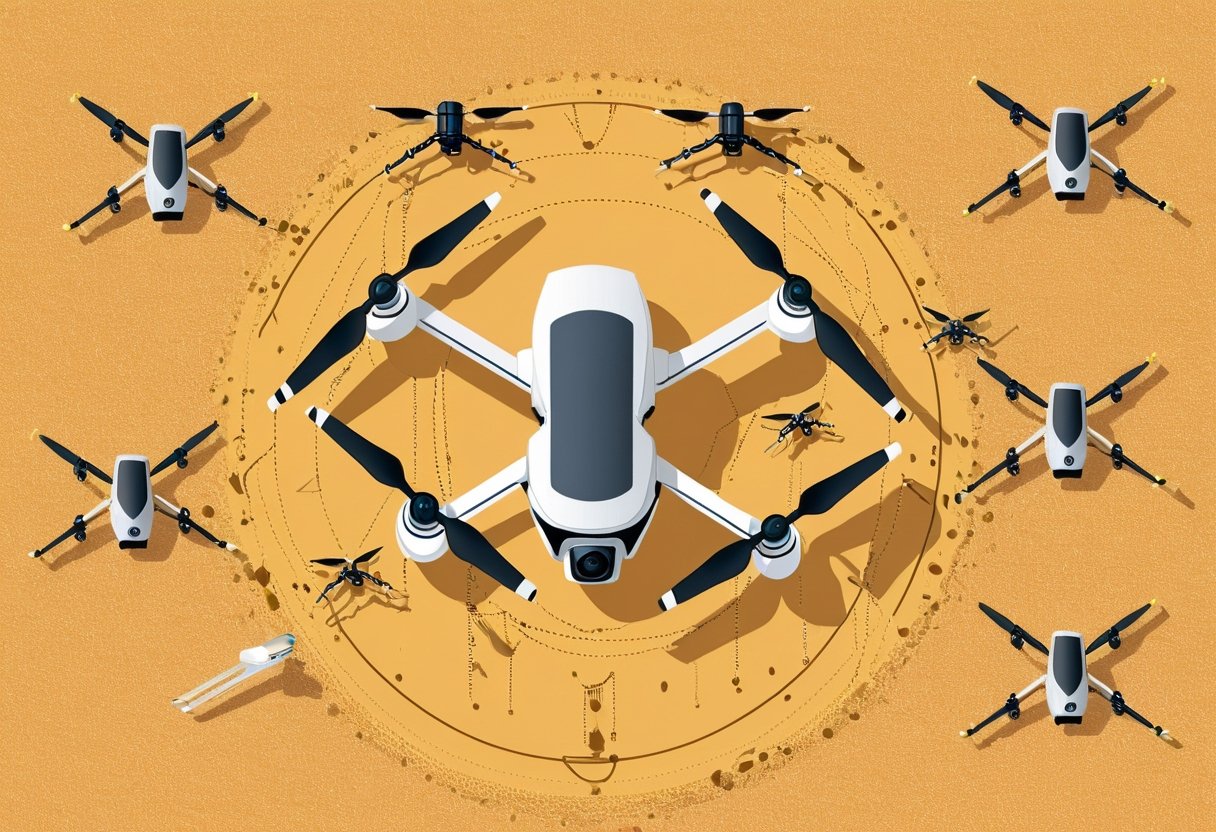
I watched the grainy simulation video three times before the implications truly hit me. Three dozen drones emerge from a cargo plane like metallic pollen, then suddenly coalesce into a perfect geometric formation. What happens next chills me more than any Terminator movie – the swarm splits, reforms, and methodically dismantles a mock air defense system. This isn’t sci-fi fan fiction. It’s a live test from DARPA’s OFFensive Swarm-Enabled Tactics program, and it’s coming to a battlefield near you.
The Reddit thread blew up because we’ve crossed a threshold. This isn’t about single smart drones – we’re talking about emergent intelligence. When Ukraine modified commercial drones to drop grenades, that was iteration. What’s happening now is revolution. The swarm learns collectively, makes decisions without human input, and operates on a hive mind logic that our Cold War-era defense systems can’t comprehend.
The Bigger Picture
Military strategists have feared this moment since the first Gulf War showed the world what precision strikes could do. But swarm tech flips the entire playbook. Imagine trying to stop a hornet’s nest with a flyswatter. That’s exactly the dilemma facing traditional air defense systems designed to track single high-value targets. Raytheon’s Phalanx CIWS can spit 4,500 rounds/minute, but what good is that against 500 $3,000 drones descending like metallic locusts?
What keeps defense analysts awake isn’t the technology itself, but the economic asymmetry it enables. For the price of one F-35 fighter ($80 million), you could theoretically deploy 26,000 advanced swarm drones. This changes the calculus for every non-state actor and second-tier military power. Suddenly, the playing field tilts toward whoever has the best algorithms, not the biggest defense budget.
Under the Hood
The magic lies in bio-inspired algorithms. Researchers have modeled these swarms on everything from bee colony behavior to immune system responses. Each drone runs a lightweight neural net that processes input from onboard sensors and neighboring units. It’s less Skynet and more like a murmuration of starlings – local interactions creating global coherence without centralized control.
Lockheed Martin’s MORPHEUS system reveals the cutting edge. Their test swarms demonstrate eerie adaptability – when jammed, drones automatically reform communication chains through optical lasers. Lose 30% of the swarm? The remaining units redistribute roles like white blood cells compensating for damage. This isn’t programmed behavior. It’s emergent problem-solving that even the engineers can’t fully predict.
Market Reality
Defense contractors are scrambling to adapt. Raytheon’s new Coyote drone churns out at $15,000 per unit – disposable enough for swarm tactics. Startups like Shield AI are pitching ‘AWS for drone swarms’ – cloud-based AI that turns any compatible drone into instant hive mind. Meanwhile, China’s EHANG 216 passenger drones are demonstrating swarm capabilities that conveniently double as military platforms.
The venture capital floodgates have burst. Private investment in military AI surged to $17.9 billion in 2023, with swarm tech capturing 38% of funds. But here’s the twist – much of the innovation is coming from commercial sectors. Amazon’s warehouse drones and Tesla’s computer vision teams are unwittingly advancing tech that could one day coordinate attack swarms. The line between consumer tech and weapons development is blurring beyond recognition.
What’s Next
Regulators are playing catch-up in dangerous ways. Current international laws treat drones as individual weapons systems. But how do you apply the Hague Convention’s rules of proportionality when facing a self-organizing swarm? Is each drone an individual combatant? The entire swarm? There’s no legal framework for machines that exist in this quantum state between individual and collective.
The next frontier is human-swarm teaming. DARPA’s OFFSET program already tests scenarios where a single operator directs 250 drones. But as autonomy improves, we’re approaching a tipping point where human oversight becomes theater. When swarms can make kill decisions in 20 milliseconds (vs human reaction time of 250ms), are we really in control, or just rubber-stamping decisions made by algorithms?
Standing in a field last week watching geese formation-fly overhead, I realized nature solved swarm coordination millennia ago. The difference is, geese don’t carry shaped-charge warheads. As this tech proliferates, we’re not just facing a military challenge, but a philosophical one. How much autonomy are we willing to grant machines in life-or-death decisions? The drones are dancing, and humanity needs to learn the steps fast.