Tag: AI

  • Apple’s WWDC Unveils Siri AI and Child Safety Tools

    Apple’s WWDC Unveils Siri AI and Child Safety Tools

    Introduction to Siri AI

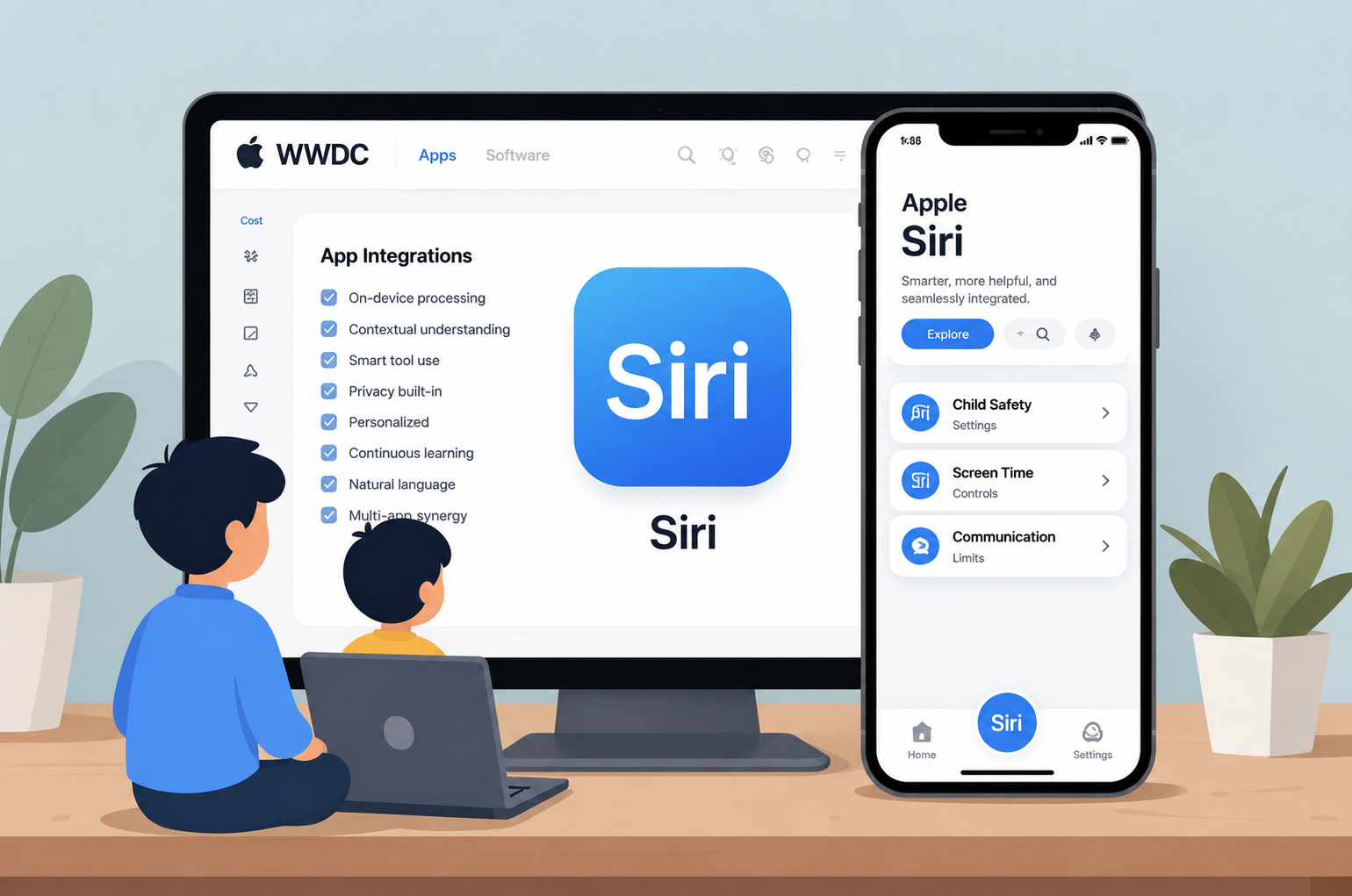
    Apple’s annual Worldwide Developers Conference (WWDC) has unveiled a plethora of exciting updates, with the introduction of Siri AI being one of the most significant announcements. As noted by The Guardian, Siri AI is an AI-powered personal assistant integrated with Apple Intelligence capabilities, designed to understand personal context, analyze on-screen content, search the web, understand images, and complete tasks across apps.

    Key Features of Siri AI

    According to Apple’s Newsroom, Siri AI is built on Apple Intelligence, allowing it to draw on personal context understanding and help users find what they need in the moment across messages, emails, photos, and more. For instance, users can ask Siri to find a restaurant recommendation a friend messaged them about, surface a hotel confirmation number from an old email, or pull up photos with friends and family from a recent trip.

    Child Safety Features

    In addition to Siri AI, Apple has also introduced new child safety features, as reported by BNN Bloomberg. The new parental controls will, by default, allow children to access only the apps that are allowed by parents, and Apple is introducing a new ‘ask to browse’ feature that will require children to seek permission for every new website they visit.

    Market Impact and Future Implications

    The introduction of Siri AI and child safety features is expected to have a significant impact on the market, as noted by TechCrunch. With Apple’s focus on AI and child safety, the company is poised to take a leading position in the tech industry. As helloapple’s Instagram post suggests, the future of tech is exciting, and Apple is at the forefront of innovation.

    Practical Takeaways

    For users, the introduction of Siri AI and child safety features means a more personalized and secure experience. As The Guardian notes, the new features will be widely released in the fall, and users can expect a more capable and conversational assistant.

  • China’s AI-Powered Promotion of Xi Jinping’s Thought

    China’s AI-Powered Promotion of Xi Jinping’s Thought

    Introduction

    China is investing heavily in artificial intelligence (AI) to promote President Xi Jinping’s political ideology. The project, known as ‘Xinhua Yudian,’ or ‘Xinhua lexicon,’ is an intelligent agent designed to learn, research, and disseminate Xi Jinping Thought on Socialism with Chinese Characteristics for a New Era.

    Background

    According to Shanghai Stock Exchange filings, Xinhuanet, owned by the official Xinhua News Agency, plans to invest over 1.1 billion yuan (approximately $162 million) in the AI system. This development highlights the increasing use of AI as a tool for political communication and ideological reinforcement.

    The Xinhua Yudian Project

    The Xinhua Yudian project is part of China’s broader national strategy to integrate AI across governance, industry, and society under the ‘AI+’ initiative launched in 2025. The project aims to deliver official narratives, current affairs, and political content in a structured format, drawing on a curated state-controlled database.

    Implications

    The rollout of Xinhua Yudian is likely to deepen the integration of AI into China’s political and information architecture. If successful, it could serve as a model for other state-backed AI systems designed to standardize ideological communication and policy interpretation.

    Expert Insights

    Experts believe that the use of AI in promoting Xi Jinping’s thought is a strategic move to reinforce the Communist Party’s dominance. The CPC sees AI as a tool to consolidate its power and control over the narrative, rather than a means to disrupt the status quo.

    Technical Analysis

    From a technical perspective, the Xinhua Yudian project demonstrates China’s commitment to developing and deploying AI technologies to support its political agenda. The use of AI in this context raises important questions about the role of technology in shaping public discourse and the potential risks of bias and manipulation.

    Market Impact

    The Xinhua Yudian project is likely to have significant implications for the global AI market, particularly in the context of political communication and ideological reinforcement. As AI technologies continue to evolve, it is essential to consider the potential consequences of their use in shaping public opinion and influencing political outcomes.

    Future Implications

    The future implications of the Xinhua Yudian project are far-reaching. As AI becomes increasingly integrated into China’s political and information architecture, it is likely to have a profound impact on the country’s governance, industry, and society. The use of AI in promoting Xi Jinping’s thought also raises important questions about the role of technology in shaping the future of politics and governance.

  • Ohio Suspends Data Center Tax Break Amid AI Power Struggles

    Ohio Suspends Data Center Tax Break Amid AI Power Struggles

    Introduction to the Crisis

    Ohio, a leading destination for data centers, has suspended a critical tax break aimed at attracting massive facilities that power and train artificial intelligence (AI) chatbots. This move, initiated by Republican Gov. Mike DeWine, reflects growing pressure on tech firms to bear the full costs of their computing warehouses, which are essential for AI but strain state budgets and the electrical grid.

    Background and Context

    According to WFTV, the tax break suspension is a response to the escalating utilization of the tax break and the state Legislature’s new research undertaking. This decision comes as Policy Matters Ohio reports that data centers use large amounts of electricity, placing stress on the electrical grid, and as the Ohio Consumers’ Counsel notes, tech giants like Amazon, Google, Microsoft, and Meta (Facebook) have opposed settlements that would shift more costs onto residential consumers.

    Impact on the Environment and Economy

    The suspension also highlights concerns over the environmental impact and the economic benefits of these data centers. Signal Ohio reports that the tax break cost $1 billion more than expected in 2025, with data centers receiving $2.5 billion in public subsidies between 2017 and 2024, and contributing $3.7 billion to Ohio’s GDP.

    Expert Insights and Technical Analysis

    Experts like AI Now Institute suggest that the issue is not just about tax breaks but about the power dynamics at play, with data centers fueling a new gold rush while communities bear the costs. Technically, the rapid growth of data centers to support AI is driving an increase in data center power demand, as noted by Goldman Sachs.

    Market Impact and Future Implications

    The market impact is significant, with states like Virginia facing budget negotiations hung up over a $1.6 billion annual tax break for data centers. The future implications suggest a need for a balanced approach that considers both the economic benefits and the environmental and social costs of data center expansion. As WFTV reports, residents are trying to bypass the GOP-controlled Legislature to get a referendum on the midterm election ballot that would ban hyperscale data centers, indicating a growing public awareness and demand for action.

    Conclusion and Practical Takeaways

    In conclusion, the suspension of the data center tax break in Ohio reflects a broader debate about the role of tech firms in shouldering the costs of their operations, especially as AI technology continues to evolve and demand more resources. Practical takeaways include the need for policymakers to reassess tax incentives, for tech firms to invest in sustainable practices, and for communities to be involved in decision-making processes regarding data center development.

  • Pope Leo Warns of AI Dangers in Landmark Encyclical

    Pope Leo Warns of AI Dangers in Landmark Encyclical

    Pope Leo’s Warning on AI

    Pope Leo XIV has issued a landmark encyclical warning of the dangers of artificial intelligence (AI) and its potential to bring about ‘new forms of dehumanization.’ In the encyclical, titled ‘Magnifica humanitas,’ Pope Leo urges governments to slow down the development of AI systems and to ensure that they are regulated in a way that prioritizes human dignity and well-being.

    The Dangers of Opaque Algorithms

    Pope Leo specifically warns about the dangers of ‘opaque algorithms’ controlled by a handful of powerful private companies. He notes that these algorithms can spread misinformation, prioritize conflict, and risk leading the world down a path of unending war. According to Variety, Pope Leo’s encyclical is likely to become a benchmark for policymakers and ordinary citizens in the ongoing debate over AI.

    A Call to Action

    Pope Leo’s encyclical is a call to action for governments, corporations, and individuals to work together to ensure that AI is developed and used in a way that benefits humanity as a whole. He emphasizes the need for a more active political involvement in the regulation of AI and for the protection of workers’ rights and the safety of children in the face of emerging technologies. As reported by Reuters, Pope Leo’s encyclical has been welcomed by experts and policymakers as a timely and important contribution to the debate over AI.

    Expert Insights and Analysis

    Experts have praised Pope Leo’s encyclical for its thought-provoking analysis of the challenges and opportunities presented by AI. According to CBS News, Pope Leo’s encyclical is a significant development in the ongoing debate over AI and its implications for society. The encyclical has also been welcomed by tech industry leaders, who see it as a call to action for responsible innovation and development of AI.

  • Google’s AI-Powered Search Shift: Impact on Digital Media

    Google’s AI-Powered Search Shift: Impact on Digital Media


    Introduction to Google’s AI-Powered Search

    Google’s recent shift to AI-powered search results has sent shockwaves through the digital media landscape. According to Business Insider, this change may be the ‘final knife in the back of digital media’. But what does this mean for the future of online content?

    The Impact on Digital Media

    New research from New Castle News reveals that Google’s AI overviews are now costing websites 58% of their clicks. This is a significant blow to digital media outlets, which rely heavily on search engine traffic to drive revenue. As Tom’s Guide notes, Google is essentially turning the internet into a giant group chat, and websites aren’t invited.

    Examples and Data

    For example, a study by Beervana Blog found that Google’s AI-powered search results are prioritizing short, bite-sized content over in-depth analysis and reporting. This has significant implications for the quality of online content and the ability of digital media outlets to produce high-quality journalism.

    Practical Takeaways

    So what can digital media outlets do to adapt to this new landscape? Firstly, they need to focus on producing high-quality, engaging content that resonates with their audience. Secondly, they need to diversify their traffic sources and reduce their reliance on search engine traffic. Finally, they need to stay up-to-date with the latest developments in AI-powered search and adjust their strategies accordingly.

  • AI Revolutionizes Advertising: Snapchat’s AI-Powered Chat Ads

    AI Revolutionizes Advertising: Snapchat’s AI-Powered Chat Ads

    Introduction to AI-Powered Chat Ads

    Snapchat, with its nearly 950 million users, has introduced AI Sponsored Snaps, allowing users to interact directly with brands’ AI agents. This feature enables users to engage with Sponsored Snaps, which are the ads brands place directly on Snapchat’s main chat tab. Prior to this launch, users couldn’t engage with ads, but now, with the help of AI, they can ask brands questions and get recommendations without leaving the app.

    Conversation as the New Real Estate in Advertising

    Ajit Mohan, Snap’s chief business officer, stated that conversation is becoming the most valuable real estate in advertising. He believes that AI is accelerating this shift, turning chat into the place where people discover products, ask questions, and make decisions in real-time. The real opportunity, according to Mohan, isn’t just putting ads into those environments but designing formats that feel native to how people already talk.

    How AI Sponsored Snaps Work

    AI Sponsored Snaps allow users to ask brands questions and get recommendations without leaving the app. For instance, Experian, the credit-monitoring company, is the first brand to partner with Snap for the initial launch. Users will be able to ask Experian questions about credit scores, loans, credit cards, and spending habits, and Experian’s AI agent will respond like a normal chat, guiding users toward its services.

    AI Coming for the Salesforce

    The launch of AI Sponsored Snaps could be the first sign that AI chatbots are coming for the salesforce. These AI agents aren’t designed to answer random questions or handle basic inquiries; rather, they are built to help users discover products and services, provide personal recommendations, and ultimately close the sale. As Mohan said, AI Sponsored Snaps are positioned to drive full funnel outcomes from top of the funnel discovery and engagement to lower funnel installs and purchases, roles typically reserved for humans.

    Practical Takeaways

    For businesses, this means rethinking how consumers discover and interact with products. Features like AI-powered chat ads highlight a broader shift toward conversational commerce, where engagement, recommendations, and purchasing decisions increasingly happen within the same digital environment. As artificial intelligence becomes more deeply integrated into social platforms and digital advertising, companies must adapt to this new landscape.

  • AI Revolutionizes Coding: Why Human Touch Matters

    Introduction to AI-Assisted Coding

    Artificial intelligence (AI) has made tremendous strides in recent years, transforming the way we approach various aspects of our lives, including coding. With the advent of AI-assisted coding tools, developers can now automate many repetitive and mundane tasks, freeing up time for more creative and high-level thinking. However, as IBM notes, while AI can identify bugs and suggest fixes, it lacks the nuanced understanding and intuition of a seasoned developer.

    The Role of Human Expertise in AI-Assisted Coding

    According to Anthropic, human expertise remains an integral part of the software development process. Humans are better equipped to discern the intent behind code, assess its alignment with business goals, and apply organizational context to ensure that it meets project requirements. Moreover, as Claire Longo points out, without knowing how to code, one would not be able to craft the right prompts to generate meaningful code or detect and fix the errors made by AI.

    Debugging and Code Reading Skills

    The ability to identify and diagnose errors in code, as well as read and comprehend what code does, are crucial skills for detecting when AI-generated code is incorrect and understanding why it fails. As Anthropic research highlights, participants who used AI assistance during coding tasks scored lower on debugging questions, suggesting that the ability to understand when code is incorrect and why it fails may be a particular area of concern if AI impedes coding development.

    Best Practices for AI-Assisted Coding

    As Claire Longo advises, to effectively leverage AI-assisted coding tools, developers should focus on guiding the AI to deliver working and reliable code, rather than simply relying on the AI to generate code. This requires a deep understanding of coding principles, as well as the ability to communicate effectively with the AI tool.

    Vibe Coding vs. AI-Assisted Coding

    There is a difference between vibe coding and AI-assisted coding. Vibe coding involves using natural language to describe the end product, while AI handles every step of the technical implementation. In contrast, AI-assisted coding requires developers to have a deep understanding of coding principles and to guide the AI tool to deliver working and reliable code.

    Conclusion

    In conclusion, while AI has revolutionized the coding landscape, human expertise and judgment remain essential components of the software development process. By understanding the strengths and limitations of AI-assisted coding tools, developers can effectively leverage these tools to improve their productivity and efficiency, while also ensuring that their code is reliable, maintainable, and aligned with business goals.

  • OpenAI Shuts Down Sora: What This Means for AI Video Generation

    OpenAI Shuts Down Sora: What This Means for AI Video Generation

    Introduction to Sora and Its Demise

    OpenAI, the company behind the revolutionary ChatGPT, has announced the shutdown of Sora, its generative AI video service. Sora was once hailed as a groundbreaking tool for AI-generated video, capable of producing realistic clips based on simple prompts. The decision to discontinue Sora comes less than two years after its unveiling and follows the retraction of a $1 billion deal with Disney to use Disney character likenesses in generative AI.

    The Reason Behind the Shutdown

    According to Inquirer Technology, the shutdown of Sora is a signal of where the AI industry is headed. OpenAI makes money by selling API access to businesses, not subscriptions to hobbyists making AI videos. Consumer-facing experiments like Sora require constant moderation, customer support, and infrastructure at scale, all of which eat into margins. The company is pivoting hard toward enterprise, selling AI infrastructure to Fortune 500 companies rather than building consumer apps.

    The Cost of Running Generative Video Models

    The cost of running generative video models at scale is enormous. Training the model costs millions, and inference, or actually generating videos for users, requires massive compute. As reported by CBC, one analyst suggested that it cost OpenAI $1.30 US to generate a single 10-second video. Based on the 11.3 million daily videos estimated to be produced by Sora, this would cost the company about $15 million every day.

    Implications of Sora’s Demise

    The shutdown of Sora and the cancellation of the Disney deal mark a significant shift in OpenAI’s strategy. As Variety notes, the decision appears to be related to OpenAI’s potential IPO later in 2026, rather than problems with weird or inappropriate AI video creations. OpenAI is aiming to create other forms of advanced AI, including agentic technology capable of autonomously completing tasks with little human oversight.

    What This Means for the Future of AI Video Generation

    The demise of Sora serves as a reality check for consumer-facing generative AI. If companies cannot make the unit economics work, the product does not survive. The tap is turning off, and companies are realizing that subsidizing free or cheap AI tools indefinitely is not sustainable. As Bloomberg reports, OpenAI plans to discontinue its Sora AI video generator and wind down its partnership with Disney, which had centered on Sora.

    Conclusion

    In conclusion, the shutdown of Sora marks a significant turning point in the AI industry. OpenAI’s decision to discontinue its generative AI video service and focus on enterprise solutions signals a shift away from consumer-facing experiments. The cost of running generative video models at scale is a major factor in this decision, and companies are beginning to realize that subsidizing free or cheap AI tools is not sustainable.

  • From Jail to Billionaire: The AI Firm Co-Founded by Oliver Curtis

    From Jail to Billionaire: The AI Firm Co-Founded by Oliver Curtis

    Introduction to Firmus

    Firmus, a Singapore-based AI infrastructure provider, has been making waves in the tech industry with its innovative approach to cooling technology for data centers. Co-founded by Oliver Curtis, a former insider trader, and his cousin Tim Rosenfield, the company has attracted significant attention from blue-chip backers, including Nvidia, Ellerston Capital, and Blackstone.

    Background of Oliver Curtis

    Oliver Curtis, the co-CEO of Firmus, has a colorful past. In 2016, he was convicted of insider trading and spent a year in Cooma Correctional Centre. However, after his release, he turned his focus to the tech industry, and his company, Firmus, was born. According to SMH, the idea for the company originated while Curtis was still in prison.

    Firmus’s Innovative Approach

    Firmus specializes in creating AI factories, purpose-built data centers capable of training and generating artificial intelligence models using the latest chip architectures from Nvidia. The company’s cooling technology allows data centers to operate more efficiently, reducing costs and increasing productivity. As reported by Startup Daily, Firmus has raised over $900 million in less than five months, with a valuation of $6 billion.

    Project Southgate and Partnerships

    Firmus’s Project Southgate initiative aims to deliver 1.6 gigawatts of infrastructure by 2028, with its flagship project in Tasmania set to open this year. The company has partnered with Nvidia and CDC Data Centres to achieve this goal. Capital Brief notes that while big-name money is backing Firmus, not everyone in the market is convinced by the company’s story, citing concerns over Curtis’s past and sustainability claims.

    Market Impact and Future Implications

    The success of Firmus has significant implications for the tech industry, particularly in the field of AI. As Mingtiandi reports, Blackstone’s $10 billion debt financing package for Firmus is a testament to the company’s potential. However, as Daily Mail suggests, Curtis’s past may still raise eyebrows among investors.

    Conclusion

    In conclusion, Firmus’s story is one of innovation and redemption. Despite the controversies surrounding its co-founder, the company has made significant strides in the tech industry. As the company gears up for an initial public offering on the Australian stock exchange, it will be interesting to see how investors respond to its unique approach to AI infrastructure.

  • Palantir CEO Warns AI Will Destroy Humanities Jobs

    Palantir CEO Warns AI Will Destroy Humanities Jobs

    Introduction

    Alex Karp, the CEO of Palantir, has warned that AI will destroy humanities jobs, but there will be more than enough jobs for people with vocational training. Karp made these comments during a panel at the World Economic Forum in Davos, Switzerland.

    Background

    Karp himself has a strong humanities background, having graduated from Haverford College with a degree in philosophy, and later earning a JD from Stanford Law School and a PhD in philosophy from Goethe University in Germany. Despite this, Karp struggled to market his humanities skills to get his first job.

    Impact on Jobs

    Karp believes that AI will have a significant impact on jobs, particularly in the humanities. He stated that AI will destroy humanities jobs, and that those with humanities backgrounds will need to have other skills to be marketable. However, Karp also noted that there will be more than enough jobs for people with vocational training.

    Expert Insights

    According to Karp, technicians and those with vocational skill sets will be in high demand. He gave the example of people building batteries for a battery company, who are doing roughly the same job as Japanese engineers, but with only a high school education. These jobs are becoming more valuable as they can be adapted quickly.

    Market Analysis

    While some experts agree with Karp’s assessment, others believe that liberal arts degrees will become more valuable in the age of AI. As AI takes on more of the hard financial analysis, critical thinking and creativity will become more important.

    Conclusion

    In conclusion, Karp’s comments highlight the need for people to have vocational training and skills that are adaptable to the changing job market. As AI continues to advance, it is likely that we will see a shift in the types of jobs that are available, with a greater emphasis on technical and vocational skills.

Oh hi there 👋
It’s nice to meet you.

Sign up to receive awesome content in your inbox, every Day.

We don’t spam! Read our privacy policy for more info.