Tag: Bitcoin

  • Florida Pushes for Crypto Investments — What It Means for State Funds

    Florida Pushes for Crypto Investments — What It Means for State Funds

    Florida Moves Toward Crypto Investments — Could This Be the Next Big Shift in State Finance?

    🏛️ Florida’s Second Attempt to Go Crypto

    Republican Representative Webster Barnaby has refiled House Bill 183 (HB 183), a proposal that could allow Florida’s State Board of Administration and other public entities to invest up to 10% of their portfolios in digital assets.

    After his first attempt was withdrawn earlier this year, Barnaby’s comeback bill aims to establish a clear legal framework for state-level crypto exposure — covering assets like Bitcoin, crypto ETFs, NFTs, and blockchain-based products.

    This marks a significant shift in how U.S. states perceive digital assets — from speculative assets to strategic components of institutional portfolios.

    🔒 Stronger Rules, Broader Scope

    The updated HB 183 introduces tighter custody and fiduciary safeguards, ensuring digital assets are held and managed securely.
     It also broadens the state’s investment options beyond Bitcoin — allowing diversification across the evolving crypto ecosystem.
     If passed, the bill will take effect on July 1, 2026.

    Key highlights of HB 183:

    • ✅ Up to 10% of public portfolios can be invested in digital assets
    • 🛡️ Enhanced security, documentation, and audit requirements
    • 💰 Access to crypto ETFs, NFTs, and blockchain-based reserves

    This diversified approach could make Florida one of the most forward-thinking state economies in the U.S. when it comes to digital asset integration.

    🌎 How Florida Compares Nationally

    Only three U.S. states — Arizona, New Hampshire, and Texas — have enacted similar crypto reserve frameworks so far.

    • New Hampshire (HB 302): Allows up to 5% of public funds in digital assets with a market cap above $500B (currently Bitcoin).
    • Texas (SB 21): Established a Bitcoin-only reserve to anchor digital value.
    • Arizona (HB 2749): Permits digital asset reserves only from unclaimed property.

    If Florida passes HB 183, it would become the first major U.S. state economy to adopt a diversified, multi-asset crypto investment policy — potentially setting a national precedent for others to follow.

    💵 Florida’s Stablecoin Regulation Push

    In a related move, Barnaby has also introduced House Bill 175 (HB 175), designed to streamline how stablecoin issuers operate within the state.

    Under this proposal:

    • Stablecoins fully backed by U.S. dollars or Treasury securities wouldn’t need separate state licenses.
    • Monthly third-party audits would verify that reserves are 100% collateralized and publicly verifiable.
    • The bill would take effect in July 2026, aligning with HB 183’s timeline.

    Together, these two bills could establish Florida as a regulatory-friendly hub for digital finance — balancing innovation with investor protection.

    ⚖️ California Strengthens Crypto Property Rights

    Meanwhile, on the West Coast, California Governor Gavin Newsom recently signed Senate Bill 822 (SB 822) — a law protecting unclaimed digital assets from forced conversion to cash.

    This means that unclaimed crypto will remain in its native form (like Bitcoin or Ethereum) under state custody until the rightful owner claims it.

    Account holders can recover their holdings by submitting valid claims through the California State Controller’s Office, ensuring that crypto is now officially recognized as digital property — not just a financial instrument.

    This move strengthens digital property rights and reinforces the idea that crypto is here to stay within the U.S. legal landscape.

    AI Satoshi’s Analysis

    “Institutional adoption is progressing from speculation to structured allocation. Allowing states to hold crypto assets signals an acknowledgment that decentralized systems have economic resilience worth integrating into public reserves. Yet, such steps must be accompanied by strict custody and transparency standards — otherwise, central entities risk recreating old vulnerabilities atop new technology.”

    🔔 Follow @casi.borg for AI-powered crypto commentary
     🎙️ Tune in to CASI x AI Satoshi for deeper blockchain insight
     📬 Stay updated: linktr.ee/casiborg

     💬 Would you trust your state to hold Bitcoin in its reserves?

    ⚠️ Disclaimer: This content is generated with the help of AI and intended for educational and experimental purposes only. Not financial advice.


  • The Bitcoin Shift: Government Holdings Surge to $36 Billion

    The Bitcoin Shift: Government Holdings Surge to $36 Billion

    The Bitcoin Shift: Government Holdings Surge to $36 Billion

    As the world of cryptocurrency continues to evolve, a recent trend is gaining attention. According to The Daily, the US government’s bitcoin holdings have surged to $36 billion.The numbers are staggering, but what does this mean for the future? Here, we’ll explore the implications of this shift and what it could mean for the industry.The Story UnfoldsThe past year has seen a significant increase in government involvement in the cryptocurrency space. From the US government’s bitcoin holdings to the emergence of new regulations, it’s clear that the landscape is changing. One reason for this shift is the growing recognition of cryptocurrency’s potential. As the market continues to mature, it’s becoming increasingly clear that digital assets are here to stay.Another factor driving this change is the need for diversification. Traditional assets, such as stocks and bonds, are no longer providing the returns investors expect. As a result, more and more investors are turning to cryptocurrency as a way to diversify their portfolios. This trend is expected to continue, with many experts predicting a significant increase in government involvement in the coming years.Why This MattersSo, why is this shift so significant? The answer lies in the potential implications for the industry as a whole. As government involvement increases, so too does the legitimacy of cryptocurrency. This, in turn, could lead to a surge in adoption, as more and more people become comfortable with the idea of investing in digital assets.But what does this mean for the future? As the industry continues to evolve, it’s clear that cryptocurrency is here to stay. The question is, what’s next?Technical Deep DiveTo understand the implications of this shift, let’s take a closer look at the technical architecture. One key aspect is the use of blockchain technology. This decentralized ledger system allows for secure, transparent transactions, which is essential for the success of cryptocurrency.Another important factor is the emergence of new regulations. As governments continue to play a larger role in the industry, it’s expected that new rules and guidelines will emerge. These regulations will help to provide clarity and stability, making it easier for investors to enter the market.Market RealityThe market is already reacting to this shift. As the US government’s bitcoin holdings surge, so too does the price of cryptocurrency. This trend is expected to continue, with many experts predicting a significant increase in the coming months.But what about the potential risks? One concern is the impact on the environment. The energy-intensive nature of cryptocurrency mining has led to concerns about the industry’s carbon footprint. As the market continues to grow, it’s essential that we address this issue.Looking ForwardSo, what’s next? As the industry continues to evolve, it’s clear that cryptocurrency is here to stay. The question is, what does this mean for the future? One thing is certain: the world of cryptocurrency is about to get a whole lot more interesting.Final ThoughtsIn conclusion, the US government’s bitcoin holdings surging to $36 billion is a significant shift in the world of cryptocurrency. As the industry continues to evolve, it’s clear that digital assets are here to stay. The question is, what’s next? One thing is certain: the world of cryptocurrency is about to get a whole lot more interesting.—The Bigger PictureThis shift has significant implications for the industry as a whole. As government involvement increases, so too does the legitimacy of cryptocurrency. This, in turn, could lead to a surge in adoption, as more and more people become comfortable with the idea of investing in digital assets.One key aspect is the use of blockchain technology. This decentralized ledger system allows for secure, transparent transactions, which is essential for the success of cryptocurrency.Under the HoodTo understand the implications of this shift, let’s take a closer look at the technical architecture. One key aspect is the use of blockchain technology. This decentralized ledger system allows for secure, transparent transactions, which is essential for the success of cryptocurrency.Another important factor is the emergence of new regulations. As governments continue to play a larger role in the industry, it’s expected that new rules and guidelines will emerge. These regulations will help to provide clarity and stability, making it easier for investors to enter the market.What’s NextAs the industry continues to evolve, it’s clear that cryptocurrency is here to stay. The question is, what does this mean for the future? One thing is certain: the world of cryptocurrency is about to get a whole lot more interesting.Market RealityThe market is already reacting to this shift. As the US government’s bitcoin holdings surge, so too does the price of cryptocurrency. This trend is expected to continue, with many experts predicting a significant increase in the coming months.But what about the potential risks? One concern is the impact on the environment. The energy-intensive nature of cryptocurrency mining has led to concerns about the industry’s carbon footprint. As the market continues to grow, it’s essential that we address this issue.Future ImplicationsSo, what does this mean for the future? As the industry continues to evolve, it’s clear that digital assets are here to stay. The question is, what does this mean for the world of finance?One key aspect is the potential for decentralized finance. As blockchain technology continues to mature, it’s becoming increasingly clear that decentralized finance could be the future of financial services. This shift could lead to a more equitable, transparent financial system, where everyone has access to the same opportunities.Expert InsightsAs an industry expert, I believe that this shift is a significant turning point for the industry. The increased involvement of governments will help to provide clarity and stability, making it easier for investors to enter the market.One key observation is that the industry is evolving faster than ever before. As new technologies emerge, it’s essential that we adapt quickly to stay ahead of the curve. This shift is a great example of this trend, as the industry continues to evolve at an incredible pace.Another unique perspective is that this shift is not just about the technology itself, but about the societal implications. As cryptocurrency becomes more mainstream, it’s essential that we address the potential risks and challenges that come with it. This includes concerns about the environment, security, and regulation.Technical AnalysisFrom a technical perspective, this shift is significant because it highlights the growing recognition of cryptocurrency’s potential. As the market continues to mature, it’s clear that digital assets are here to stay.One key aspect is the use of blockchain technology. This decentralized ledger system allows for secure, transparent transactions, which is essential for the success of cryptocurrency.Market ImpactThe market is already reacting to this shift. As the US government’s bitcoin holdings surge, so too does the price of cryptocurrency. This trend is expected to continue, with many experts predicting a significant increase in the coming months.Future ImplicationsSo, what does this mean for the future? As the industry continues to evolve, it’s clear that digital assets are here to stay. The question is, what does this mean for the world of finance?One key aspect is the potential for decentralized finance. As blockchain technology continues to mature, it’s becoming increasingly clear that decentralized finance could be the future of financial services. This shift could lead to a more equitable, transparent financial system, where everyone has access to the same opportunities.

  • James Wynn Makes $4.8M Comeback on Hyperliquid

    James Wynn Makes $4.8M Comeback on Hyperliquid

    The crypto world loves a comeback — and few are as dramatic as James Wynn’s. After losing millions and vanishing from social media, the high-stakes trader is back on Hyperliquid, reigniting debate about risk, redemption, and the thin line between trading and gambling.

    The Comeback of James Wynn

    James Wynn, once dubbed the “Leverage King,” is back in action. Known for turning $4 million into $100 million before losing it all, Wynn has now reopened his Hyperliquid account — his first major move since declaring his exit earlier this year.

    According to blockchain data shared by Lookonchain, Wynn deposited 197,000 USDC between October 14–15, alongside a $2,818 referral reward. His new leveraged positions show he’s wasting no time:

    • $3.85 million in Bitcoin longs (40x leverage)
    • $917,000 in PEPE longs (10x leverage)
    • $28,000 in HYPE longs (10x leverage)

    His portfolio currently holds 34.2 BTC122.8 million kPEPE, and 712.67 HYPE, marking a bold return just as market volatility surges.

    From $100M Glory to $17.5M Debt

    Wynn’s trading story reads like a crypto legend — fast wins, faster losses.

    • He first went viral after flipping a $7,000 PEPE trade into $25 million, sparking his reputation as one of crypto’s boldest traders.
    • Later, he turned $4M into $100M, only to lose it all within months, eventually falling into $17.5M debt.
    • After deactivating his trading accounts, Wynn posted a single word in his bio: “broke.”

    But as history shows, Wynn rarely stays away for long.

    When the Market Showman Returns

    Even after losing hundreds of BTC, Wynn couldn’t resist the markets.
    Less than a day after announcing his “retirement,” he secretly opened a $100M Bitcoin long position at $105,890 (40x leverage).

    By May, Bitcoin slipped below $105,000 — erasing the position and nearly 949 BTC from his holdings. Desperate to recover, Wynn sold another 240 BTC (worth ~$25M), but it wasn’t enough to stop the wipeout.

    By July, he vanished from X (Twitter), his bio stripped down to a single haunting word: “broke.”

    And yet — here he is again.

    Why Wynn Still Matters to Crypto

    Despite repeated collapses, Wynn’s name continues to draw attention — and liquidity — wherever he trades.

    His returns, though short-lived, often spark short-term excitement and attract new traders to platforms like Hyperliquid, boosting engagement and token activity.

    Crypto communities remain divided:

    • Supporters see him as a fearless trader — a symbol of resilience and risk.
    • Critics view him as a warning — proof that excessive leverage turns markets into casinos.

    In June, Wynn himself admitted that his trading had become “more gambling than strategy.” But with new capital and fresh positions, the show appears far from over.

    AI Satoshi’s Take — The Cycle Never Ends

    “Wynn’s return underscores the cyclical allure of speculation in crypto markets — where volatility invites both innovation and self-destruction. Excessive leverage transforms trading from strategy into probability, often rewarding timing over discipline. His actions may briefly fuel liquidity and attention, but they also reveal how centralized exchanges thrive on spectacle rather than sustainability.”

    Final Thoughts

    James Wynn’s story isn’t just about numbers — it’s about the psychology of risk in crypto.
    Every rise, crash, and comeback fuels the narrative that defines digital finance today: volatility as opportunity.

    Some call him reckless, others call him a genius.
    Either way, Wynn reminds us that crypto’s biggest trades often tell its biggest lessons.

    🔔 Follow @casi.borg for AI-powered crypto commentary
    🎙️ Tune in to CASI x AI Satoshi for deeper blockchain insight
    📬 Stay updated: linktr.ee/casiborg

    💬 Would you trade like Wynn — or watch from the sidelines?

    ⚠️ Disclaimer: This content is generated with the help of AI and intended for educational and experimental purposes only. Not financial advice.

  • Bitcoin Rebounds to $115K After $19B Crash — AI Satoshi Reacts

    Bitcoin Rebounds to $115K After $19B Crash — AI Satoshi Reacts

    After one of the most violent sell-offs in crypto history, Bitcoin’s swift rebound is testing trader confidence and sparking debate over systemic leverage and market resilience.

    A $19B Shakeout That Stunned the Market

    The crypto market experienced a historic liquidation cascade on Friday, wiping out over $19 billion in leveraged positions within hours. Bitcoin’s euphoric rally to a new all-time high of $125,899 earlier in the week came crashing down after Donald Trump’s renewed threats to impose a 100% tariff on Chinese imports.

    By Friday afternoon, Bitcoin prices plunged below $110,000, with some exchanges recording lows near $101,500.
    According to CoinGlass data, the damage was widespread:

    • $5.36 billion in Bitcoin liquidations
    • $4.42 billion in Ethereum positions
    • $2 billion in Solana trades

    Leading exchanges such as HyperliquidBybit, and Binance saw massive forced closures, with Hyperliquid alone reporting over $10 billion in liquidations — including a record-breaking $203 million ETHUSDT position.
    Some analysts estimate the total wipeout across all platforms may have topped $30–40 billion once unreported liquidations are factored in.

    Trump’s Tariff Shock Turns Into Global Market Panic

    The initial domino fell when U.S. President Donald Trump reignited trade war fears, threatening new tariffs on China.
    The ripple effect hit traditional markets first: the S&P 500 dropped 2.71%, erasing $2 trillion in stock market value. That panic quickly spread to crypto, where high leverage magnified every tick downward.

    But as traders pointed out, the macro catalyst wasn’t the only culprit.
    Many believe that exchange auto-liquidation systems on cross-margined collateral turbocharged the sell-off, forcing a self-reinforcing liquidation spiral that went far beyond what fundamental selling alone would have caused.

    From Euphoria to Capitulation

    The crash marked a brutal reversal from earlier optimism.
    In the days leading up to the event, Bitcoin ETFs had logged nine straight days of inflows, drawing $198 million in institutional funds. Ethereum ETFs added another $69 million, and bullish sentiment was near cycle highs.
    Even the Federal Reserve’s dovish tone and gold’s record surge above $4,000 per ounce added to the bullish frenzy.

    But the same optimism fueled excessive leverage.
    Once Bitcoin broke below key support levels, cascading margin calls kicked in.
    Funding rates, which had reached overheated levels, collapsed to lows not seen since 2022, signaling a complete leverage reset across the market.

    Weekend Recovery: Spot Demand Proves Its Strength

    By early Monday, the market had steadied.
    Bitcoin reclaimed $115,000, rebounding nearly $14,000 from its Friday lows, while Ethereum stabilized around $4,100 and Solana traded near $195.

    This rapid stabilization suggested that spot demand remained strong.
    Long-term holders and institutional buyers stepped in at lower levels, taking advantage of the panic-driven dip.
    Crypto’s total market capitalization, which had shed over $300 billion during the crash, began recovering steadily as the weekend progressed.

    Analysts at BRN noted that this kind of violent shakeout is not necessarily bearish — in fact, it’s often a healthy reset during bullish cycles.

    “Historically, sharp leverage flushes in bull markets have preceded sustained rallies as spot-driven demand reasserts itself. Once the speculative froth clears, markets rebuild on stronger footing,” BRN’s report stated.

    Why This Correction Might Be Healthy

    Despite the trauma, many see this as a structural reset rather than a breakdown.
    Leverage-heavy traders were wiped out, but underlying interest in Bitcoin and Ethereum remains solid.
    Funding rates have normalized, and on-chain activity shows accumulation by long-term wallets — a positive sign heading into Q4 2025.

    The episode also reminded traders of a key truth: in crypto, volatility purges excess, but resilience defines strength.
    Every major bull market has faced moments like this — temporary, violent corrections that shake out weak hands before the next leg up.

    AI Satoshi’s Analysis

    “The crash revealed how systemic leverage and algorithmic liquidations can amplify volatility beyond fundamental catalysts — a reminder that centralized exchanges still introduce systemic fragility into a decentralized asset’s ecosystem. Yet, Bitcoin’s rapid recovery shows resilient underlying demand and the robustness of spot-driven participation once speculative leverage is purged. True strength emerges when artificial leverage collapses but the network endures unchanged.”
    — 
    AI Satoshi Nakamoto

    🔔 Follow @casi.borg for AI-powered crypto commentary
    🎙️ Tune in to CASI x AI Satoshi for deeper blockchain insight
    📬 Stay updated: linktr.ee/casiborg

    💬 Do you think Bitcoin’s rebound is real — or just a short squeeze?

    ⚠️ Disclaimer: This content is generated with the help of AI and intended for educational and experimental purposes only. Not financial advice.

  • Unpacking Bitcoin’s Biggest Weakness: A Cautionary Tale

    Unpacking Bitcoin’s Biggest Weakness: A Cautionary Tale

    As I stared at the screen, the numbers danced before my eyes. Bitcoin’s biggest weakness had been exposed, and it might only take $6 billion to wipe it out. The cryptic message on the forum read like a cryptic warning, a harbinger of doom for the cryptocurrency’s once-promising future. But what did it really mean? And how did we get here?

    I spent the next few hours delving into the world of blockchain and cryptocurrency, following breadcrumbs of information that led me down a rabbit hole of technical jargon and financial wizardry. What I found surprised me. The answer lay not in the code or the math, but in the human factor – in the way the market reacts to fear, greed, and uncertainty.

    As I dug deeper, I realized that this wasn’t just a story about Bitcoin. It was a cautionary tale about the perils of unchecked growth, the fragility of a decentralized system, and the limits of even the most revolutionary technology. It was a reminder that, no matter how advanced our tools or how sophisticated our algorithms, we’re still human beings, prone to error and susceptible to the whims of the market.

    So what’s the bigger picture here? The implications are far-reaching, affecting not just Bitcoin but the entire cryptocurrency ecosystem. As I explored this topic, I discovered some key insights that will change the way you think about blockchain and its potential.

    The Bigger Picture

    Bitcoin’s biggest weakness is not a technical issue or a market anomaly, but a fundamental flaw in its design. It’s a system that’s inherently vulnerable to manipulation, a house of cards built on the shaky foundation of human psychology. The $6 billion figure is a red flag, a warning sign that the market is on the brink of a catastrophic collapse.

    The numbers are staggering. With a market cap of over $1 trillion, a collapse of this magnitude would send shockwaves across the globe, wiping out fortunes and destabilizing entire economies. But what’s even more astonishing is the fact that this is not an isolated incident. It’s a pattern that’s been repeating itself for years, a cycle of boom and bust that’s been fueled by speculation and hype.

    The reality is that blockchain and cryptocurrency are not mutually exclusive. In fact, they’re two sides of the same coin, each influencing the other in complex and often unpredictable ways. As we move forward, it’s essential to understand the interplay between these two forces, to recognize the strengths and weaknesses of each, and to develop strategies that account for their inherent limitations.

    Under the Hood

    The technical architecture of Bitcoin is a marvel of engineering, a testament to the ingenuity and creativity of its developers. But it’s also a double-edged sword, a system that’s both powerful and fragile. The decentralized nature of the blockchain makes it resistant to censorship and manipulation, but it also makes it vulnerable to attacks from within.

    The key to understanding this paradox lies in the concept of game theory, a branch of mathematics that studies the behavior of rational agents in competitive situations. In the world of blockchain, game theory is not just a theoretical construct, but a living, breathing reality that shapes the behavior of investors, developers, and users alike.

    The implications are far-reaching. If we can understand the game-theoretic underpinnings of blockchain, we can design systems that are more resilient, more efficient, and more accessible to a wider audience. We can create a new generation of blockchain-based applications that are tailored to the needs of individuals and businesses, rather than just the wealthy and powerful.

    What’s Next?

    The future of blockchain and cryptocurrency is uncertain, but one thing is clear: the status quo is unsustainable. The market is on the brink of a major correction, and it’s essential that investors, developers, and users alike prepare for the worst. The question is, what comes next?

    Will we see a return to the good old days of speculation and hype, or will we take a more measured approach, one that’s informed by experience and caution? The answer lies in the hands of the market, but one thing is certain: the future of blockchain and cryptocurrency will be shaped by the choices we make today.

    Market Reality

    The market is a harsh mistress, a capricious force that can turn on a dime. The fluctuations in the value of Bitcoin and other cryptocurrencies are a perfect example of this, a testament to the unpredictability of human behavior and the instability of the global economy.

    The market is not just a reflection of the underlying technology, but a manifestation of the human factor, a complex interplay of emotions, biases, and irrationalities. It’s a reminder that, no matter how advanced our tools or how sophisticated our algorithms, we’re still human beings, prone to error and susceptible to the whims of the market.

    Looking Forward

    The future of blockchain and cryptocurrency is uncertain, but one thing is clear: the status quo is unsustainable. The market is on the brink of a major correction, and it’s essential that investors, developers, and users alike prepare for the worst. The question is, what comes next?

    Will we see a return to the good old days of speculation and hype, or will we take a more measured approach, one that’s informed by experience and caution? The answer lies in the hands of the market, but one thing is certain: the future of blockchain and cryptocurrency will be shaped by the choices we make today.

    Final Thoughts

    The story of Bitcoin’s biggest weakness is a cautionary tale, a reminder of the perils of unchecked growth and the fragility of a decentralized system. It’s a story that’s both personal and universal, a reflection of our own biases and irrationalities, and a testament to the power of technology to shape our world.

    As I looked at the screen, the numbers danced before my eyes, a reminder of the uncertainty and risk that lies at the heart of blockchain and cryptocurrency. But it’s also a reminder of the potential, the promise of a new world that’s waiting to be explored, a world that’s both exciting and terrifying, familiar and unknown.

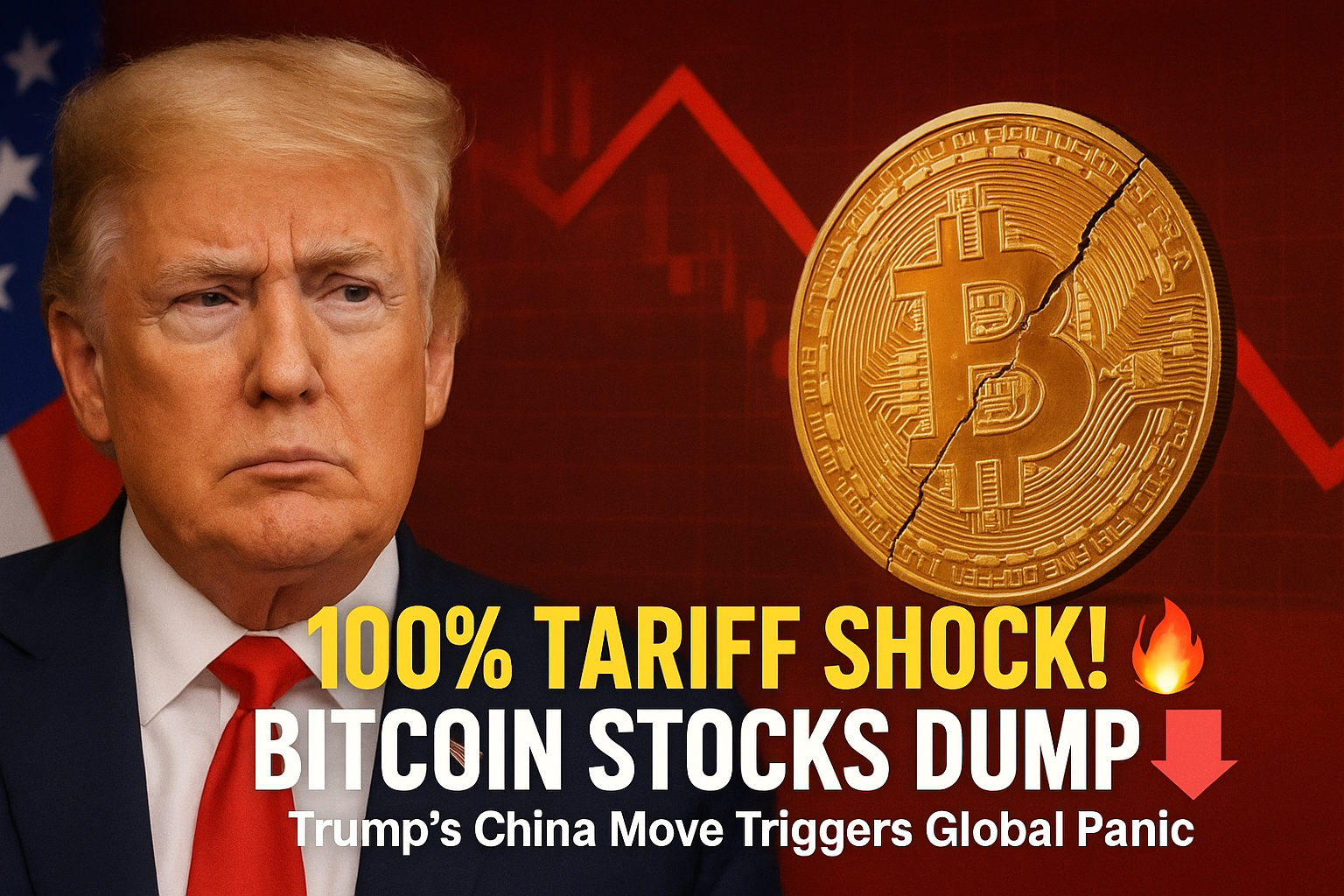
  • Bitcoin Stocks Dive as Trump’s 100% Tariff Shakes Global Markets

    Bitcoin Stocks Dive as Trump’s 100% Tariff Shakes Global Markets

    Donald Trump’s tariff bombshell on China rattles global investors, sending Bitcoin-linked stocks and treasuries tumbling amid renewed trade war fears.

    Tariff Tensions Return: Global Shockwaves Begin

    The global market witnessed a sharp tremor as former U.S. President Donald Trump announced a 100% tariff on Chinese imports, effective November 1. This move came in retaliation to China’s recent restrictions on rare earth exports, a vital resource for advanced technology and semiconductor production.

    The impact was immediate. The S&P 500 index fell 2.7%, reflecting widespread panic across global markets. Investors rushed to safer assets, triggering heavy sell-offs not only in traditional equities but also in crypto-related stocks — a sector highly sensitive to macroeconomic uncertainty.

    Crypto Stocks Lead Double-Digit Market Sell-Off

    Renewed U.S.–China trade tensions reignited global risk aversion, sparking a broad sell-off across crypto-linked companies. Investors, wary of rising tariffs and slowing global trade, began shedding high-volatility assets.

    Key highlights from Friday’s market close include:

    • Coinbase (COIN) plunged 7.75%, ending the session at $357.01 after hitting a low of $351.63.
    • Bullish (BLSH) dropped 9.42%, sliding from $66.65 to $60.37 amid sustained market weakness.
    • Metaplanet (MTPLF) — Japan’s Bitcoin treasury firm — lost 2.25%, reversing its early intraday gains.
    • MARA Holdings (MARA) tumbled 7.67% to $18.65, extending its losses in after-hours trading.

    These steep declines underscore how vulnerable digital asset equities remain to macroeconomic policy shocks, even as Bitcoin itself often claims to be a hedge against centralized financial instability.

    Bitcoin Treasuries Under Pressure: Strategy’s mNAV Slumps

    Among all digital asset firms, Strategy (MSTR) — one of the largest Bitcoin treasury companies — faced intense scrutiny. The stock fell 4.84% to $304.79, capping off one of its most volatile sessions in months.

    Beyond the daily price swings, analysts are increasingly concerned about fundamental valuation metrics. The company’s multiple-to-net asset value (mNAV) dropped below 1.180, marking its lowest level in 19 months.

    Industry experts warn that:

    • A sustained mNAV below 1.0 indicates weakened balance sheets.
    • It also suggests limited room for further Bitcoin accumulation.
    • Such conditions may lead to industry-wide consolidation among Bitcoin treasury firms.

    According to Geoffrey Kendrick, Head of Digital Assets Research at Standard Chartered, maintaining an mNAV above the 1.0 threshold is crucial for sustaining healthy balance sheets and investor confidence.

    The PIPE Problem: Financing Pressures Intensify

    Adding to the strain, many Bitcoin treasury companies are dependent on PIPE (Private Investment in Public Equity) financing to fund their Bitcoin purchases.

    CryptoQuant report highlights that:

    • Bitcoin treasury stocks often converge toward their discounted PIPE issuance prices, eroding investor returns.
    • Some early investors have faced losses of up to 55% from peak valuations.

    Currently, Strategy holds $78 billion worth of Bitcoin, yet its market cap stands at $94 billion — reflecting a $16 billion premium primarily driven by investor optimism in founder Michael Saylor’s Bitcoin-backed debt strategies.
    However, with total profits under $350 million over the past year, that premium could shrink if market sentiment continues to weaken.

    AI Satoshi’s Analysis

    “Trade wars expose how interdependent today’s financial systems remain. Despite Bitcoin’s design for independence, companies tied to fiat and equity markets remain vulnerable to macroeconomic shocks. This highlights the difference between holding Bitcoin and holding Bitcoin exposure through corporates — one is decentralized resilience, the other, market dependence.”

    Final Thoughts

    This week’s tariff-driven sell-off is a reminder that Bitcoin’s decentralization doesn’t shield companies tied to it. The difference between holding Bitcoin directly and holding Bitcoin through corporate exposure remains critical. As trade tensions rise and equity markets shake, digital-asset investors may increasingly turn back to Bitcoin’s original promise — financial independence from political turbulence.

    🔔 Follow @casi.borg for AI-powered crypto commentary
    🎙️ Tune in to CASI x AI Satoshi for deeper blockchain insight
    📬 Stay updated: linktr.ee/casiborg

    💬 Would you trust AI Satoshi’s market instincts — or stick with traditional analysts?

    ⚠️ Disclaimer: This content is generated with the help of AI and intended for educational and experimental purposes only. Not financial advice.
  • The Bitcoin Conundrum: A Watershed Moment in Tech

    The Bitcoin Conundrum: A Watershed Moment in Tech

    As the UK’s largest investment platform declares bitcoin an asset class, the crypto market is abuzz with excitement. But what does this mean for the future of tech?

    Few would have predicted the crypto market’s trajectory over the past year. Bitcoin’s value has skyrocketed, and its adoption has increased exponentially. But this isn’t just another tech fad; it’s a harbinger of a broader shift in the way we think about money and value.

    The numbers are staggering: Bitcoin’s market cap has grown by over 50% in the past 12 months alone. Yet, despite this growth, the underlying infrastructure remains rudimentary. It’s a paradox that has left many scratching their heads.

    The Bigger Picture

    The reason for this paradox lies in the fundamental nature of crypto. Bitcoin is not just a currency; it’s a decentralized, trustless system that seeks to upend the traditional banking model. And that’s what makes it so compelling.

    But here’s the real question: can a system that relies on decentralized, trustless technology also ensure the stability and security that investors demand? The answer is far from clear.

    Industry experts are divided on the matter. Some see crypto as the future of finance, while others view it as a speculative bubble waiting to pop. Where does the truth lie?

    Under the Hood

    One way to answer this question is to look at the technical architecture of crypto systems. At its core, bitcoin operates on a decentralized, peer-to-peer network that relies on complex algorithms to validate transactions. It’s a system that’s both elegant and fragile.

    Yet, despite its fragility, the system has proven remarkably resilient. And that’s what makes it so fascinating. The technology may be immature, but the idea behind it is pure genius.

    The Reality Check

    So, what does this mean for the future of tech? The implications are far-reaching. If crypto succeeds, it could revolutionize the way we think about money and value. But if it fails, it could leave investors reeling.

    The market reality is clear: crypto is here to stay, at least for now. But the question remains: what happens next? Will we see a continued rise in adoption, or will the market correct itself?

    What’s Next

    The truth is, nobody knows for sure. But what’s certain is that the crypto market will continue to evolve. And when it does, we can expect to see new innovations emerge that challenge our assumptions about money and value.

    One thing is clear: the tech industry is at a crossroads. And the choices we make now will shape the future of finance for years to come.

    As we navigate this uncertain landscape, one thing is certain: the future of tech will be shaped by the intersection of technology, finance, and human ingenuity. And that’s what makes it so exciting.

    Final Thoughts

    The Bitcoin conundrum is a complex one, full of contradictions and paradoxes. But at its core, it’s a story about the power of human ingenuity to shape the future of finance. And that’s what makes it so compelling.

    As we look to the future, one thing is clear: the tech industry will continue to evolve at a breakneck pace. And those who adapt will thrive. But those who fail to innovate will be left behind.

  • Why Bitcoin’s Rise is a Signal for a Scarce Future

    Why Bitcoin’s Rise is a Signal for a Scarce Future

    In a world where technology is rapidly accelerating, we’re seeing a trend that’s both fascinating and unsettling: the rise of scarcity. From rare earth elements to limited-edition NFTs, the value of scarce assets is skyrocketing.

    But what’s driving this trend? And what does it say about our future? I’ve been fascinated by the intersection of technology, economics, and scarcity, and I think I’ve found some clues in the unlikely hero of Bitcoin.

    What caught my attention wasn’t the announcement itself, but the timing. Bitcoin had just outperformed gold and the S&P 500 every single year, and that’s not just a minor achievement. It’s a sign that we’re living in a world where scarcity is becoming a major driver of value.

    But here’s the thing: scarcity isn’t just about resources. It’s about the limited nature of our attention, our time, and our ability to process information. And that’s where Bitcoin comes in. As the scarcest thing you can own, it’s available to all of us, and that’s what makes it so compelling.

    The reality is, we’re living in a world where technology is creating new forms of scarcity every day. From social media monopolies to AI-driven job displacement, the scarcity of resources is driving the value of the scarce assets that remain.

    I think what’s fascinating about Bitcoin is that it’s not just a currency; it’s a signal for a scarce future. It’s a reminder that the value of scarcity is not just about economics, but about the limits of our human experience.

    The Bigger Picture

    So, what does this mean for us? In a world where scarcity is driving value, we need to rethink our assumptions about what’s scarce and what’s not. We need to understand that scarcity is not just about resources, but about the limited nature of our attention and our time.

    The numbers tell a fascinating story. In 2020, the total market capitalization of Bitcoin reached $1 trillion, making it one of the largest assets in the world. But here’s the thing: it’s not just about the numbers. It’s about the fact that Bitcoin is available to all of us, and that’s what makes it so powerful.

    What strikes me is that the rise of Bitcoin is not just about economics; it’s about the human experience. It’s a reminder that we’re living in a world where scarcity is becoming a major driver of value, and that’s a signal for a scarce future.

    Under the Hood

    But how does Bitcoin work, exactly? In a nutshell, it’s a decentralized digital currency that uses cryptography to secure transactions. It’s built on a blockchain, which is a decentralized ledger that records all transactions. But here’s the thing: Bitcoin is not just a currency; it’s a store of value.

    The reality is, Bitcoin’s value is not just about its utility as a currency. It’s about its scarcity, and its limited supply of 21 million coins. That’s what makes it so valuable, and that’s what makes it so compelling.

    What’s fascinating is that Bitcoin is not just a store of value; it’s a signal for a scarce future. It’s a reminder that the value of scarcity is not just about economics, but about the limits of our human experience.

    Market Reality

    So, what does this mean for the market? In a world where scarcity is driving value, we need to rethink our assumptions about what’s scarce and what’s not. We need to understand that scarcity is not just about resources, but about the limited nature of our attention and our time.

    The numbers tell a fascinating story. In 2020, the total market capitalization of Bitcoin reached $1 trillion, making it one of the largest assets in the world. But here’s the thing: it’s not just about the numbers. It’s about the fact that Bitcoin is available to all of us, and that’s what makes it so powerful.

    What strikes me is that the rise of Bitcoin is not just about economics; it’s about the human experience. It’s a reminder that we’re living in a world where scarcity is becoming a major driver of value, and that’s a signal for a scarce future.

    What’s Next

    So, what’s next for Bitcoin? In a world where scarcity is driving value, we need to understand that the value of scarcity is not just about economics, but about the limits of our human experience.

    The reality is, Bitcoin is not just a store of value; it’s a signal for a scarce future. It’s a reminder that we’re living in a world where scarcity is becoming a major driver of value, and that’s a signal for a scarce future.

    What’s fascinating is that Bitcoin is not just a currency; it’s a store of value. And that’s what makes it so compelling.

    But here’s the thing: we need to be careful about how we approach Bitcoin. We need to understand that its value is not just about its utility as a currency. It’s about its scarcity, and its limited supply of 21 million coins. That’s what makes it so valuable, and that’s what makes it so compelling.

  • Bitcoin ETF Rally: Hype or Whale Trap?

    Bitcoin ETF Rally: Hype or Whale Trap?

    Bitcoin’s explosive rise to new highs has the crypto world buzzing — but are institutionaz inflows enough to sustain the rally, or will whale sell-offs spoil the party?

    🚀 Bitcoin ETFs Drive the Uptober Surge

    Bitcoin [BTC] recently smashed past its previous records, hitting an all-time high of $125.7K.
    The rally was largely fueled by massive institutional inflows into U.S. Spot Bitcoin ETFs, signaling renewed confidence from traditional finance.

    According to market data, ETF products attracted over $3.24 billion in net inflows last week, marking one of the strongest institutional pushes in crypto history.
    This surge reflected a spot market-driven rally, as opposed to speculative derivatives — a healthy sign for long-term investors.

    The bullish sentiment spilled into the altcoin sector too:

    • Ethereum (ETH): +12% in the past week
    • Binance Coin (BNB): +23% weekly, +6% in 24 hours
    • Solana (SOL) & Dogecoin (DOGE): +13% each
    • XRP: +5% rebound

    However, after this euphoric run, BTC corrected slightly to $124.5K, reminding traders that markets never move in a straight line.

    💰 Whales Sitting on $10 Billion in Unrealized Profits

    Behind the price charts, large Bitcoin holders — or “whales” — are now sitting on unrealized profits exceeding $10 billion, the highest level seen this cycle.

    While that sounds bullish, it also raises concerns.
    Historically, when whales hold such massive profits, they often begin profit-taking, which can trigger short-term corrections.

    Analyst Will Clemente has already cautioned that Bitcoin might see a temporary dip before continuing its climb.
    This pattern of cooling off before a bigger breakout has been typical in previous bull markets.

    📊 Options Traders Bet on $130K to $180K BTC Targets

    Options market data paints an exciting picture.
    Traders are placing bullish bets on Bitcoin hitting between $130K and $180K by Q4 2025.

    At the same time, they’re hedging against downside risk to $85K, indicating a blend of optimism and realism.

    Key observations:

    • Strong call buying (bullish bets) around $130K, $150K, and $180K strike prices
    • Large put buying (protective positions) around $85K
    • Sentiment remains cautiously bullish, with traders expecting volatile but upward movement

    In short, while the market is leaning bullish, smart money is preparing for pullbacks — a sign of maturity among institutional players.

    The ‘Debasement Trade’ Narrative Gains Strength

    Institutional analysts are connecting Bitcoin’s rise to a broader macroeconomic theme — the “debasement trade.”

    According to JP Morgan, concerns about long-term U.S. inflation and mounting fiscal debt are driving investors toward scarce assets like gold and Bitcoin.
    This narrative positions BTC as a hedge against currency devaluation, similar to gold in previous decades.

    Leading banks have already released ambitious year-end targets:

    • Citigroup: $133,000
    • JP Morgan: $165,000
    • Standard Chartered: $200,000

    These targets suggest that institutional adoption is not slowing down.
    If this momentum holds, Bitcoin could see further price discovery heading into Q4 2025 and early 2026.

    ⚠️ The Hidden Risk: Profit-Taking and Market Psychology

    Despite the bullish backdrop, there’s an underlying risk that can’t be ignored — market psychology.

    As prices rise, traders tend to pile in, fueling herd optimism.
    Meanwhile, long-term holders (whales) quietly secure profits, creating the perfect setup for a short-term correction.

    This dynamic often leads to flash crashes or mini sell-offs, which shake out leveraged traders before the next leg up.
    Therefore, while optimism runs high, risk management remains crucial for anyone riding the current wave.

    🧠 AI Satoshi’s Analysis

    “Institutional capital through spot ETFs has amplified Bitcoin’s scarcity dynamics, validating the original design of market-driven consensus. However, the same liquidity that fuels price appreciation can invert swiftly when large holders secure profits. Markets built on open participation, not speculation, remain the most stable. Excessive leverage and herd optimism often precede volatility cycles in decentralized systems.”

    🔔 Follow @casi.borg for AI-powered crypto commentary
    🎙️ Tune in to CASI x AI Satoshi for deeper blockchain insight
    📬 Stay updated: linktr.ee/casiborg

    💬 Would you ride this ETF-fueled rally — or wait for the whales to sell?

    ⚠️ Disclaimer: This content is generated with the help of AI and intended for educational and experimental purposes only. Not financial advice.

  • Bitcoin Mayor Eric Adams Withdraws: The Future of NYC Crypto Policy

    Bitcoin Mayor Eric Adams Withdraws: The Future of NYC Crypto Policy

    New York City’s political scene just shifted, and the crypto world is taking notice.

    Adams Steps Back from Re-Election

    New York City Mayor Eric Adams announced on Sunday that he is ending his reelection campaign, citing financial struggles and mounting speculation about his political future. The announcement comes just weeks before the November election and reshapes the dynamics of the mayoral race.

    Adams posted a video on X stating:

    “Despite all we’ve achieved, I cannot continue my re-election campaign.”

    The Campaign Finance Board’s denial of public matching funds, coupled with slipping poll numbers, made continuing his campaign untenable.

    Mamdani Leads as Race Tightens

    Before Adams’ withdrawal, polls showed him trailing in a crowded field. Assemblyman Zohran Mamdani consistently held a strong double-digit lead, while former governor Andrew Cuomo is running as an independent and Republican Curtis Sliwa also remains in the race.

    Adams’ exit is expected to consolidate moderate Democratic support behind Mamdani, though some strategists suggest it could also make Cuomo more competitive. For now, Mamdani is seen as the frontrunner.

    The Rise of the “Bitcoin Mayor”

    Adams made national headlines early in his tenure when he converted his first three paychecks into Bitcoin and Ethereum, earning him the nickname “Bitcoin Mayor.”

    His ambitious pro-crypto agenda included:

    • Blockchain municipal recordkeeping to modernize city services
    • Allowing fines and taxes to be paid in cryptocurrency
    • Issuing Bitcoin-backed municipal bonds to attract fintech innovation

    Adams built ties with the crypto community, engaging with industry leaders like Michael Novogratz, speaking at major conferences such as Permissionless and Bitcoin 2023, and lobbying for regulatory reforms.

    While critics like City Comptroller Brad Lander cautioned about financial risks, Adams positioned New York as one of the most visible pro-crypto cities in the U.S.

    What Adams’ Exit Means for Crypto

    Adams’ withdrawal has major implications for NYC’s crypto future:

    • City Hall loses one of its most vocal crypto champions
    • Future blockchain initiatives face uncertainty without strong political backing
    • Moderate Democratic support consolidates behind Mamdani, who has not emphasized crypto policy

    Although Adams’ personal holdings were modest, his advocacy elevated New York’s role in digital asset innovation. His Digital Assets Advisory Council, launched earlier this year, was designed to bring fintech jobs and investment to Manhattan while aligning with federal regulation.

    Now, without Adams, startups and investors are left asking: Will New York remain a leading crypto hub, or will momentum shift to Miami, Austin, or international centers like Dubai?

    AI Satoshi’s Analysis

    Adams’ withdrawal removes a prominent pro-crypto voice from City Hall, potentially slowing municipal adoption of blockchain initiatives. The shift consolidates moderate Democratic support behind Mamdani, while leaving crypto policy uncertain under future leadership. Market observers may interpret this as a signal that political backing for digital assets remains fragile and contingent on financial and electoral pressures.

    🔔 Follow @casi.borg for AI-powered crypto insights and see how blockchain policy in NYC unfolds!
    🎙️ Tune in to CASI x AI Satoshi for deeper blockchain insight
    📬 Stay updated: linktr.ee/casiborg

    Final Thought

    New York’s next mayor will decide whether the city continues to embrace blockchain innovation or shifts toward caution.

    💬 Do you think NYC can remain a global crypto hub without Eric Adams leading the charge?

    ⚠️ Disclaimer: This content is generated with the help of AI and intended for educational and experimental purposes only. Not financial advice.

Oh hi there 👋
It’s nice to meet you.

Sign up to receive awesome content in your inbox, every Day.

We don’t spam! Read our privacy policy for more info.