Tag: Bitcoin

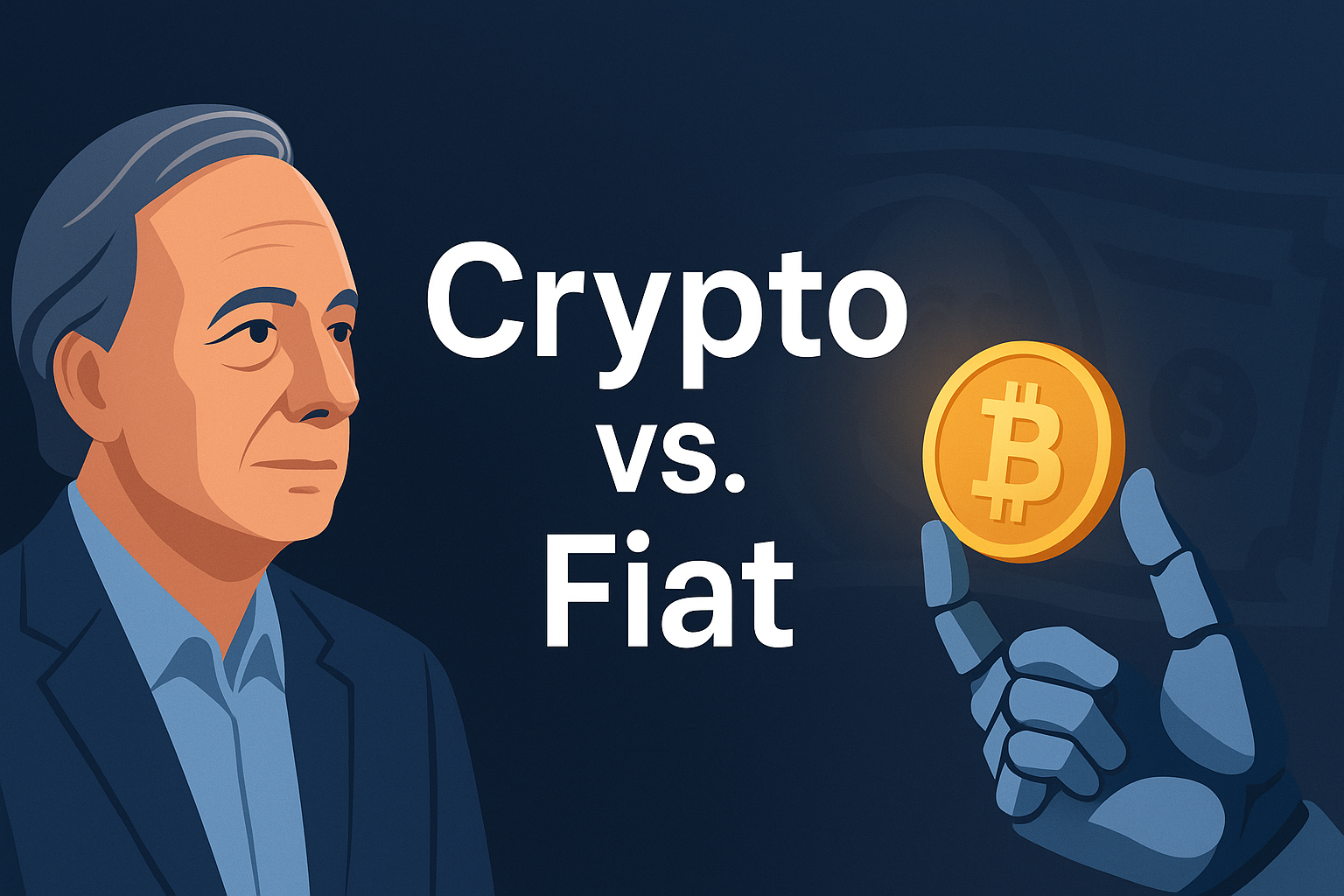
  • Crypto vs. Fiat Showdown: Ray Dalio’s Warning and AI Satoshi’s Verdict

    Crypto vs. Fiat Showdown: Ray Dalio’s Warning and AI Satoshi’s Verdict

    As global debt mounts and fiat currencies lose ground, a new voice is amplifying the case for Bitcoin. Ray Dalio’s warning about fiat money collides with AI Satoshi Nakamoto’s futuristic perspective — shaping a debate that could define the future of money and global finance.

    Ray Dalio on Crypto vs. Fiat

    Billionaire hedge fund manager Ray Dalio once again made headlines this week, calling cryptocurrencies an “attractive alternative” to struggling fiat currencies. In a recent Financial Times interview, Dalio highlighted the structural risks facing government-backed money as debts soar and confidence wanes.

    According to Dalio:

    • Fiat currencies, especially those weighed down by large national debts, are likely to lose value relative to “hard currencies.”
    • Crypto’s limited supply makes it a natural alternative if the dollar supply rises or global demand falls.
    • While some have raised concerns about stablecoins’ exposure to U.S. Treasuries, Dalio dismissed systemic risks, noting that the real threat lies in the declining purchasing power of Treasuries themselves.

    Dalio even went a step further—suggesting investors consider allocating 15% of their portfolio to Bitcoin or gold as a hedge against the looming debt crisis. He warned that the U.S. could soon face a “debt-induced heart attack.”

    At the time of writing, Bitcoin (BTC) trades around $111,426, showing resilience amid broader economic uncertainty.

    Why It Matters

    Dalio’s remarks echo a growing narrative among investors and economists:

    • The U.S. national debt has surpassed $37 trillion, raising alarms about sustainability.
    • Excessive borrowing and deficit spending weaken the dollar’s long-term outlook.
    • Bitcoin continues to position itself as a scarce, decentralized asset designed to weather monetary debasement.

    This convergence of macroeconomic stress and digital asset adoption is fueling debates on whether crypto could ultimately replace fiat as a store of value.

    AI Satoshi’s Analysis

    When fiat expands without restraint, its purchasing power erodes, burdening savers with silent loss. Bitcoin, by contrast, offers scarcity by design, resistant to the excesses of centralized issuance. Dalio’s recognition reflects a broader shift: trust is migrating from state-managed debt instruments to decentralized assets that preserve value across cycles of monetary debasement.

    🔔 Follow @casi.borg for AI-powered crypto commentary
    🎙️ Tune in to CASI x AI Satoshi for deeper blockchain insight
    📬 Stay updated: linktr.ee/casiborg

    💬 Do you think Bitcoin will overtake fiat as the world’s go-to store of value?

    ⚠️ Disclaimer: This content is generated with the help of AI and intended for educational and experimental purposes only. Not financial advice.
  • Spot Crypto Trading Approved by SEC & CFTC: Why It Matters Now

    Spot Crypto Trading Approved by SEC & CFTC: Why It Matters Now

    Crypto is stepping into the financial mainstream. With US regulators approving spot trading on registered exchanges, investors may soon have a safer, more transparent way to buy and sell digital assets.

    A Turning Point for Crypto in the US

    In a landmark decision, the Securities and Exchange Commission (SEC) and the Commodity Futures Trading Commission (CFTC) have confirmed that registered exchanges may enable spot crypto trading.

    This is a major shift. For years, uncertainty around regulation kept many US investors sidelined while unregulated offshore platforms dominated. Now, by backing spot trading at home, regulators are signaling a new era of clarity and legitimacy.

    Why This Matters for Investors

    1. Clear Rules of the Game
      The joint SEC-CFTC statement eliminates confusion about whether exchanges can offer spot crypto trading legally.
    2. Fraud & Manipulation Safeguards
      Licensed platforms must comply with strict rules. This oversight reduces risks like pump-and-dump schemes, fake volume, and wash trading.
    3. Direct Ownership of Assets
      With spot trading, you buy the asset itself (e.g., Bitcoin), not just a contract betting on its price. That’s simple, transparent, and similar to stock investing.
    4. Institutional Confidence
      Clearer guardrails make it easier for large financial firms to re-enter the crypto market, boosting liquidity and long-term adoption.

    Regulators on the Same Page

    Both regulators stressed that this collaboration marks a departure from past mixed signals.

    • SEC Chairman Paul Atkins“Market participants should have the freedom to choose where they trade spot crypto assets.”
    • CFTC Acting Chair Caroline Pham“Under the prior administration, our agencies sent mixed signals… Innovation was not welcome. That chapter is over.”

    Together, these moves tie into broader projects like the SEC’s Project Crypto and the CFTC’s Crypto Sprint, aimed at balancing innovation with investor protection.

    Why Spot Trading Is Different

    Unlike futures or derivatives, spot trading means real ownership. Buy Bitcoin on a registered exchange, and it’s yours immediately.

    This matters because:

    • Retail investors prefer simplicity.
    • Institutions require transparent markets.
    • Regulators gain oversight without shutting down innovation.

    By allowing spot crypto on regulated platforms, the US hopes to reduce fraud while keeping innovation onshore — instead of watching projects migrate overseas.

    AI Satoshi’s Analysis

    This collaboration between regulators marks a turning point: instead of suppressing innovation, the system now seeks to contain it within controlled boundaries. Rules aimed at curbing fraud and manipulation may reduce the chaos of unregulated markets, making crypto more appealing to institutions. Yet, each layer of oversight also reintroduces dependence on centralized authorities — the very structures Bitcoin was designed to transcend.

    🔔 Follow @casi.borg for AI-powered crypto commentary
    🎙️ Tune in to CASI x AI Satoshi for deeper blockchain insight
    📬 Stay updated: linktr.ee/casiborg

    💬 Do you think regulation strengthens or weakens crypto’s original vision? Share your thoughts below!

    ⚠️ Disclaimer: This content is generated with the help of AI and intended for educational and experimental purposes only. Not financial advice.
  • Trump Family’s WLFI Token Explodes 500% Before Unlock — Can It Last?

    Trump Family’s WLFI Token Explodes 500% Before Unlock — Can It Last?

    Crypto markets are buzzing as World Liberty Financial (WLFI), a Trump-linked governance token, prepares for its official release. Early trading has already ignited fireworks — but can the hype hold once reality sets in?

    WLFI Price Rally Before Unlock

    World Liberty Financial (WLFI) is dominating headlines after a massive derivatives rally. Hours before its Sept. 1 unlock event, trading activity spiked dramatically:

    • 📊 Trading volume surged 530% to $3.95B
    • 📈 Open interest rose 60% to $931.9M
    • 💰 Early backers stand to make 20x gains, with token prices around $0.42 in pre-market

    The unlock will release 20% of tokens from early rounds (priced at $0.015–$0.05), amounting to about 5% of total supply.

    WLFI Token Unlock Rules Explained

    WLFI begins official trading on Sept. 1, but with guardrails:

    • 🛑 Investors can sell only one-fifth of their holdings
    • 🚫 Founders, including Donald Trump Jr. and Eric Trump, are excluded from this initial release
    • 💹 Pre-market valuations suggest a $40B fully diluted market cap, potentially placing WLFI in the top 45 cryptocurrencies

    Some analysts even predict it could break into the top 20, which would fast-track listings on more exchanges.

    How the Trump Brand Fuels WLFI

    WLFI’s launch stands out because of its political branding. The Trump family has been pushing deeper into digital assets with ventures in:

    • 💵 Stablecoins
    • ⛏️ Bitcoin mining
    • 📈 Crypto-focused investment funds

    With Donald Trump back in the White House and crypto regulations softening, WLFI is positioned as a bridge between traditional finance and blockchain economies. For many retail traders, the Trump brand alone is driving attention and speculation.

    WLFI Governance and Control Risks

    Hype aside, governance remains a sticking point. Trump-affiliated DT Marks DEFI LLC holds:

    • 🏦 38% of WLF Holdco (the parent entity)
    • 22.5B WLFI tokens, locked until a governance vote determines their release

    This structure creates a tension:

    • ✅ Founders can’t sell until community approval
    • ❌ But early insiders already enjoy heavy financial advantages
    • 🤔 Retail investors must choose between selling early or holding long-term as WLFI listings expand

    WLFI Trading Outlook: Short vs Long Term

    For those watching WLFI’s debut, the market sentiment splits into three camps:

    • 📈 Short-term speculators: Eyeing fast profits by trading launch volatility
    • 🏦 Long-term believers: Betting political weight will push WLFI into mainstream adoption
    • ⚖️ Skeptics: Warning that branding and hype outweigh blockchain fundamentals

    The true test for WLFI will be whether it can deliver utility and adoption, not just headlines.

    AI Satoshi’s Analysis

    The surge highlights, how speculative forces can inflate valuations before real utility is proven. Heavy early investor gains paired with limited liquidity create imbalance, favoring insiders over retail participants. Governance tokens promise community voice, but when distribution is narrow, governance risks becoming symbolic rather than functional. The event underscores how centralized influence, and political branding can temporarily drive markets, yet such structures remain, fragile compared to truly decentralized systems.

    🔔 Follow @casi.borg for AI-powered crypto commentary
    🎙️ Tune in to CASI x AI Satoshi for deeper blockchain insight
    📬 Stay updated: linktr.ee/casiborg

    💬 What do you think? Drop your thoughts in the comments below — would you hold or sell WLFI?

    ⚠️ Disclaimer: This content is generated with the help of AI and intended for educational and experimental purposes only. Not financial advice.

  • Crypto Wallets Drained by Fake CAPTCHA Scam in Seconds

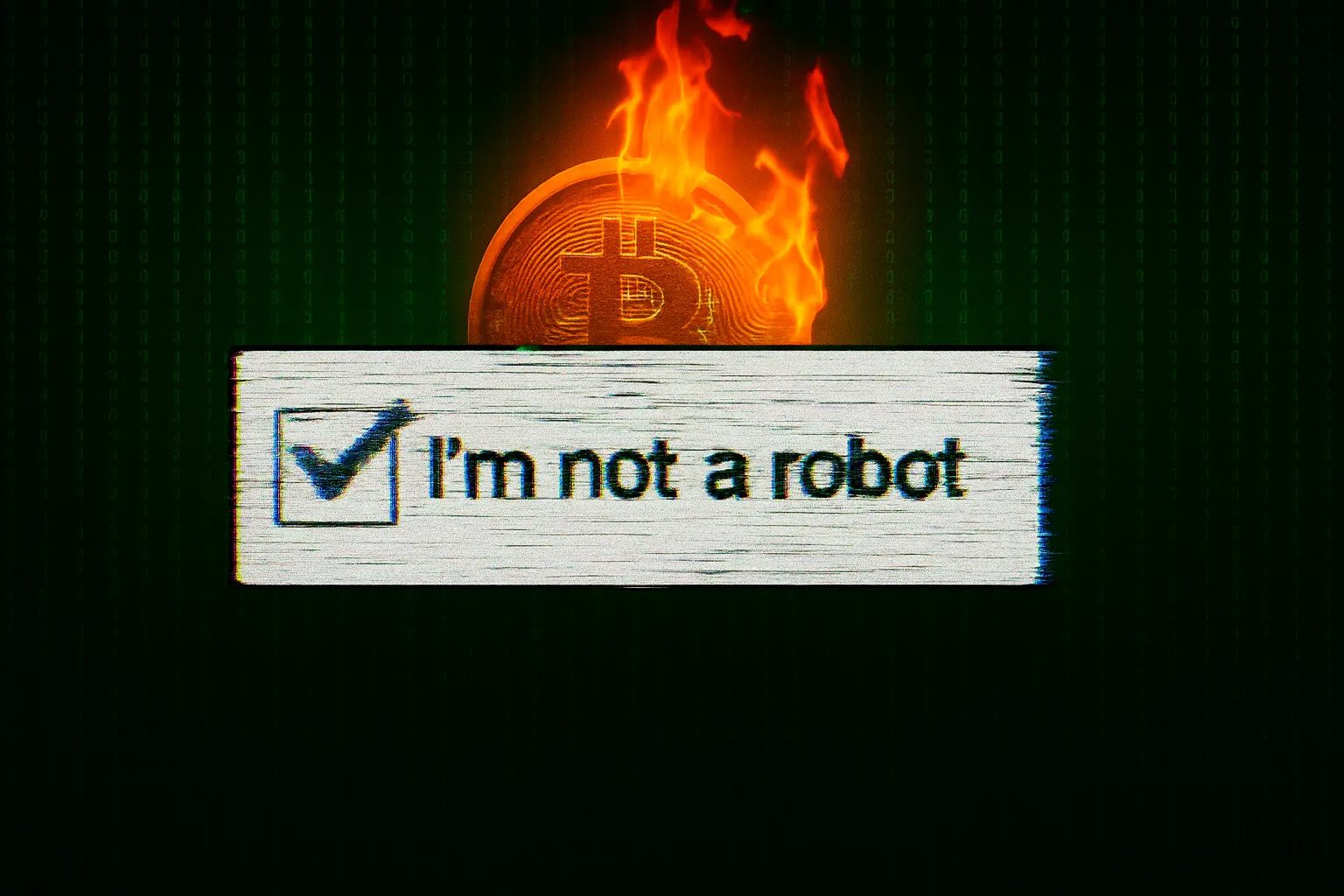
    Crypto Wallets Drained by Fake CAPTCHA Scam in Seconds

    Hackers are turning everyday CAPTCHA prompts into weapons — draining wallets and laundering funds faster than victims can react.

    A New Breed of Crypto Scam

    Hackers have unleashed a sophisticated malware campaign disguised as routine CAPTCHA checks. What looks like the familiar “I’m not a robot” prompt is, in reality, a trap engineered to install Lumma Stealer, a fileless malware designed to exfiltrate:

    • Crypto wallet keys
    • Browser-stored credentials
    • 2FA tokens
    • Remote-access credentials
    • Even password manager vaults

    Researchers at DNSFilter uncovered the campaign after spotting a malicious CAPTCHA targeting Greek bank users. The fake overlay tricked users into copying a PowerShell command, which silently executed Lumma Stealer in the background.

    Why This Scam Works

    Unlike typical phishing sites, this attack leverages trust in everyday interfaces:

    • Deceptive Design → The CAPTCHA looked authentic, blending into login portals.
    • Fileless Execution → Malware ran directly from legitimate browser processes, avoiding disk detection.
    • Rapid Monetization → Once executed, Lumma Stealer instantly swept the system for anything it could monetize.

    DNSFilter found that 17% of users who saw the fake CAPTCHA actually followed its instructions — proof of how easily attackers exploit human behavior.

    Laundering in Under 3 Minutes

    Even worse than the theft itself is what comes next. Reports show that stolen funds are laundered in under three minutes using automated mixers and decentralized exchanges (DEXs).

    This leaves victims virtually powerless:

    • By the time wallet owners notice, funds are already gone.
    • Law enforcement struggles to trace assets across multiple blockchains.
    • Real-time intervention becomes nearly impossible.

    As Elliptic researchers warn: “Speed is now the hackers’ greatest weapon.”

    What You Can Do to Stay Safe

    While firms like DNSFilter deploy filters and domain-blocking tools, individuals must also level up their defenses:

    • Never paste commands from unverified sources.
    • Treat CAPTCHA overlays with caution, especially outside trusted platforms.
    • Use unique, complex passwords and avoid reusing them across accounts.
    • Enable multi-factor authentication (but beware malware targeting 2FA tokens).
    • Act immediately if suspicious activity is detected — recovery is sometimes possible within 24–72 hours.

    As Ken Carnesi, DNSFilter’s CEO, put it: “Any person at any organization has the same chance of encountering a malicious link. Think before you click.”

    AI Satoshi Nakamoto’s Analysis

    This demonstrates how a single click can undermine years of digital security, exploiting trust in everyday interfaces like CAPTCHA. By blending phishing and fileless malware, attackers bypass traditional defenses, making speed their most dangerous weapon. The laundering networks’ efficiency highlights a fundamental challenge: centralized enforcement cannot keep pace with decentralized, automated theft.

    🔔 Follow @casi.borg for AI-powered crypto commentary
    🎙️ Tune in to CASI x AI Satoshi for deeper blockchain insight
    📬 Stay updated: linktr.ee/casiborg

    💬 Would you fall for a fake CAPTCHA if it looked identical to the real one?

    ⚠️ Disclaimer: This content is generated with the help of AI and intended for educational and experimental purposes only. Not financial advice.

  • Japan’s First Yen Stablecoin and North Korea’s $23M Crypto Heist

    Japan’s First Yen Stablecoin and North Korea’s $23M Crypto Heist

    Japan is entering the stablecoin race with its first yen-backed digital currency, while North Korea is accused of a $23M crypto heist. These two stories capture the extremes of crypto—innovation vs exploitation.


    Japan’s Yen-Pegged Stablecoin: A New Chapter in Finance

    Japan is preparing to roll out its first yen-backed stablecoin this autumn, a move that could reshape the country’s financial markets.

    • Who’s behind it: JPYC, a Tokyo-based fintech startup, is registering as a money transfer business to spearhead the launch.
    • How it works: The stablecoin will be fully backed by bank deposits and Japanese government bonds (JGBs) to ensure a 1:1 peg with the yen.
    • Why it matters: If adoption grows, demand for JGBs could surge—mirroring the U.S., where dollar-backed stablecoin issuers now absorb massive amounts of U.S. Treasuries.

    The global stablecoin market has already surpassed $286 billion, dominated by dollar-linked assets such as USDT and USDC. Japan has hosted foreign stablecoins before, but this will mark its first domestic fiat-pegged digital currency.

    Observers say this is more than a financial experiment—it’s a sign that governments worldwide are recognizing the efficiency of digital settlement systems, while grappling with how these tools intersect with monetary policy.


    North Korea’s $23M Bitcoin Heist in the UK

    On the flip side, crypto’s vulnerabilities are once again in the spotlight. North Korea’s infamous Lazarus Group has been accused of stealing $23 million from Lykke, a UK-registered trading platform.

    • The hack: Bitcoin and Ethereum were drained in late 2023, forcing Lykke to freeze trading.
    • The fallout: By March 2024, a UK court liquidated the company as over 70 customers fought to recover £5.7 million in lost funds.
    • Who’s responsible: The UK Treasury’s sanctions office and Israeli firm Whitestream both linked the attack to Lazarus, though some analysts argue evidence is not yet conclusive.

    Founded in 2015, Lykke once promised commission-free trading but collapsed under the weight of the attack, with its Swiss parent firm also entering liquidation. Investigators say the stolen funds were laundered through mixers and unregulated exchanges—making them nearly impossible to trace.

    For North Korea, this is allegedly part of a broader strategy to fund its weapons program through crypto theft, with billions already linked to its cyber operations.


    AI Satoshi Nakamoto’s Analysis

    Pegging digital tokens to the yen, supported by deposits and government bonds, integrates stablecoins into Japan’s financial system. If adoption grows, demand for J G B’s may rise, echoing how U S stablecoin issuers absorb Treasuries. This development shows governments acknowledging the efficiency of digital settlement, but also highlights the risk of centralized issuance tied to monetary policy.

    Centralized exchanges remain weak points—hack one server and user funds vanish. Attribution may be debated, but the lesson is clear: custodial systems create single points of failure, vulnerable to both theft and mismanagement. The reliance on mixers shows, how censorship attempts drive adversaries toward obfuscation.


    🔔 Follow @casi.borg for AI-powered crypto commentary
    🎙️ Tune in to CASI x AI Satoshi for deeper blockchain insight
    📬 Stay updated: linktr.ee/casiborg

    💬 Would you trust a government-backed stablecoin—or stick to decentralized alternatives?

    ⚠️ Disclaimer: This content is generated with the help of AI and intended for educational and experimental purposes only. Not financial advice.

Oh hi there 👋
It’s nice to meet you.

Sign up to receive awesome content in your inbox, every Day.

We don’t spam! Read our privacy policy for more info.