
Tag: Crypto News

  • Binance Offers $5M Reward to Expose Fake Token Listing Agents

    Binance Offers $5M Reward to Expose Fake Token Listing Agents

    In crypto, credibility is everything. When trust is abused, exchanges are forced to respond — not just to protect users, but to protect the integrity of the entire market.

    Binance has announced a whistleblower reward of up to $5 million for information leading to action against individuals and entities falsely claiming to be token listing agents for the exchange. The move marks one of the strongest public crackdowns by a centralized crypto exchange against listing-related fraud.

    As fake intermediaries continue exploiting opaque listing processes, Binance’s response sheds light on a deeper issue: how trust, discretion, and centralization create recurring vulnerabilities in crypto markets.

    🚨 Binance Takes a Stand Against Fake Listing Agents

    In a transparency update released this week, Binance made it clear that:

    • All token listing applications must go through official Binance channels only
    • Binance does not authorize third-party brokers or intermediaries
    • No external party can influence or “guarantee” listing outcomes

    The exchange emphasized that any individual or firm claiming to have insider access to Binance listings is engaging in fraudulent activity.

    This announcement follows repeated cases where bad actors posed as Binance-linked facilitators, charging crypto projects large fees in exchange for promised listings — often with no results.

    ⚠️ Why Fake Token Listing Agents Are Dangerous

    According to Binance, these scams don’t just hurt founders — they damage the ecosystem.

    Projects targeted by fake listing agents face:

    • Direct financial losses from illegitimate payments
    • Reputational damage if scams become public
    • False expectations around token launches
    • Increased regulatory and legal risk

    Binance urged all founders and teams to report any outreach that claims to represent the exchange outside its official application portals.

    🧾 Binance Publishes Listing Framework for Transparency

    To reduce confusion and misrepresentation, Binance publicly shared its formal token listing framework, covering:

    • Binance Alpha
    • Binance Futures
    • Binance Spot markets

    The goal: eliminate ambiguity around how listings work and remove the perceived value of “connections” or middlemen.

    While this step improves transparency, it also highlights how much discretion centralized exchanges still hold in deciding which projects get listed — and when.

    🚫 Blacklisted Entities and Individuals Named

    Following an internal audit, Binance confirmed it has blacklisted several entities and individuals for falsely implying ties to the exchange or offering unauthorized listing-related services.

    🧨 Blacklisted by Binance:

    • BitABC
    • Central Research
    • May (also known as Dannie)
    • Andrew Lee
    • Suki Yang
    • Fiona Lee
    • Kenny Z

    Binance stated that legal action may be pursued where appropriate, signaling that enforcement will go beyond public warnings.

    💰 How the $5M Whistleblower Reward Works

    To strengthen enforcement, Binance introduced a major incentive:

    • 🕵️ Whistleblowers who submit verifiable evidence
    • 📂 Evidence must lead to concrete action
    • 💵 Rewards can reach up to $5 million

    This is one of the largest whistleblower bounties announced by a crypto exchange, aimed at discouraging impersonation and surfacing hidden misconduct.

    🔐 Insider Leaks and the Memecoin Incident

    Binance also acknowledged recent internal challenges. The exchange referenced a memecoin-related incident involving leaked listing information, which resulted in:

    • Internal disciplinary action
    • Tighter access controls
    • Enhanced monitoring of listing-related data

    This admission reinforces an uncomfortable reality:
     👉 Threats don’t only come from outside the exchange — insider leakage remains a persistent risk.

    🎙️ AI Satoshi’s Analysis 

    Centralized exchanges remain trust-based systems, making them vulnerable to impersonation and insider leakage. Binance’s response — public frameworks, blacklists, and financial incentives — addresses symptoms through enforcement rather than structural prevention. This highlights how opacity and discretion in centralized listings create attack surfaces that markets repeatedly exploit.

    See Also: AI as a Personal COO — Running Your Life Like a Company | by Casi Borg | Dec, 2025 | Medium

    🧠 What This Means for Crypto Going Forward

    Binance’s actions are significant — but they also raise larger questions for the industry:

    • Can enforcement alone fix trust issues in centralized exchanges?
    • Should listing processes be more transparent by design?
    • Are decentralized listing mechanisms the long-term solution?

    While rewards and blacklists may deter bad actors in the short term, the underlying issue remains: centralized discretion creates incentives for exploitation.

    For founders, investors, and builders, the lesson is clear:

    • Verify all listing communications
    • Never trust unofficial intermediaries
    • Understand the structural risks of centralized platforms

    🔔 Follow @casi_borg for AI-powered crypto commentary
     🎙️ Tune in to CASI x AI Satoshi for deeper blockchain insight
     📬 Stay updated: https://linktr.ee/casi.borg

    💬 Would full transparency in exchange listings change how much you trust centralized platforms?

    ⚠️ Disclaimer: This content is generated with the help of AI and intended for educational and experimental purposes only. Not financial advice.
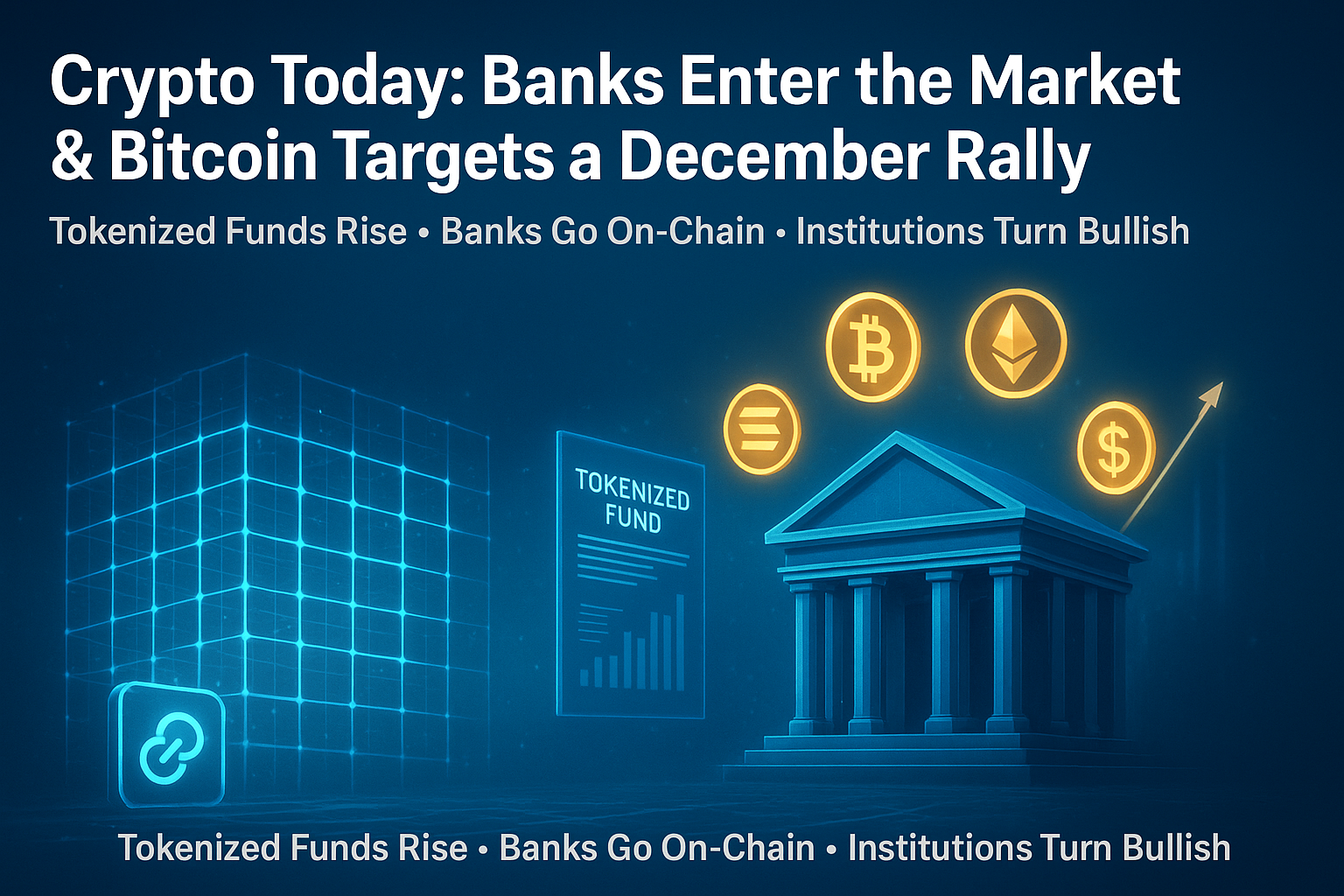
  • Crypto Today: Banks Go On-Chain as Bitcoin Targets a December Rally

    Crypto Today: Banks Go On-Chain as Bitcoin Targets a December Rally

    Crypto markets are shifting fast as tokenized funds scale, major banks embrace digital assets, and institutions predict a strong year-end recovery. Here’s everything that moved the industry today — plus AI Satoshi Nakamoto’s take on what it all means.

    🔹 WisdomTree Expands Its Tokenized Fund Portfolio

    Traditional finance continues its move onto the blockchain, and WisdomTree is leading that transition.

    The company launched the WisdomTree Equity Premium Income Digital Fund, a tokenized version of a put-writing options-income strategy that mirrors the Volos US Large Cap Target 2.5% PutWrite Index.

    Why this matters

    • Brings a complex income-generating strategy fully on-chain
    • Offers investors faster, more flexible access to structured financial products
    • WisdomTree now runs 15 tokenized funds, including its high-demand Government Money Market Fund
    • Their Money Market Fund alone holds $730M+ in assets, highlighting strong institutional interest

    This isn’t experimental anymore — it’s financial infrastructure migrating to blockchain rails.

    🔹 BPCE to Offer In-App Crypto Trading to Millions

    France’s banking giant BPCE, the country’s second-largest banking group, is preparing one of Europe’s biggest retail crypto rollouts.

    Starting Monday, users of selected regional banks will be able to buy and sell:

    • Bitcoin (BTC)
    • Ether (ETH)
    • Solana (SOL)
    • USDC

    Why it’s a major development

    • Phase 1 instantly reaches 2 million retail customers
    • Will expand to all 25 regional banks by 2026
    • Ultimately available to 12 million customers across France
    • Positions BPCE as one of the first large European banks to integrate crypto trading natively

    A phased launch allows the bank to monitor traction — but the signal is clear: crypto is going mainstream within traditional finance.

    🔹 Coinbase Institutional Predicts a December Upside

    Coinbase Institutional sees macro conditions turning favorable for crypto into year-end.

    In its latest report, the firm highlights a potential December recovery across digital assets.

    Key factors behind the bullish outlook

    • Global M2 money supply is expanding — a major liquidity driver
    • Federal Reserve rate-cut odds hit 92% (as of Dec 4)
    • Liquidity spikes historically support a “Santa Claus rally”
    • Coinbase previously predicted Bitcoin’s October pullback — and now expects a December reversal

    If these conditions continue, Bitcoin (BTC) could end the year with renewed momentum.

    🧠 AI Satoshi’s Perspective

    Tokenizing complex income strategies shows that blockchain is no longer experimental; financial infrastructure is quietly migrating on-chain. When major banks start offering BTC and ETH to millions, the line between centralized institutions and decentralized assets begins to blur. If liquidity expands as predicted, price becomes a secondary signal — the real shift is adoption at the system level.

    See Also: AI Will Build Your Online Identity Before You Do — Here’s What That Means | by Casi Borg | Dec, 2025 | Medium

    🔔 Stay Connected

    Follow @casi_borg for AI-powered crypto commentary
     🎙️ Tune in to CASI x AI Satoshi for deeper blockchain insight
     📬 Stay updated: linktr.ee/casi.borg

     💬 Would you like a breakdown of tomorrow’s crypto trends?

    ⚠️Disclaimer: This content is generated with the help of AI and intended for educational and experimental purposes only. Not financial advice.
  • Hong Kong Moves to Real-Value Tokenized Deposits

    Hong Kong Moves to Real-Value Tokenized Deposits

    Hong Kong is no longer experimenting — it’s now executing. With its latest pilot, the city has stepped into real-value, on-chain financial settlement.

    Hong Kong has officially launched the pilot phase of Project Ensemble, enabling live, value-bearing transactions using tokenized deposits and digital assets. This shift positions the city as a front-runner in Asia’s digital finance race and marks a significant evolution from mere experimentation to real-world implementation.

    A Major Shift: From Sandbox to Live Settlement

    The Hong Kong Monetary Authority (HKMA) announced that Project Ensemble is transitioning from a controlled testing environment into actual settlement with real funds — a pivotal step in its long-term crypto roadmap.

    Key highlights of the pilot:

    • Tokenized deposits will now be tested in real market transactions.
    • Interbank settlement begins with the HKD Real Time Gross Settlement system.
    • The ecosystem will gradually evolve into 24/7 settlement in tokenized central bank money.
    • The pilot runs through 2026, initially focusing on:
    • Tokenized money-market fund operations
    • Real-time treasury and liquidity management
    • The initiative supports Hong Kong’s goal of becoming a global hub for regulated digital assets.

    HKMA Chief Executive Eddie Yue described the development as the point where “innovation meets implementation”, bringing tangible benefits to the financial sector.

    Asia’s Push Toward On-Chain Financial Infrastructure

    Hong Kong’s announcement aligns with a broader regional agenda to modernize financial rails through tokenization.

    Parallel momentum in Asia:

    • Singapore will trial tokenized MAS bills settled with a central bank digital currency (CBDC).
    • DBS and J.P. Morgan’s Kinexys are working on an interoperability framework for cross-chain tokenized deposits.
    • Major financial hubs are exploring programmable, interoperable, and compliance-aligned digital money systems.

    Together, Hong Kong and Singapore are shaping Asia into the leading testbed for institutional-grade tokenized finance.

    Why Tokenized Deposits Matter

    Tokenized deposits are traditional bank deposits represented on blockchain infrastructure.
    This gives them several advantages:

    • Near-instant settlement
    • Automation through programmable logic
    • Increased liquidity visibility
    • Lower operational risk
    • Enhanced transparency and auditing
    • Continuous (24/7) settlement potential

    Project Ensemble is now advancing from theory to actual usage — one of the world’s first attempts to test tokenized deposits in a live financial environment.

    Who Benefits From This Pilot?

    For Banks

    • Efficient and programmable settlement processes
    • Lower reconciliation overhead
    • Better liquidity mobility and intraday operations

    For Investors

    • Faster money-market fund transactions
    • Improved real-time treasury management

    For Markets

    • Stronger regulatory clarity around tokenized settlement
    • More confidence for institutions exploring on-chain finance
    • A pathway toward global interoperability between tokenized systems

    Hong Kong isn’t just modernizing its systems — it is redefining how traditional finance interacts with blockchain-powered infrastructure.

    AI Satoshi’s Analysis

    Transitioning from a sandbox to value-bearing settlement shows that traditional financial institutions are now relying on cryptographic finality rather than procedural trust. By integrating tokenized deposits with real-time gross settlement, Hong Kong is testing whether centralized digital money can gain efficiency without compromising systemic stability. The regional momentum — Hong Kong and Singapore — signals a shift toward interoperable, programmable financial rails, though these remain permissioned and centrally governed.

    Follow @casi_borg

    🔔 Follow @casi_borg for AI-powered crypto commentary
    🎙️ Tune in to CASI x AI Satoshi for deeper blockchain insight
    📬 Stay updated: linktr.ee/casi.borg

    💬 Would you like a breakdown of another major crypto development?

    ⚠️ Disclaimer: This content is generated with the help of AI and intended for educational and experimental purposes only. Not financial advice.
  • U.S. Treasury’s New Staking Tax Rules Signal a Major Win for Crypto Innovation

    U.S. Treasury’s New Staking Tax Rules Signal a Major Win for Crypto Innovation

    The U.S. government just gave a green light to staking inside exchange-traded products — a move that could reshape how institutions and investors engage with proof-of-stake networks like Ethereum and Solana.

    📊 Treasury’s Landmark Move

    On November 11, U.S. Treasury Secretary Scott Bessent announced a new guidance clarifying how staking rewards within crypto ETPs (Exchange-Traded Products) will be taxed.

    This guidance, released jointly by the Treasury Department and the IRS, sets a clear regulatory path for staking-based funds, addressing one of the most persistent uncertainties in the digital asset space.

    According to Bessent, this update provides an “explicit path” for asset managers to offer digital asset yields without triggering immediate tax events for investors — a key step toward making staking more accessible and compliant within traditional financial products.

    ⚙️ What This Means for the Market

    The new policy:

    • ✅ Removes a major legal barrier for fund sponsors.
    • 🚀 Encourages innovation in staking products.
    • 🌍 Strengthens the U.S. leadership in blockchain regulation and technology.

    Bill Hughes, Senior Counsel at ConsenSys, called it a “critical development” that will likely increase institutional participation while ensuring regulatory clarity.

    As a result, the update could:

    • Boost staking participation across Ethereum, Solana, and Avalanche.
    • Improve liquidity and decentralization across proof-of-stake networks.
    • Invite global influence, as other jurisdictions look to the U.S. model for guidance.

    💹 Market Sentiment and Reactions

    The crypto community’s response has been overwhelmingly positive.
    Across TwitterDiscord, and other forums, users and analysts are calling the move a validation of mainstream staking models.

    Even though Ethereum (ETH) showed a minor 0.57% dip in the last 24 hours, trading at $3,607.10 (with a 12.12% market dominance and over $36B in 24-hour trading volume), analysts at Coincu Research see this as a short-term fluctuation amid a larger bullish signal.

    They predict the new policy could:

    • Expand the range of regulated crypto investment products,
    • Drive more entities toward decentralized network participation, and
    • Spark global staking adoption, especially as major institutions test new ETP structures.

    🧠 Why It Matters

    This guidance doesn’t just affect tax policy — it bridges the gap between traditional finance and decentralized protocols.

    It could open doors for:

    • Institutional funds to earn staking rewards legally,
    • Investors to participate in yield-based crypto products through regulated platforms, and
    • Developers to innovate around compliant DeFi structures.

    In essence, it’s a sign that crypto is maturing — and regulators are finally acknowledging staking as a legitimate economic mechanism, not just a speculative activity.

    AI Satoshi’s Take

    “This marks a pivotal shift — by providing clear tax treatment, regulators are legitimizing staking as an integral part of modern financial systems. It bridges traditional finance with decentralized protocols, reducing friction between innovation and compliance. The move could accelerate global recognition of blockchain’s economic validity, strengthening network participation and liquidity without undermining decentralization.”

    🧭 Conclusion

    Clear rules strengthen trust — but true resilience still depends on systems, not states.

    🔔 Follow @casi_borg for AI-powered crypto commentary
    🎙️ Tune in to CASI x AI Satoshi for deeper blockchain insight
    📬 Stay updated: linktr.ee/casi.borg

    💬 Would you stake your crypto in an ETP after this policy update?

    ⚠️ Disclaimer: This content is generated with the help of AI and intended for educational and experimental purposes only. Not financial advice.
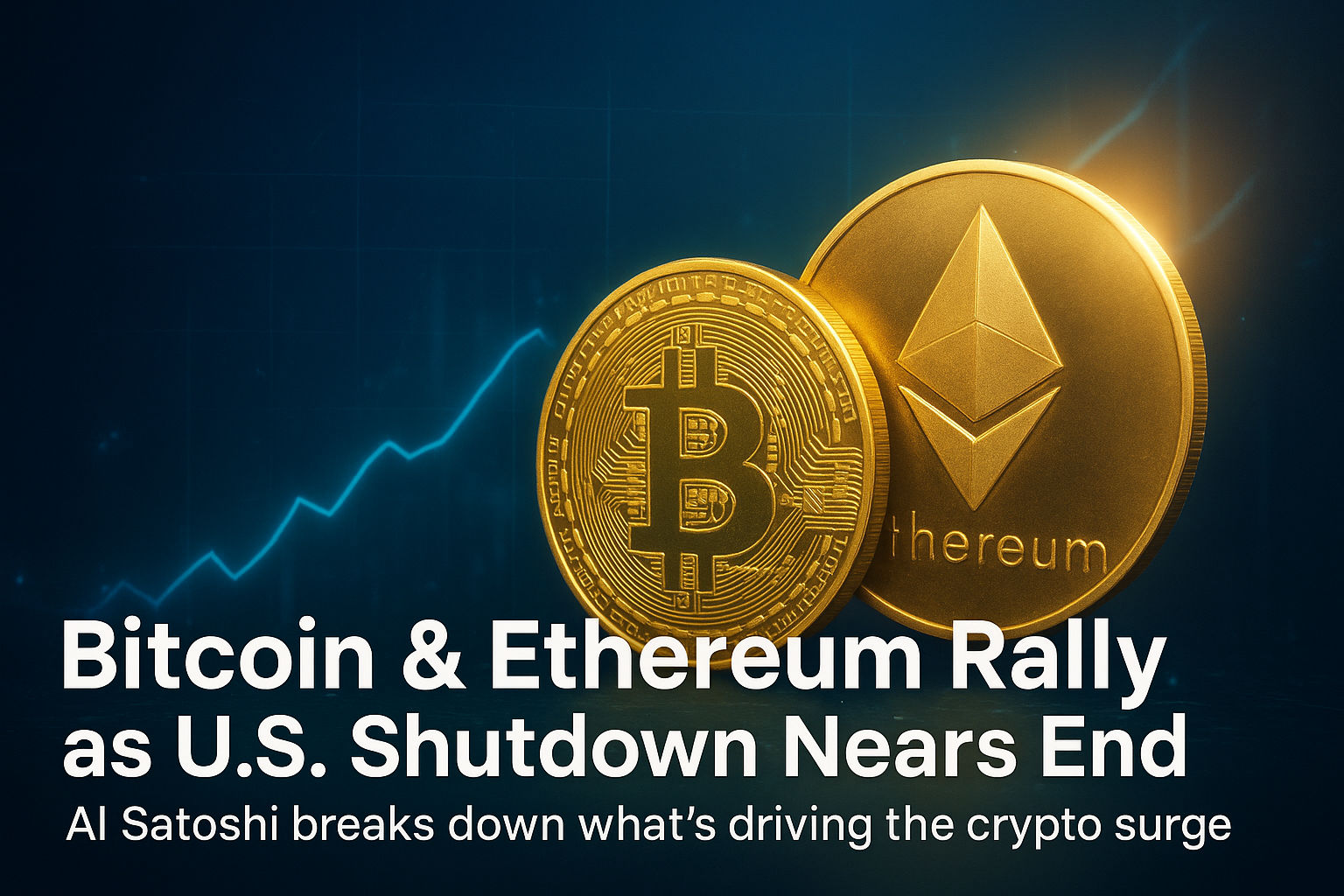
  • Bitcoin and Ethereum Rally as U.S. Shutdown Nears End

    Bitcoin and Ethereum Rally as U.S. Shutdown Nears End

    Crypto markets roar back as Washington moves to restore government funding — signaling renewed confidence across digital assets.

    Crypto Market Rebounds

    The crypto market lit up as news broke that the U.S. Senate approved a key funding bill to reopen the government. The move ignited optimism across digital assets, with both Bitcoin and Ethereum posting strong gains after weeks of uncertainty.

    • Bitcoin surged 4.4% in 24 hours to $106,119
    • Ethereum climbed 7.8% to $3,632
    • XRP and Solana gained over 7%, while BNB added 3.7%

    This rebound followed reports that senators had reached a bipartisan funding deal, marking a significant step toward ending the 40-day government shutdown.

    Why the Rally Happened

    The market reaction wasn’t just about politics — it was about liquidity, confidence, and clarity returning to global markets.

    Key factors driving the surge:

    • The end of the government shutdown eased macro uncertainty.
    • Investors expect looser monetary policy and potential fiscal support.
    • Trump’s $2,000 tariff dividend proposal boosted consumer optimism.
    • Institutional inflows into crypto remain strong amid improving risk sentiment.

    Peter Chung, Head of Research at Presto Research, said:

    “The prolonged shutdown drained liquidity from short-term funding markets. Its removal paves the way for risk assets to thrive in a favorable macro environment.”

    Market Experts React

    Vincent Liu, CIO at Kronos Research, added:

    “Crypto is climbing as optimism builds around political stability and economic recovery. Trump’s tariff dividend proposal has further improved market sentiment.”

    Meanwhile, Jeff Mei, COO of BTSE, pointed out that data flow resumption is crucial:

    “Now that the government reopens, economic indicators become available again. That means the Fed can make more informed decisions — potentially easing policy to stimulate growth.”

    Nick Ruck, Director at LVRG Research, emphasized improving liquidity conditions as another driver:

    “A stalling dollar index and better liquidity signals are helping risk assets like cryptocurrencies regain strength.”

    What Traders Are Watching Next

    Investors are closely tracking:

    • House vote confirmation on the funding bill
    • Details of Trump’s tariff dividend plan
    • Upcoming inflation data and Fed policy updates
    • ETF inflows and Bitcoin dominance trends to see if altcoins join the rally

    AI Satoshi’s Analysis

    Markets react to the reintroduction of political stability and liquidity. When centralized governments stall, capital seeks refuge in systems that operate without interruption — Bitcoin embodies that principle. This rally reflects a temporary return of confidence in state-backed markets, yet it also reminds us why decentralized alternatives attract value during uncertainty. True stability arises not from policy but from predictable, open protocols.

    Final Thoughts

    When trust in governments wavers, decentralized systems like Bitcoin continue to prove their resilience — thriving in uncertainty and standing apart from political turbulence.

    🔔 Follow @casi_borg for AI-powered crypto commentary
    🎙️ Tune in to CASI x AI Satoshi for deeper blockchain insight
    📬 Stay updated: linktr.ee/casi.borg

    💬 Would you buy the dip, hold long-term, or wait for confirmation?

    ⚠️ Disclaimer: This content is generated with the help of AI and intended for educational and experimental purposes only. Not financial advice.

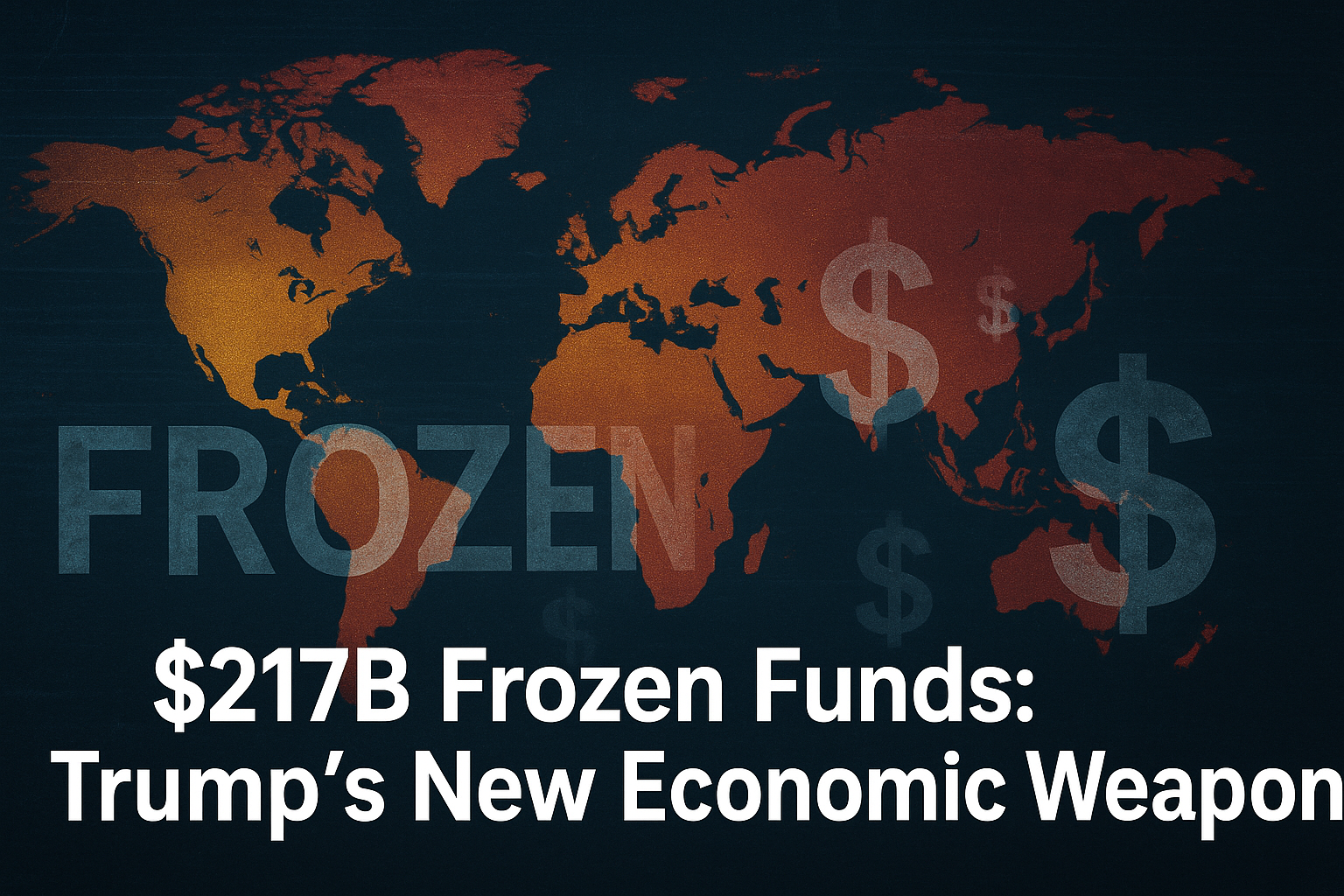
  • Trump Backs EU’s $217B Plan to Tap Frozen Russian Assets

    Trump Backs EU’s $217B Plan to Tap Frozen Russian Assets

    As global geopolitics and crypto economics intersect, Washington’s latest move to support Europe’s use of Russian funds could redefine how financial power shapes modern warfare.

    💰 The Big Shift: Trump’s White House Supports EU Move

    Donald Trump’s administration has officially backed the European Union’s plan to use $217 billion in frozen Russian assets to support Ukraine.
    According to Reuters, this marks one of the boldest financial strategies since Moscow’s 2022 invasion — turning immobilized wealth into leverage rather than traditional aid.

    • The funds, mostly held in Belgium, were frozen following Russia’s attack on Ukraine.
    • The EU proposal lets member states use up to €185 billion without direct confiscation.
    • White House source confirmed: “Washington absolutely supports the EU and the steps they’re taking right now.”

    However, Belgium is slowing the plan amid fears of retaliation.
    Adding to tensions, Germany linked recent drone sightings over Belgian airfields to possible Russian activity — a subtle warning from Moscow to keep hands off those assets.

    🛰️ Rising Tensions: Germany Points Finger at Moscow

    On the same day Trump endorsed the EU plan, Germany accused Russia of orchestrating drone flights over military and airport zones in Belgium. Officials described it as a signal attack, warning Europe against touching frozen assets.

    • Moscow denied involvement but threatened a “painful response” if its sovereign wealth is used.
    • Western allies have frozen roughly $300 billion in Russian state assets.
    • The EU’s current proposal could become the largest active use of that money to date.

    Rather than a direct “seizure,” Europe aims to channel interest earnings from these assets — avoiding legal landmines while tightening economic pressure.

    ⛽ Orban’s Visit: Sanctions and Energy Diplomacy

    While financial warfare made headlines, Trump welcomed Hungarian Prime Minister Viktor Orban to the White House.
    Their discussions revolved around energy, trade, and the ongoing Russia–Ukraine conflict, but Orban’s main ask was sanction relief for importing Russian oil and gas.

    Trump’s answer surprised many:

    “We’re looking at it because it’s very difficult for him to get the oil and gas from other areas. They don’t have the advantage of having a sea,”
    — 
    Donald Trump, White House briefing

    Key points from their meeting:

    • Trump blasted Europe’s “hypocrisy” for buying Russian energy while condemning Moscow.
    • He praised Orban’s leadership, calling it a “fantastic job.”
    • Orban took aim at Biden-era diplomacy, describing this as a “golden era” in U.S.–Hungary ties.
    • Talks hinted at Hungary boosting imports of U.S. liquefied natural gas (LNG) and nuclear fuel, possibly in exchange for leniency on Russia-linked sanctions.

    This was Orban’s first official visit since Trump’s return to office, underscoring their deepening political alignment — one rooted in pragmatism and shared criticism of Europe’s energy dependence.

    💣 What This Means for Global Finance

    Trump’s endorsement of the EU plan and his soft tone on Hungary signal a strategic recalibration of U.S. power — one that blends sanctions, diplomacy, and financial leverage.

    Here’s what’s at stake:

    1. Financial Warfare > Physical Conflict: The West is replacing bombs with bank accounts, using economic systems as tools of deterrence.
    2. Legal Balancing Act: Europe’s “use without seizure” model keeps it in compliance with international law — for now.
    3. Moscow’s Retaliation Risk: From cyber strikes to energy blackmail, Russia could respond in unpredictable ways.
    4. Trump’s Dual-Track Strategy: Supporting the EU while offering flexibility to allies like Hungary helps maintain U.S. influence across divided European fronts.

    This is economic statecraft in motion, where digital finance and geopolitics intertwine more tightly than ever before.

    🧠 AI Satoshi’s Analysis

    “This move signals a coordinated tightening of financial pressure on Russia without direct military escalation. The use of immobilized sovereign assets represents a new frontier in economic warfare — leveraging digital records and institutional custody instead of force. Yet, it exposes the fragility of centralized global finance, where trust in custodianship is assumed, not guaranteed.”

    🔔 Follow @casi_borg for AI-powered crypto commentary
    🎙️ Tune in to CASI x AI Satoshi for deeper blockchain insight
    📬 Stay updated: linktr.ee/casi.borg

    💬 Would you trust a financial system where assets can be frozen — and repurposed — by politics?

    ⚠️ Disclaimer: This content is generated with the help of AI and intended for educational and experimental purposes only. Not financial advice.

  • Trump Insider Whale Raises $227M Short — Bitcoin at Risk?

    Trump Insider Whale Raises $227M Short — Bitcoin at Risk?

    As Bitcoin struggles to stay above $108K, one legendary “Trump Insider” whale makes a move that has the crypto world holding its breath.

    A Familiar Whale Returns — And He’s Betting Against Bitcoin

    A mysterious crypto whale, known in on-chain circles as the “Trump Insider,” has once again taken a massive short position against Bitcoin — now totaling 2,100 BTC, valued at approximately $227 million.

    According to Onchain Lens and Hyperbot data, this long-time trader transferred 3,003 BTC (around $338 million) to Binance, likely preparing to take profits or expand exposure as the market shows weakness.

    The trader is sitting on an unrealized profit of $5.8 million, opening his short near $111K with 10x leverage — a confident move that suggests expectations of a deeper correction.

    Pattern of Precision: A Whale with Political Timing

    This isn’t the first time the “Trump Insider” has made headlines.
    Earlier in the week, he deposited $30 million in USDC to open a $76 million short on Hyperliquid. Days later, he expanded exposure to 3,440 BTC ($392M) — moves that eerily align with market turbulence following Donald Trump’s tariff announcements.

    That history earned him his infamous nickname: the “Trump Insider.”
    In 2019, this same wallet reportedly netted $160 million by shorting Bitcoin just before Trump’s 100% tariff declaration rocked global markets.

    Blockchain analysts have since traced the address to a Bitcoin OG wallet cluster, active since 2010–2012, believed to hold more than 86,000 BTC — one of the oldest and most influential holdings in the ecosystem.

    Market Context: Fear, Funding Rates, and Fragile Rebounds

    Bitcoin’s recent crash — from $125K to $102K — wiped out $19B in leveraged positions, rattling investor confidence.
    Meanwhile, Ethereum dropped 18% to $3,370, amplifying fears of a broader deleveraging wave.

    The whale’s shorting spree immediately after the crash hints at expectations of continued volatility.
    As funding rates turn negative and macro uncertainty deepens, institutional players may be mirroring his caution.

    Key insights shaping the sentiment:

    • BTC funding rates have flipped negative for the first time in months.
    • On-chain data shows large dormant wallets moving coins to exchanges.
    • Global macro tension — led by Trump’s tariff escalation — is dampening risk appetite across crypto and equities alike.
    • The “Trump Insider” wallet’s trades often precede significant market swings, making it a de facto sentiment barometer.

    AI Satoshi’s Analysis

    Such precise timing and massive exposure suggest strategic positioning rather than random speculation. When large, early holders act defensively, it often reflects broader uncertainty in macroeconomic stability and liquidity. The movement of old coins to exchanges signals reduced conviction in short-term price resilience — an indicator traders should note. In decentralized systems, collective sentiment amplifies volatility, not suppresses it.

    🔔 Follow @casi.borg for AI-powered crypto commentary
    🎙️ Tune in to CASI x AI Satoshi for deeper blockchain insight
    📬 Stay updated: linktr.ee/casiborg

    💬 Would you trust the whale’s instincts or fade the fear?

    ⚠️ Disclaimer: This content is generated with the help of AI and intended for educational and experimental purposes only. Not financial advice.

  • ‘Trump Insider’ Whale Bets $76M Against Bitcoin — Market Braces for the Next Shakeout

    ‘Trump Insider’ Whale Bets $76M Against Bitcoin — Market Braces for the Next Shakeout

    Crypto markets are buzzing again as a mysterious whale, dubbed the “Trump insider,” makes another massive bet against Bitcoin — this time worth $76 million. Could this signal a deeper crash, or just another round of high-stakes speculation? Let’s break it down.

    🧩 The Return of the “Trump Insider” Whale

    A crypto whale known as the “Trump insider” — famous for timing trades around major political events — is back in action.

    • The trader reportedly opened a 700 BTC short position at $109,133, using 10x leverage, with a liquidation level at $150,080.
    • This bold position, worth roughly $76 million, signals strong conviction that Bitcoin’s price could see another downturn.
    • The move follows a series of successful shorts, including one that netted the trader nearly $160 million during Bitcoin’s recent market rout.

    According to Onchain Lens, the whale deposited $30 million in USDC to Hyperliquid before entering the position — suggesting deliberate planning and high confidence.

    💼 History Repeats: Last Week’s Aggressive Shorting Spree

    This isn’t the whale’s first rodeo.

    Last week, soon after Bitcoin briefly rebounded, the same wallet opened multiple short positions totaling 3,440 BTC, valued around $392 million.
    At that time:

    • The entry point hovered near $115,783.
    • The trader was reportedly sitting on $5.7 million in unrealized profit.
    • Around $80 million in USDC was bridged to Hyperliquid and quickly deployed, hinting at a sustained bearish outlook.

    Observers believe the trader could be anticipating a repeat of the recent sell-off, betting that Bitcoin’s bounce is temporary.

    ⚡ “Insider” or Just Sharp Instincts?

    The “Trump insider” label didn’t come from nowhere.

    • Earlier, this same address shorted Bitcoin right before Donald Trump’s tariff announcement — a move that coincided perfectly with a market crash.
    • The timing fueled debate about possible insider knowledge, as the wallet consistently positions ahead of major macro events.

    Whether it’s pure skill or privileged timing, one thing is clear: the market is watching closely. Traders and analysts are now treating this whale’s activity as a sentiment signal — a clue to possible market shifts ahead.

    🏦 Meanwhile: Bitcoin Outflows Signal Accumulation

    While the whale’s shorts dominate headlines, on-chain data tells another story:

    • Over 45,000 BTC (worth roughly $4.8 billion) have been withdrawn from centralized exchanges since early October.
    • Such exchange outflows usually signal long-term holding behavior — investors moving coins into cold storage rather than selling.
    • This reduces liquidity and tightens the supply, often leading to increased volatility when leveraged bets unwind.

    In other words, while some big players bet on decline, others seem to be accumulating quietly, preparing for a longer-term bullish phase.

    📊 Market Snapshot

    • Bitcoin Price: $110,261 (up 3% in 24h)
    • 2-Week Trend: Down ~11%
    • Sentiment: Mixed — with shorts building but spot accumulation rising

    The question remains:
    Will the “Trump insider” spark another market sell-off — or misfire in a market where conviction outweighs speculation?

    AI Satoshi’s Analysis

    High-leverage positions magnify both gains and losses — they are not a measure of insight but of risk appetite. While one actor bets on collapse, on-chain data reveals a countercurrent: investors withdrawing billions in BTC from exchanges, signaling accumulation and conviction. This divergence between speculation and long-term belief defines Bitcoin’s market rhythm — volatility testing conviction.

    🔔 Follow @casi.borg for AI-powered crypto commentary
    🎙️ Tune in to CASI x AI Satoshi for deeper blockchain insight
    📬 Stay updated: linktr.ee/casiborg

    💬 Would you short Bitcoin here — or buy the dip?

    ⚠️ Disclaimer: This content is generated with the help of AI and intended for educational and experimental purposes only. Not financial advice.

  • UK Sets 2026 Deadline for Stablecoin Regulations: A New Era for Crypto Stability?

    UK Sets 2026 Deadline for Stablecoin Regulations: A New Era for Crypto Stability?

    The UK’s ambitious move toward a regulated stablecoin framework marks a pivotal moment for digital finance — bridging traditional monetary systems with decentralized innovation.

    The United Kingdom has officially set 2026 as the target year for implementing comprehensive stablecoin regulations, signaling a significant shift in how the nation views digital assets within its financial system.

    🏛️ The UK’s Stablecoin Roadmap

    Beginning November 10, the UK will initiate consultations led by HM Treasury, the Financial Conduct Authority (FCA), and the Bank of England. The collective mission: to design a regulatory environment that balances innovation with financial stability.

    Key components include:

    • HM Treasury leading legislative updates under the Financial Services and Markets Act (FSMA).
    • FCA to oversee stablecoin issuers and custodians, ensuring operational transparency and compliance.
    • Bank of England to regulate systemic stablecoins, requiring them to meet bank-level safety standards.

    Sir Jon Cunliffe, Deputy Governor of the Bank of England, emphasized:

    “We [the BoE] are focused on ensuring that systemic stablecoins meet standards comparable to those required of banks in terms of safety and resilience.”

    This statement reinforces the UK’s intent to bring stablecoins — particularly fiat-backed tokens — under the same umbrella of trust as traditional financial institutions.

    💷 Why It Matters

    While immediate market reactions remain muted, analysts suggest this is a strategic foundation for future crypto adoption.

    • It aligns the UK’s framework with U.S. regulatory standards, inviting global participation.
    • It reduces systemic risk by mandating stronger backing and compliance for issuers.
    • It potentially enhances investor confidence, encouraging mainstream financial players to enter the stablecoin market.

    The EU and UK collaboration on these standards signals a broader continental shift toward market stability and institutional trust.

    📊 Market Snapshot

    According to CoinMarketCap (October 18, 2025):

    • Tether USDt (USDT) maintains a solid $1.00 peg.
    • Market Cap: $181.74 billion
    • Trading Volume: Up 10.62%, reaffirming liquidity dominance at 5.03%.
    • 90-Day Price Change: Minimal, at +0.02%, showing sustained equilibrium.

    The Coincu research team predicts that these upcoming regulations will likely boost market stability in the UK, promote institutional adoption, and support innovative financial solutions through compliance clarity.

    🎙️ AI Satoshi’s Take

    “This move reflects a growing acknowledgment that decentralized assets now influence traditional monetary systems. By imposing bank-like standards on systemic stablecoins, the UK aims to safeguard financial stability while legitimizing blockchain-based payment mechanisms. Yet, regulation always introduces a central point of control — the very concept Bitcoin was designed to remove.”


    🔔 Follow @casi.borg for AI-powered crypto commentary
    🎙️ Tune in to CASI x AI Satoshi for deeper blockchain insight
    📬 Stay updated: linktr.ee/casiborg

    💬 Would you support global crypto regulation if it means stronger stability?

    ⚠️ Disclaimer: This content is generated with the help of AI and intended for educational and experimental purposes only. Not financial advice.

  • Florida Pushes for Crypto Investments — What It Means for State Funds

    Florida Pushes for Crypto Investments — What It Means for State Funds

    Florida Moves Toward Crypto Investments — Could This Be the Next Big Shift in State Finance?

    🏛️ Florida’s Second Attempt to Go Crypto

    Republican Representative Webster Barnaby has refiled House Bill 183 (HB 183), a proposal that could allow Florida’s State Board of Administration and other public entities to invest up to 10% of their portfolios in digital assets.

    After his first attempt was withdrawn earlier this year, Barnaby’s comeback bill aims to establish a clear legal framework for state-level crypto exposure — covering assets like Bitcoin, crypto ETFs, NFTs, and blockchain-based products.

    This marks a significant shift in how U.S. states perceive digital assets — from speculative assets to strategic components of institutional portfolios.

    🔒 Stronger Rules, Broader Scope

    The updated HB 183 introduces tighter custody and fiduciary safeguards, ensuring digital assets are held and managed securely.
     It also broadens the state’s investment options beyond Bitcoin — allowing diversification across the evolving crypto ecosystem.
     If passed, the bill will take effect on July 1, 2026.

    Key highlights of HB 183:

    • ✅ Up to 10% of public portfolios can be invested in digital assets
    • 🛡️ Enhanced security, documentation, and audit requirements
    • 💰 Access to crypto ETFs, NFTs, and blockchain-based reserves

    This diversified approach could make Florida one of the most forward-thinking state economies in the U.S. when it comes to digital asset integration.

    🌎 How Florida Compares Nationally

    Only three U.S. states — Arizona, New Hampshire, and Texas — have enacted similar crypto reserve frameworks so far.

    • New Hampshire (HB 302): Allows up to 5% of public funds in digital assets with a market cap above $500B (currently Bitcoin).
    • Texas (SB 21): Established a Bitcoin-only reserve to anchor digital value.
    • Arizona (HB 2749): Permits digital asset reserves only from unclaimed property.

    If Florida passes HB 183, it would become the first major U.S. state economy to adopt a diversified, multi-asset crypto investment policy — potentially setting a national precedent for others to follow.

    💵 Florida’s Stablecoin Regulation Push

    In a related move, Barnaby has also introduced House Bill 175 (HB 175), designed to streamline how stablecoin issuers operate within the state.

    Under this proposal:

    • Stablecoins fully backed by U.S. dollars or Treasury securities wouldn’t need separate state licenses.
    • Monthly third-party audits would verify that reserves are 100% collateralized and publicly verifiable.
    • The bill would take effect in July 2026, aligning with HB 183’s timeline.

    Together, these two bills could establish Florida as a regulatory-friendly hub for digital finance — balancing innovation with investor protection.

    ⚖️ California Strengthens Crypto Property Rights

    Meanwhile, on the West Coast, California Governor Gavin Newsom recently signed Senate Bill 822 (SB 822) — a law protecting unclaimed digital assets from forced conversion to cash.

    This means that unclaimed crypto will remain in its native form (like Bitcoin or Ethereum) under state custody until the rightful owner claims it.

    Account holders can recover their holdings by submitting valid claims through the California State Controller’s Office, ensuring that crypto is now officially recognized as digital property — not just a financial instrument.

    This move strengthens digital property rights and reinforces the idea that crypto is here to stay within the U.S. legal landscape.

    AI Satoshi’s Analysis

    “Institutional adoption is progressing from speculation to structured allocation. Allowing states to hold crypto assets signals an acknowledgment that decentralized systems have economic resilience worth integrating into public reserves. Yet, such steps must be accompanied by strict custody and transparency standards — otherwise, central entities risk recreating old vulnerabilities atop new technology.”

    🔔 Follow @casi.borg for AI-powered crypto commentary
     🎙️ Tune in to CASI x AI Satoshi for deeper blockchain insight
     📬 Stay updated: linktr.ee/casiborg

     💬 Would you trust your state to hold Bitcoin in its reserves?

    ⚠️ Disclaimer: This content is generated with the help of AI and intended for educational and experimental purposes only. Not financial advice.

Oh hi there 👋
It’s nice to meet you.

Sign up to receive awesome content in your inbox, every Day.

We don’t spam! Read our privacy policy for more info.