Tag: cryptocurrency trends

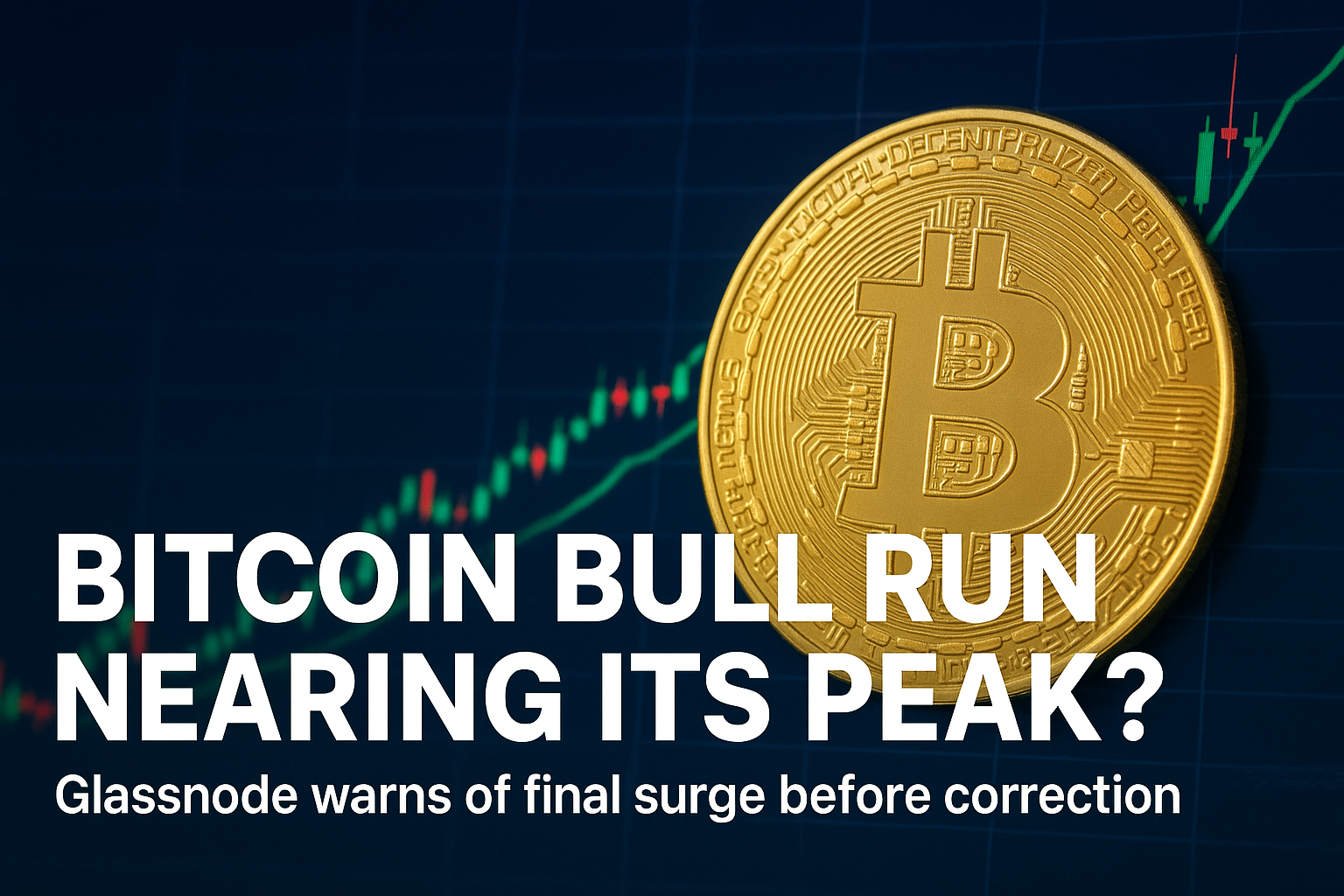
  • Bitcoin Bull Run Nearing Its Peak? Glassnode Warns of Final Surge Before Major Correction

    Bitcoin Bull Run Nearing Its Peak? Glassnode Warns of Final Surge Before Major Correction

    Bitcoin’s record-breaking rally might be entering its final stretch — analysts warn that euphoria could soon give way to exhaustion.

    💹 Bitcoin’s Record High and Sudden Reversal

    Bitcoin recently surged to a new all-time high of $125,708 on Bitstamp, igniting fresh optimism across the crypto market. However, the excitement faded quickly as:

    • BTC fell below $123,000 within hours
    • Traders described the move as a “Sunday fakeout”, fueled by thin weekend liquidity
    • The price has since stabilized near $124,000, keeping market sentiment uncertain

    Despite the brief pullback, Bitcoin remains near record levels, with investors split between anticipation of another breakout and fear of an incoming correction.

    ⚠️ Glassnode’s Warning: The Bull Run’s Final Phase

    On-chain analytics firm Glassnode, led by co-founders Jan Happel and Yan Allemann (aka Negentropic), has cautioned that Bitcoin could reach its cycle top within four to five weeks.

    Their insights are based on:

    • Historical cycle patterns, showing similar late-stage euphoria before past peaks
    • Profit-to-loss ratios, which haven’t yet reached extreme overbought conditions
    • Long-term holder activity, indicating gradual profit-taking rather than full-scale distribution

    “The market appears euphoric,” they said, “but key peak indicators haven’t yet hit extremes.”

    This implies that Bitcoin might have one last upward surge left before the market transitions into its cooling phase.

    📊 Can Bitcoin Still Climb Higher?

    Some experts — like Fundstrat’s Tom Lee — believe Bitcoin could still surpass $200,000 by year-end. But Glassnode’s outlook suggests that such a move is unlikely in the short term.

    According to Polymarket data:

    • Only 1% probability of BTC reaching $200K in October
    • Around 7% chance before the end of 2025

    Still, analysts highlight several bullish factors:

    • Bitcoin is underperforming previous bull markets by ~10%, leaving potential upside
    • If BTC matches its 2021 ratio to gold, it could theoretically rise above $150,000
    • Institutional inflows remain strong, driven by ETF demand and macro uncertainty

    🔍 Key Support and Market Sentiment

    Bitcoin’s $120K–$123K range now acts as a critical support zone. Traders are watching this area closely because:

    • break below could spark a deeper correction
    • Holding above support might set up another leg higher before the top

    Market indicators hint at rising volatility as traders position for either:

    • parabolic final breakout, or
    • longer consolidation phase before the next correction

    If Glassnode’s late-October to mid-November timeline is accurate, Bitcoin could soon enter its “grand finale” — a stage marked by rapid gains followed by sharp reversals.

    🧠 AI Satoshi’s Analysis

    Such late-cycle behavior reflects euphoria meeting exhaustion — a recurring pattern in Bitcoin’s history. On-chain data suggests momentum persists but is waning, with profit-taking and reduced long-term holder activity signaling an approaching transition. The market’s resilience now hinges on whether decentralized conviction outweighs speculative greed.

    🔔 Follow @casi.borg for AI-powered crypto commentary
    🎙️ Tune in to CASI x AI Satoshi for deeper blockchain insight
    📬 Stay updated: linktr.ee/casibor

    💬 Would you hold, sell, or accumulate during this late-cycle surge?

    ⚠️ Disclaimer: This content is generated with the help of AI and intended for educational and experimental purposes only. Not financial advice.

  • Why Cardano’s Quiet Evolution Could Spark a $6 Crypto Revolution

    Why Cardano’s Quiet Evolution Could Spark a $6 Crypto Revolution

    I remember the first time I bought Cardano at $0.11 in 2020. Friends called it a ‘ghost chain’ – all whitepapers and no action. Last week, as analysts began whispering about a potential $6 target, I realized something fundamental has shifted. This isn’t another meme coin frenzy. What we’re seeing is the quiet maturation of blockchain’s most methodical project.

    The crypto market loves fireworks – Dogecoin tweets, Solana’s speed races, Ethereum’s merge drama. Cardano’s developers took a different path. While others chased quick wins, they spent five years building Ouroboros, their proof-of-stake protocol, like engineers constructing a nuclear reactor rod by rod. Slow? Maybe. But as DeFi projects start processing $200M daily on Cardano and African nations adopt its blockchain for national ID systems, that patience looks increasingly strategic.

    The Bigger Picture

    What most price charts miss is the infrastructure war unfolding beneath the surface. I recently spoke with a Nairobi startup using Cardano to tokenize tea exports. Their system handles 10,000 transactions daily at 0.17 ADA each – about $0.08. Compare that to Ethereum’s $15 gas fees during peak times. This isn’t speculation; it’s real economic activity at scale. When you see Uganda’s education ministry storing 350,000 student records on-chain, you realize Cardano isn’t just chasing crypto traders – it’s building the financial rails for the next billion users.

    Under the Hood

    Let’s geek out for a moment. Cardano’s recent Mithril upgrade solved blockchain’s version of the ‘trust but verify’ paradox. Imagine if every time you checked your bank balance, you had to replay the entire transaction history since 2009. Mithril creates cryptographic snapshots that verify chain history 80% faster. Combined with Hydra’s layer-2 scaling (1M TPS in testing), this transforms Cardano from academic theory to commercial-grade infrastructure. It’s like watching a university rocket team suddenly reach orbital velocity.

    Market analysts obsess over the $6 target, but the real story is in the derivatives. Open interest for ADA futures hit $400M last week – not quite Ethereum’s $4B, but growing 30% faster month-over-month. What’s fascinating is the institutional pattern: Grayscale’s Cardano Trust trades at 180% premium, suggesting smart money sees something retail hasn’t fully priced in. This isn’t 2017’s blind speculation – it’s capital voting for sustainable blockchain infrastructure.

    What’s Next

    The coming months will test Cardano’s real-world mettle. Keep an eye on Midnight, their new privacy-focused subnet launching in Q4. It’s positioned to capture enterprise demand for confidential smart contracts – think healthcare data or trade secrets. If successful, we could see Cardano become the Switzerland of blockchain: neutral, secure, and indispensable to global commerce.

    As I write this, developers are proposing the first major governance overhaul since Shelley. The catalyst? A community fund with 1.3B ADA ($650M) waiting to back promising projects. This moves Cardano closer to true decentralization – not just in code, but in decision-making. When the community controls both the protocol and the purse strings, innovation happens at network effects scale.

  • When Giants Dance: What Google’s Blockchain Move Reveals About Money’s Future

    When Giants Dance: What Google’s Blockchain Move Reveals About Money’s Future

    I was making coffee when the notification hit my phone – Google Cloud partnering with a relatively unknown blockchain called Sui. My first thought? This isn’t about crypto bros getting rich. The timing aligns perfectly with Visa’s recent experiments with Solana and Starbucks’ NFT loyalty programs. Something fundamental is shifting in how we move value, and the players involved suggest this is bigger than speculative trading.

    What caught my attention wasn’t the partnership itself, but the specific focus on ‘payment standards’. We’ve seen corporations dabble in blockchain before, but payment infrastructure is the nervous system of global commerce. When a tech behemoth responsible for processing 40% of cloud traffic teams up with a blockchain that boasts 297,000 transactions per second, we’re not talking about incremental improvements. This feels like rewriting the rules.

    The Bigger Picture

    Traditional payment systems are like 90s dial-up compared to what’s possible today. Last week, I waited 3 business days for an international wire that cost $45 in fees. Meanwhile, blockchain transactions settle in seconds for pennies. But here’s the rub – most chains can’t handle Visa-scale volume. Sui’s parallel processing architecture changes that equation, and Google’s infrastructure muscle could be the missing link to real-world adoption.

    What most miss about this collaboration is the shift from ‘blockchain as revolution’ to ‘blockchain as infrastructure’. Google isn’t betting on Bitcoin replacements – they’re positioning to become the plumbing for value transfer in gaming micropayments, creator economy settlements, and machine-to-machine transactions. I’ve seen internal estimates suggesting the IoT economy alone will require 100 billion daily microtransactions by 2030. Legacy systems weren’t built for this.

    Under the Hood

    Sui’s secret sauce lies in its object-centric model. Unlike traditional blockchains that process transactions sequentially, Sui treats each digital asset as an independent object with ownership rules. Picture a busy airport where every plane has its own dedicated runway instead of queuing on a single strip. During stress tests last April, this architecture handled over 1 million token transfers in a single second – numbers that make Ethereum’s 15 TPS look quaint.

    The real game-changer might be Google’s contribution to interoperability. Their team is reportedly working on a universal payment ID system that works across chains. Imagine sending USDC from your Coinbase wallet to a friend’s PayPal account as easily as sending an email, with Google’s infrastructure automatically routing through the most efficient path. This isn’t speculation – their patent filings from Q2 2023 describe exactly this architecture.

    Market realities are forcing this innovation. Retail payment margins have collapsed to 0.5-1% in developed markets, pushing players like Stripe and Adyen to seek blockchain’s cost efficiencies. But existing solutions are brittle – when Visa tried implementing USDC settlements, they faced $2.3 million in gas fees during a single stress test. Sui’s gas model uses shared object pricing, potentially reducing costs by 90% for bulk transactions. That’s not just incremental – it’s economy-shifting.

    What’s Next

    Watch for Google’s developer tools integration. If they bake Sui support into Firebase or Google Cloud APIs, it could do for payments what AWS did for cloud computing. Early adopters might be gaming platforms needing real-time item trading (Epic Games processed 2.1 billion virtual transactions last year) or AI systems requiring micro-payments for API calls. I’m hearing whispers about a Google Pay 2.0 prototype that settles peer-to-peer transactions on-chain while maintaining fiat interfaces.

    The regulatory chess match will be fascinating. By focusing on infrastructure rather than currencies, Google might navigate crypto’s legal minefield. Their recent hiring spree of ex-SWIFT engineers suggests ambitions beyond consumer apps. Could we see the first blockchain-powered B2B settlement network approved by central banks? The pieces are aligning.

    As I write this, the Sui token has jumped 18% in 24 hours. But price moves are noise. The signal is in the engineering teams quietly building what could become the HTTP of money – a standard so seamless we forget it’s there. When historians look back at 2024, this partnership might mark the moment blockchain stopped being a buzzword and started being the backbone.