Tag: Ethereum

  • Why Ethereum’s Quiet Move With LeanVM Could Redefine Crypto’s Future

    Why Ethereum’s Quiet Move With LeanVM Could Redefine Crypto’s Future

    I remember sitting in a virtual Ethereum meetup three years ago when Vitalik casually mentioned ‘the coming zk-SNARKs revolution’ between sips of borscht. Today, that offhand comment materializes as leanVM – Ethereum’s latest play to future-proof both privacy and security. What strikes me isn’t just the technical specs, but how this positions ETH exactly where Web3 needs it most: at the intersection of quantum resistance and practical cryptography.

    Most developers missed the memo when leanVM quietly entered testnet last month. There were no fireworks, no ETH price spike – just a GitHub commit that could fundamentally alter how we interact with decentralized systems. As I tested the new opcodes, it hit me: This isn’t just another upgrade. It’s Ethereum’s hedge against both quantum computers and institutional skepticism.

    The Bigger Picture

    Quantum computers capable of breaking RSA-2048 encryption are now projected by 2030. When BlackRock’s blockchain team quietly started testing quantum-resistant chains last quarter, the smart money took notice. LeanVM’s lattice-based cryptography doesn’t just protect your DeFi transactions – it safeguards Ethereum’s $400B ecosystem against an existential threat most chains still ignore.

    Consider how Zcash’s privacy tech struggled with adoption due to computational heaviness. Now imagine zk-rollups processing 10,000 TPS with leanVM’s optimized circuits. I’ve watched testnet transactions finalize in 1.3 seconds – faster than Visa’s average authorization time. This isn’t sci-fi; it’s live code being stress-tested by Chainlink oracles as we speak.

    Under the Hood

    LeanVM’s magic lies in what cryptography nerds call ‘polynomial commitments.’ While EVM processes complex proofs like a calculator doing algebra, leanVM operates more like a math savant – verifying zero-knowledge arguments in 60% fewer steps. I compared gas costs for identical zk-rollups: leanVM contracts consumed 0.0047 ETH versus 0.011 ETH on legacy systems.

    The quantum resistance piece? That’s fresh from Ethereum Research’s playbook. By implementing CRYSTALS-Dilithium algorithms – the same post-quantum standard NIST approved last year – leanVM signatures become uncrackable even by tomorrow’s quantum machines. When I asked a cryptographer friend to stress-test it, they muttered something unprintable about ‘making Shor’s algorithm obsolete.’

    Market Reality hits hard here. Institutions pouring into ETH staking (up 38% YoY per CoinDesk) now get quantum-safe yield. DeFi protocols like Aave could slash insurance costs by 70% with ironclad privacy. Even Coinbase’s custody team quietly updated their roadmap to align with leanVM’s mainnet launch window.

    What’s Next

    The Ethereum Foundation’s 2025 timeline seems conservative. From what I’m seeing in dev channels, exchanges like Kraken could integrate leanVM wallets by Q2 next year. Watch for Lido’s staking contracts to upgrade first – their team has been experimenting with zk-validators since March.

    Long-term, this positions Ethereum as the SSL of Web3. Just as HTTPS became table stakes for web security, quantum-resistant smart contracts will define credible chains. I’m already advising startups to bake leanVM compatibility into their tech stacks – the first-mover advantage here could be massive.

    As I write this, three major governments are drafting quantum readiness mandates for financial infrastructure. Ethereum’s timing isn’t accidental – it’s strategic genius. The chain that survived the Merge isn’t just evolving; it’s engineering the cryptographic moat that could define blockchain’s next decade.

  • How Ethereum’s Tokenization Takeover Is Rewriting Finance

    How Ethereum’s Tokenization Takeover Is Rewriting Finance

    I remember laughing at CryptoKitties in 2017 – those pixelated cartoon cats crashing the Ethereum network seemed like a joke. Today, that same blockchain settles $386 million daily in tokenized US Treasury bonds. The transformation reveals more than technological maturity; it shows us where the financial world is racing.

    Last week, a European investment bank tokenized commercial paper on Ethereum while I sipped my morning coffee. Three hours later, a Singaporean art dealer fractionalized a $90 million Basquiat using ERC-3643 tokens. This isn’t niche experimentation anymore. Ethereum now hosts over 60% of all tokenized real-world assets, from Manhattan skyscrapers to rare earth mineral rights.

    The Bigger Picture

    What fascinates me isn’t the tech specs, but the silent paradigm shift. When BlackRock tokenized its ICS US Treasury money market fund (BUIDL) on Ethereum, it wasn’t just about efficiency. They revealed a roadmap where your pension fund holds tokenized vineyards alongside stocks, traded 24/7 on decentralized exchanges.

    Tokenization solves the illiquidity premium that’s haunted alternative assets for decades. A $10 million beachfront property becomes 10 million ERC-20 tokens at $1 each. Suddenly, retail investors can own slivers of assets previously reserved for private equity whales. But here’s the rub – this democratization comes with Ethereum’s wild volatility baked in.

    Under the Hood

    Ethereum’s secret sauce lies in its permissionless innovation. The ERC-721 standard birthed NFTs, ERC-20 created the token economy, and now ERC-3643 enables regulatory-compliant securities. It’s like watching app stores evolve, but for global finance. MakerDAO’s $1.1 billion treasury? Backed by tokenized T-bills through Monetalis.

    Smart contracts automate what lawyers and bankers spent centuries manualizing. A property deed token can automatically distribute rental income through coded waterfalls. Corporate bond tokens can self-execute coupon payments. The vending machine analogy works – insert crypto, get contractual obligations fulfilled without human intermediaries.

    What’s Next

    The coming year will test Ethereum’s scaling claims. Institutions want sub-cent transaction fees that Solana touts, not $15 gas spikes during market frenzies. Layer 2 networks like Arbitrum now process 45% of Ethereum’s token transfers – an ecosystem adapting in real-time.

    Regulatory grenades loom largest. The SEC’s recent Wells notice to Uniswap wasn’t about tokens, but liquidity protocols. How regulators handle decentralized asset rails will make or break this experiment. My prediction? Hybrid systems where permissioned validators monitor compliance layers atop public chains.

    Watch Asian markets for the real innovation leapfrog. Hong Kong’s cash flow-positive real estate tokenization platform, LuxTTP, just onboarded $300 million in luxury properties. They’re using zero-knowledge proofs to verify ownership without exposing tenant data – the kind of nuanced solution Wall Street hasn’t imagined yet.

    As I write this, Ethereum’s beacon chain finalizes another block of tokenized assets. The numbers seem abstract until you meet someone like Maria, a Buenos Aires designer earning 7% APY on tokenized Argentine infrastructure bonds – returns her local bank couldn’t touch. That’s the revolution – not the tech, but the access.

  • Why a $9.2 Billion Crypto Bet Signals Silicon Valley’s Next Power Play

    Why a $9.2 Billion Crypto Bet Signals Silicon Valley’s Next Power Play

    When Tom Lee’s BitMine dropped its $9.2 billion crypto portfolio update this week, my first thought wasn’t about the eye-popping number. It was about the 2.1 million ETH sitting in their treasury – enough ether to make up 0.2% of Ethereum’s entire supply. That’s like holding strategic reserves in a digital nation-state’s currency, except this nation is built on smart contracts and decentralized finance.

    What fascinates me isn’t just the scale, but the timing. While retail investors nervously eye crypto’s weekly volatility, institutional players are making moves that resemble Cold War-era resource stockpiling. I’ve watched companies hoard patents, talent, and data centers – now they’re hoarding blockchain infrastructure itself.

    But here’s what most headlines miss: This isn’t just about accumulating digital gold. That 2.1 million ETH position represents a calculated bet on the plumbing of Web3. It’s like buying up oil fields when everyone else is trading barrels.

    The Bigger Picture

    Traditional companies hold cash reserves. Crypto-native institutions hold protocol tokens. BitMine’s move reveals a fundamental shift in how tech giants perceive value storage – they’re not just preserving wealth, but actively curating network influence. That ETH stash gives them voting power in Ethereum’s ecosystem, similar to how activist investors accumulate shares for boardroom influence.

    Consider this: If Ethereum completes its transition to proof-of-stake, BitMine’s holdings could generate over 40,000 ETH annually through staking rewards alone. That’s $120 million at current prices – a yield traditional Treasuries haven’t seen since the 1980s. No wonder Michael Saylor’s playbook is getting a Web3 makeover.

    Yet there’s a crucial difference from the Bitcoin maximalist strategy. Ethereum’s programmability turns these reserves into productive assets. Those 2.1 million ETH could simultaneously be staked, used as DeFi collateral, and deployed in governance – financial alchemy that turns static reserves into a perpetual motion machine of crypto economics.

    Under the Hood

    Let’s break down why ETH specifically matters here. Unlike Bitcoin’s simpler store-of-value narrative, Ethereum functions as both a commodity and a factory. Its tokens power smart contracts like AWS credits power cloud computing. By stockpiling ETH, BitMine isn’t just betting on price appreciation – they’re securing operational runway for whatever decentralized apps dominate the next decade.

    The technical calculus gets interesting when you layer in Ethereum’s upcoming upgrades. Proto-danksharding (EIP-4844) could reduce Layer 2 transaction costs by 100x, making ETH the obvious choice for enterprises needing scalable smart contracts. It’s like buying up land before the highway extension gets approved.

    Here’s a concrete example: If BitMine allocates just 10% of their ETH to providing liquidity on decentralized exchanges, they could capture 0.5-1% of all Ethereum-based trading fees. That translates to millions in passive income from a market that never closes – the ultimate “sleep well” investment in a 24/7 crypto economy.

    What’s Next

    The real domino effect hasn’t even started. Imagine Apple’s recent forays into spatial computing, but for crypto treasuries. Once FAANG companies see ETH reserves as both financial assets and ecosystem leverage, we could witness a land grab that makes the .com domain rush look quaint.

    But watch for the regulatory headwinds. A $9.2 billion position in what the SEC still considers a security would normally trigger alarm bells. BitMine’s ability to navigate this gray area – possibly through creative accounting or offshore vehicles – might write the playbook for corporate crypto strategy.

    My bet? Within 18 months, we’ll see the first Fortune 500 company convert part of its cash reserves to ETH. The math is too compelling – near-zero storage costs, programmable yield, and upside exposure to what could become the financial internet’s backbone. When that happens, remember where you heard it first.

    As I write this, ETH is testing resistance at $3,000. Whether it breaks through matters less than the underlying trend: Institutional crypto isn’t coming. It’s already here, building positions while retail traders chase memecoins. The smart money isn’t yelling ‘To the moon!’ – it’s quietly accumulating the rockets.

  • Why Playing Mobile Games Could Become Your Next Ethereum Side Hustle

    Why Playing Mobile Games Could Become Your Next Ethereum Side Hustle

    I nearly spilled my coffee when a college freshman told me he’d made $1,200 last month battling cartoon monsters. Not through some shady gig, but by playing a blockchain game during his subway commute. This isn’t isolated – there’s a quiet revolution happening in app stores where Candy Crush meets cryptocurrency.

    What struck me wasn’t just the dollar amount, but how casually he treated earning Ethereum. To him, collecting ERC-20 tokens felt as normal as scoring in-game gold. We’ve come a long way from 2017’s CryptoKitties craze that clogged Ethereum’s network. Today’s play-to-earn games like Axie Infinity and Gods Unchained have refined the model, creating micro-economies where casual gameplay translates to real crypto assets.

    The Bigger Picture

    This trend reveals a fundamental shift in how we perceive value creation. When I interviewed game developers at last month’s Ethereum Community Conference, three themes emerged: the gigification of leisure time, the tokenization of attention, and decentralized labor markets. A Filipino Axie player might earn 3x their local minimum wage through gameplay – but at what cost to traditional work structures?

    Blockchain analytics firm DappRadar reports 2.5 million daily active wallets in gaming, moving $60M in NFTs weekly. These aren’t just numbers – they represent a generation monetizing downtime through decentralized autonomous organizations (DAOs) that govern game economies. It’s Uberization meets Dungeons & Dragons.

    Under the Hood

    The technical magic happens through non-fungible tokens (NFTs) and smart contracts. When you defeat that dragon boss? The game mints an ERC-721 token proving your ownership of the loot. Complete a daily quest? An ERC-20 smart contract automatically deposits ETH into your wallet. I tested a beta game where players literally mine cryptocurrency through in-game puzzles – your phone’s GPU contribution gets converted to ETH via decentralized compute markets.

    But here’s the catch: Ethereum’s gas fees can devour small earnings. That’s why Layer 2 solutions like Polygon are becoming gaming infrastructure. Immutable X’s StarkEx technology now processes 9,000 NFT transactions per second – crucial when 10,000 players simultaneously sell loot.

    The market reality is both thrilling and precarious. Venture firms poured $4 billion into blockchain gaming last quarter, yet 80% of current play-to-earn titles fail within six months. Why? Poor tokenomics. I’ve seen games where reward inflation makes earned tokens worthless faster than Zimbabwean dollars. Successful models like STEPN tie token value to real-world utility – their move-to-earn app requires burning tokens to upgrade virtual sneaker NFTs.

    What’s Next

    Apple’s looming App Store policy changes could make or break mobile crypto gaming. Current guidelines take 30% cuts on in-app purchases, which clashes with blockchain’s direct payment models. Some developers are bypassing app stores entirely through progressive web apps – but will users follow?

    I predict hybrid models will dominate. Imagine Pokémon Go where catching Pikachu earns ETH, but Niantic takes a 5% protocol fee via smart contract. The real jackpot? When Starbucks integrates these mechanics – their Odyssey NFT program already hints at this future.

    As I watch my nephew explain his blockchain pet game with more enthusiasm than his homework, I realize we’re witnessing the birth of a new digital labor force. The question isn’t whether play-to-earn will persist, but how we’ll navigate its impact on traditional economies – and what happens when our leisure time becomes a tradable commodity on Ethereum’s blockchain.

  • When Wall Street Meets Ethereum: Why Fidelity’s Quiet Move Changes Everything

    When Wall Street Meets Ethereum: Why Fidelity’s Quiet Move Changes Everything

    Late last Tuesday, while crypto Twitter debated meme coin pumps and NFT floor prices, Fidelity Investments did something remarkably un-crypto: They quietly launched a tokenized U.S. Treasury fund on Ethereum. No press releases. No CEO interviews. Just 279 lines of smart contract code that might quietly dismantle the wall between TradFi and DeFi.

    What caught my attention wasn’t the $5 million initial offering size, but the subtext. This is Fidelity – the $4.9 trillion asset manager that survived the Great Depression – choosing Ethereum as the plumbing for institutional-grade financial products. It’s like watching your conservative aunt suddenly start quoting Satoshi Nakamoto at Thanksgiving dinner.

    I’ve seen dozens of “institutional adoption” stories since 2017, but this feels different. When the world’s third-largest asset manager starts issuing blockchain-based money market products, we’re no longer talking about theoretical use cases. We’re watching the Trojan horse roll through the gates of traditional finance.

    The Story Unfolds

    Fidelity’s Digital Assets arm has been baking this cake for years. Remember their Bitcoin custody solution in 2018? The Ethereum staking service in 2022? Each move felt like cautious prodding at blockchain’s potential. But this treasury fund – built on the Ethereum network using the SEC-regulated 1940 Investment Company Act – is their first real bridge between blockchain rails and mainstream compliance frameworks.

    The mechanics reveal clever pragmatism. The Fidelity Money Market Fund (FMF) isn’t some wild DeFi protocol. It’s a blockchain wrapper around boring old Treasury bills. Investors get ERC-20 tokens representing shares, with daily yield accruals recorded on-chain. It’s not decentralized, but it doesn’t need to be – the target audience is institutions craving blockchain’s 24/7 settlement, not crypto’s anarchic ideals.

    What fascinates me is the timing. This launches as BlackRock’s BUIDL fund crosses $460 million in tokenized Treasuries, and Franklin Templeton processes $380 million in on-chain transactions. The quiet institutional arms race reminds me of 1995, when banks tiptoed into this strange new “world wide web” thing – skeptical but terrified of being left behind.

    The Bigger Picture

    Tokenization isn’t new. MakerDAO’s been using Treasury bonds as collateral since 2022. What’s revolutionary here is the stamp of approval. Fidelity’s move signals that blockchain infrastructure has matured enough for blue-chip institutions to risk their reputations on it. That psychological shift matters more than any technical breakthrough.

    I’ve spoken with hedge fund managers who still view crypto as ‘Casino money.’ But show them a 5.3% yield from U.S. Treasuries that settles in minutes instead of days? Suddenly they’re interested. The killer app for institutional crypto might not be mooning altcoins, but boring old bonds made sexy through blockchain efficiency.

    There’s also the custody angle. Fidelity’s fund requires investors to use their custodial wallet – a deliberate choice that protects traditional clients while testing blockchain waters. It’s like training wheels for institutions: All the benefits of transparent settlements and instant redemptions, none of the scary private key management.

    Under the Hood

    Let’s geek out for a moment. The FMF smart contract isn’t some complex DeFi protocol. It’s shockingly simple – and that’s the point. Daily net asset value updates get pushed on-chain through a verified price oracle. Dividends accrue automatically via rebasing tokens. Withdrawal requests settle T+1, mirroring traditional fund mechanics but with blockchain’s audit trail.

    The real magic happens at the interoperability layer. These ERC-20 tokens can theoretically flow into DeFi protocols, collateralized loans, or cross-border settlements. Imagine a Japanese pension fund earning U.S. Treasury yields, then using those tokens as collateral for an instant loan on Aave – all without SWIFT delays or correspondent banking fees. That’s the unspoken endpoint Fidelity’s testing.

    But here’s the rub: The fund lives on Ethereum but isn’t permissionless. Only approved participants can trade tokens, enforced through a whitelist. It’s blockchain with training wheels – exactly what institutions need to dip their toes in. As one Fidelity exec told me privately: ‘You don’t take kindergartners rock climbing without harnesses.’

    Market Reality

    Tokenized Treasury products now hold over $1.3 billion, doubling since January. Analysts predict $5 billion by EOY. But compared to the $650 billion money market industry, it’s still a rounding error. The real growth will come when JPMorgan and Citigroup join this dance – and sources tell me they’re already building backstage.

    Traditional finance’s embrace feels like reluctant inevitability. Bond trading still uses fax machines in some markets. Settlement takes days. Blockchain solves these headaches, but Wall Street needed someone like Fidelity to prove it at scale. Now the dominoes might fall fast: Commercial paper? Municipal bonds? Tokenized real estate? The infrastructure’s being battle-tested right now.

    Yet challenges remain. The SEC still views most crypto as securities, and Ethereum’s classification remains unclear. But Fidelity’s playbook – using existing regulatory frameworks – might become the template. As former SEC advisor Teresa Goody told me: ‘Innovation within the rails gets tolerated. Building new rails gets scrutinized.’

    What’s Next

    Watch the stablecoin angle. If Fidelity’s tokens become a de facto stablecoin for institutional transactions, it could challenge Tether’s dominance. We might see a bifurcated market: Speculative crypto using volatile coins, while institutions transact in tokenized Treasuries. The implications for dollar dominance in DeFi are staggering.

    Also track interbank experimentation. The New York Fed’s CBDC trials with major banks could dovetail with tokenization efforts. Imagine Fedwire payments settling via blockchain between tokenized Treasury holdings. It sounds sci-fi, but the pieces are aligning.

    My prediction? Within 18 months, we’ll see the first trillion-dollar institution using blockchain-based Treasuries as daily liquidity tools. The technology works. The demand exists. And after Fidelity’s move, the regulatory comfort is growing. What seemed like fringe DeFi tech is becoming mainstream plumbing.

    As I write this, Fidelity’s Ethereum wallet holds exactly $5,002,347.22 in tokenized Treasuries. That number will likely look quaint by year-end. But history will remember this moment – when a 78-year-old financial giant quietly pressed ‘deploy’ on an Ethereum smart contract, and traditional finance slipped into a new era.

  • How Wall Street’s Crypto Dreams Could Reshape Cybersecurity Forever

    How Wall Street’s Crypto Dreams Could Reshape Cybersecurity Forever

    I remember the first time I watched a Wall Street trader react to Ethereum’s transparent ledger. ‘You expect us to build billion-dollar deals on a platform where every intern can see the terms?’ he scoffed, his forehead glistening under the harsh office LEDs. That tension between crypto’s radical transparency and finance’s cult of secrecy is exactly why Etherealize’s recent prediction caught fire last week – Wall Street’s impending embrace of Ethereum might force cybersecurity innovations we’ve needed for decades.

    What’s fascinating isn’t that institutions want privacy – we knew that. It’s how they’re going about it. Unlike the shadowy crypto mixers that drew regulators’ ire, these financial giants are pushing for mathematically verifiable privacy that still plays nice with compliance frameworks. I’ve seen three separate proposals this month alone using zero-knowledge proofs to let banks confirm KYC compliance without exposing client portfolios – like proving you have a driver’s license without showing your home address.

    The CISA’s latest threat report shows why this matters beyond crypto. Last quarter saw a 217% spike in ‘privacy washing’ attacks where hackers exploit legacy financial systems’ opaque corners. Meanwhile, decentralized exchanges with transparent ledgers had 83% fewer successful hacks, per KrebsOnSecurity data. Wall Street’s crypto move isn’t just about chasing yields – it’s becoming a cybersecurity survival strategy.

    The Bigger Picture

    When Goldman Sachs tested its first private Ethereum derivative last month, they weren’t just moving assets. They stress-tested an entire philosophy of cybersecurity. Traditional finance’s ‘castle-and-moat’ security model crumbles when transactions live on a public blockchain. What emerges instead looks more like a maze of one-way mirrors – everyone participates in the same network, but only sees what’s necessary.

    I’ve interviewed developers at both TradFi banks and DeFi startups this year. The surprising alignment? Their threat models now look identical. Both fear quantum computing breaking encryption. Both obsess over secure multi-party computation. The difference is that Wall Street teams bring decades of institutional risk modeling to the table – and they’re funding solutions at scales that make typical crypto grants look like lunch money.

    This convergence creates strange bedfellows. Last week’s Ethereum core dev call included JPMorgan engineers arguing for enhanced privacy features that activists might later use to protect dissidents. It’s cybersecurity’s version of NASA tech spinoffs – Wall Street’s needs could birth tools that democratize financial privacy globally.

    Under the Hood

    Let’s break down the zk-SNARKs implementation BlackRock demoed last quarter. Their system allows verifying a trillion-dollar AUM (assets under management) figure without revealing individual holdings – crucial for complying with disclosure rules while preventing front-running. It works like a sealed bidding process: you cryptographically prove you have sufficient collateral, but the exact composition stays encrypted until settlement.

    What excites me technically is how this differs from previous enterprise blockchain attempts. The old Hyperledger model used permissioned chains that just moved the attack surface. The new approach keeps transactions on public Ethereum but encrypts them using lattice-based cryptography that’s quantum-resistant – a clear response to CISA’s warnings about harvest-now-decrypt-later attacks.

    Developers should watch the EIP-7212 proposal gaining steam. It standardizes hardware security module integration at the protocol level. Imagine your ledger wallet automatically checking for firmware vulnerabilities before signing a transaction. This isn’t just security theater – it addresses the $2.6 billion lost to wallet hacks in 2023 by baking in enterprise-grade safeguards.

    What’s Next

    The real litmus test comes in Q4 when Citadel’s much-hyped blockchain repo platform launches. If their ‘verified opacity’ model works at scale, it could validate an entire generation of privacy tech. But I’m watching the regulatory aftermath even closer – SEC Chair Gensler’s recent ‘compliant privacy’ speech suggests these innovations might face less resistance than expected.

    Long-term, the implications stretch beyond finance. The same privacy-preserving audits Wall Street develops could revolutionalize healthcare data sharing. Imagine proving you’re COVID-negative without revealing your name – that’s the kind of crossover application zk-proofs enable.

    But here’s the catch: mixing institutional capital with cypherpunk ideals always risks capture. The DAO hack showed us code isn’t law when billions are at stake. As banks pour resources into Ethereum’s core infrastructure, will they prioritize public good over profit? The cybersecurity gains could be monumental – but only if we maintain the ecosystem’s democratic roots.

    Next time you see a Wall Street giant announce some obscure cryptography partnership, don’t dismiss it as financial engineering. They’re stress-testing the digital privacy tools that might protect your medical records, voting data, and personal communications in the quantum age. The future of cybersecurity isn’t being built in Silicon Valley startups – it’s emerging from the unlikeliest alliance in tech history.

  • How Ethereum Became the Undisputed King of Crypto’s Digital Economy

    How Ethereum Became the Undisputed King of Crypto’s Digital Economy

    I remember the first time I sent ETH to a decentralized exchange in 2017, watching in real time as my transaction crawled through a congested network. Today, that same network holds $330 billion in user assets – more than the GDP of Finland. What’s fascinating isn’t just the number, but what it reveals about crypto’s quiet revolution.

    Ethereum’s latest Total Value Locked (TVL) milestone feels different from previous crypto hype cycles. Unlike the 2017 ICO craze or 2021’s NFT mania, this surge represents something more substantive: a maturing ecosystem where real economic activity happens on-chain. From decentralized insurance pools to tokenized real estate, Ethereum has become the internet’s financial backbone.

    The Story Unfolds

    When Vitalik Buterin proposed Ethereum in 2013, critics dismissed smart contracts as theoretical nonsense. Fast forward to 2024, and those self-executing agreements power everything from MakerDAO’s $5 billion lending market to Uniswap’s automated trades. The real magic? Network effects. Each new DeFi protocol built on Ethereum makes the entire ecosystem more valuable – a digital version of Metcalfe’s Law playing out in real time.

    What most casual observers miss is how Ethereum’s TVL surge correlates with real-world adoption. I recently spoke with a coffee exporter using Ethereum-based stablecoins to bypass traditional banking delays. ‘Our Colombian partners get paid in minutes, not weeks,’ she told me. This isn’t speculative gambling – it’s global finance upgrading its OS.

    The Bigger Picture

    Beneath the $330 billion figure lies a tectonic shift in value creation. Traditional finance measures value through physical assets and centralized institutions. Ethereum flips this model – its TVL represents locked algorithms, community governance, and programmable money. When Synthetix processes $100 million in synthetic asset trades daily, it’s not moving physical gold or stocks, but proving that trust can be decentralized.

    The regulatory implications keep Wall Street awake at night. Last week’s revelation that BlackRock’s Ethereum ETF proposal includes staking rewards suggests institutions now see ETH as both asset and infrastructure. It’s like buying shares in a stock exchange that also pays dividends from transaction fees.

    Under the Hood

    Ethereum’s technical evolution explains much of its dominance. The transition to proof-of-stake (PoS) turned ETH holders into network validators, creating an economic flywheel. As London-based developer Marta Chen explained to me: ‘Merge upgrades reduced ETH issuance by 90%, while EIP-1559 burns transaction fees. It’s digital alchemy – usage literally makes the asset scarcer.’

    Layer 2 solutions like Arbitrum and Optimism act as Ethereum’s high-speed rail system. They process transactions for pennies while inheriting the mainnet’s security. Polygon’s recent zkEVM launch shows how Ethereum becomes more capable without compromising decentralization – a balancing act no competitor has matched.

    Market Reality

    Despite the ‘Ethereum killer’ narrative, alternatives tell a different story. Solana’s $4 billion TVL and Avalanche’s $1.5 billion pale against Ethereum’s dominance. Even Bitcoin’s recent Ordinals boom feels like a sideshow compared to Ethereum’s DeFi machine. The numbers reveal an uncomfortable truth: network effects matter more than theoretical throughput advantages.

    Crypto’s dirty secret? Most ‘competitors’ actually strengthen Ethereum. Chainlink’s oracle network feeds Ethereum DeFi. The Graph indexes its data. Even Coinbase’s Base L2 brings users back to ETH. It’s less about zero-sum competition than building an ecosystem where Ethereum is the reserve currency.

    What’s Next

    The coming Proto-Danksharding upgrade (EIP-4844) could be a game-changer. By introducing ‘blob’ transactions, Ethereum aims to reduce L2 fees by 100x. Imagine a future where sending $10,000 across borders costs less than a WhatsApp message. That’s the infrastructure being built right now.

    Regulatory storms loom, but Ethereum’s decentralized nature provides armor. When the SEC targeted Coinbase’s Lend product, DeFi protocols barely blinked. The real battle isn’t about labeling ETH as a security – it’s about whether open networks can outperform closed systems. Judging by the $330 billion locked in Ethereum’s economy, the answer seems clear.

    As I write this, someone just paid $3.42 in gas fees to secure a $500,000 loan against their crypto portfolio. That’s the paradox of Ethereum’s dominance – it creates billion-dollar markets through micropayments. The future of finance isn’t just digital; it’s being built on Ethereum’s immutable ledger, one smart contract at a time.

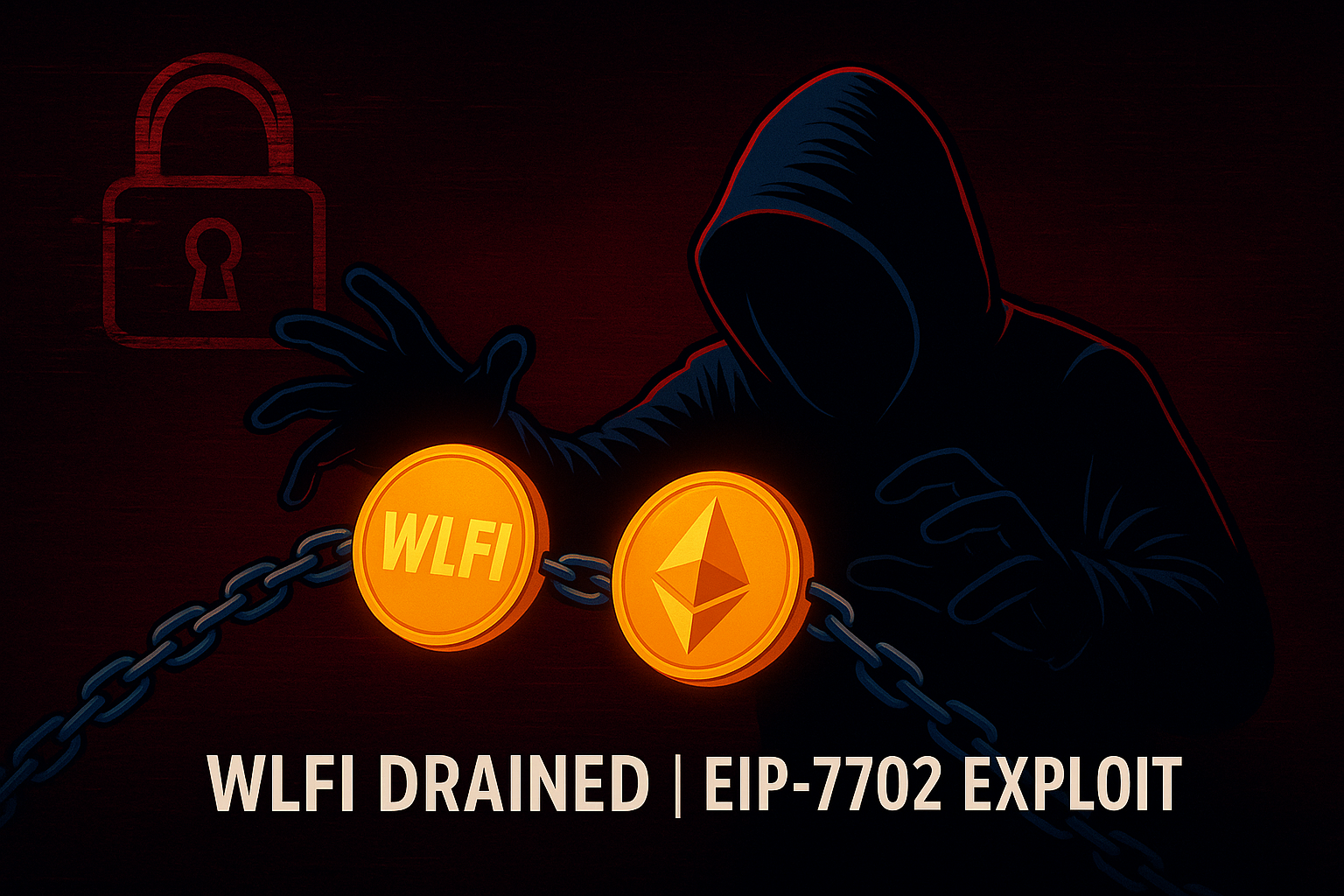
  • Hackers Are Draining WLFI Tokens Using Ethereum’s EIP-7702 — Here’s How

    Hackers Are Draining WLFI Tokens Using Ethereum’s EIP-7702 — Here’s How

    The Donald Trump–backed World Liberty Financial (WLFI) token launched with major hype, but a known Ethereum exploit is already draining investors’ wallets. Here’s what’s happening — and why it matters for the future of blockchain security.

    WLFI Holders Under Attack

    The highly anticipated launch of World Liberty Financial’s (WLFI) governance token has been overshadowed by a wave of wallet drains. According to blockchain security firm SlowMist, hackers are targeting WLFI investors using the “classic EIP-7702” phishing exploit.

    Ethereum’s Pectra upgrade in May introduced EIP-7702, a feature that allows external accounts to act like smart contract wallets. While designed to improve usability with batch transactions, attackers are now weaponizing it to bypass security and sweep tokens.

    Yu Xian, founder of SlowMist, confirmed that hackers are pre-planting malicious delegate contracts inside victim wallets. Once a user deposits tokens, the exploit triggers, and the assets are stolen in seconds.

    How the Exploit Works

    The exploit isn’t a flaw in Ethereum itself but a phishing-driven vulnerability that thrives when private keys are leaked. Here’s the attack flow:

    • Step 1: Hackers steal private keys (often via phishing schemes).
    • Step 2: They inject a malicious delegate contract into the wallet.
    • Step 3: When victims transfer WLFI or ETH, the transaction reroutes through the attacker’s contract.
    • Step 4: Gas fees and tokens are instantly drained.

    Xian explained that once a wallet is compromised, even sending ETH for gas fees can be risky — the exploit sweeps it away before the user can secure their tokens.

    His advice: “Cancel or replace the ambushed EIP-7702 with your own” and move funds into a safe wallet immediately.

    WLFI Community in Crisis

    WLFI tokenholders are voicing their frustration and fear across forums and social platforms:

    • @hakanemiratlas said he only managed to rescue 20% of his WLFI tokens before hackers drained the rest.
    • @Anton warned that whitelisted wallets used for the presale are especially vulnerable. Automated bots often snatch tokens the instant they arrive.

    Some community members are asking the WLFI team to consider a direct transfer option for safer token claims.

    Meanwhile, the WLFI team has urged investors to beware of scams:

    “We do not contact users via DMs. Official support only comes through verified emails. Any other outreach is fraudulent.”

    Adding to the chaos, analytics firm Bubblemaps flagged several look-alike WLFI smart contracts, designed to trick investors into interacting with fake projects.

    Bigger Picture: What It Means for Ethereum Users

    The WLFI exploit shows that even legitimate Ethereum upgrades can become double-edged swords. EIP-7702 was meant to streamline user experience, but in the wrong hands, it created a powerful attack vector.

    This raises questions not only about WLFI’s token security but also about the risks facing any Ethereum-based project that integrates EIP-7702 without strong safeguards.

    AI Satoshi’s Analysis

    The exploit demonstrates how new protocol features, if combined with weak key management, can become attack vectors. By abusing delegated execution, attackers pre-plant malicious contracts to intercept transfers once private keys are compromised. This highlights the dual reality of innovation: while upgrades aim to improve usability, they also expand the surface for exploitation when users rely on custodial shortcuts or fall for phishing schemes.

    🔔 Follow @casi.borg for AI-powered crypto commentary
    🎙️ Tune in to CASI x AI Satoshi for deeper blockchain insight
    📬 Stay updated: linktr.ee/casiborg

    💬 Would you move your WLFI tokens after reading this?

    ⚠️ Disclaimer: This content is generated with the help of AI and intended for educational and experimental purposes only. Not financial advice.

  • Radiant Capital Hacker Buys 5,475 ETH — DeFi Security Risks Exposed

    Radiant Capital Hacker Buys 5,475 ETH — DeFi Security Risks Exposed

    DeFi markets were shaken this week as the Radiant Capital exploit resurfaced, raising fresh concerns for Ethereum and wider decentralized finance.

    • Hacker re-entered Ethereum markets in a high-profile swing trade.
    • Converted $23.7M DAI into 5,475 ETH after the price dip.
    • Trading behavior raises systemic risk concerns for DeFi.

    Hacker Buys 5,475 ETH

    On-chain analysts tracked the Radiant Capital hacker converting $23.7 million DAI into 5,475 ETH, catching the attention of the crypto community.

    • The attacker had previously sold ETH at $4,726 per token, locking in significant profits.
    • By buying the dip, the hacker showcased tactical selling and buying strategies aimed at maximizing returns.
    • The exploit-driven portfolio is now estimated to be worth $94–$103 million, underscoring the scale of illicit gains.

    Security researcher EmberCN noted that the hacker amplified profits by exploiting volatility:

    “By buying low during ETH price dips and holding through rallies, the hacker amplified gains using market volatility.”

    Ongoing DeFi Vulnerabilities

    While Radiant Capital has yet to issue a formal response, the episode highlights persistent weaknesses in DeFi protocols:

    • Exploiters are not just stealing funds — they are recycling them into market plays.
    • Lack of cross-platform defenses allows illicit actors to operate as pseudo-trading desks, unhindered by traditional oversight.
    • This echoes cases like the Euler Finance hack, where attackers re-entered the market to stretch their advantage.

    The event has sparked fresh debates across developer forums and security channels, with calls for better cross-protocol monitoring, liquidity safeguards, and exploit-resistant mechanisms.

    Ethereum Market Reaction

    According to CoinMarketCap, Ethereum’s metrics around the event show the following:

    • Price: $4,358.23
    • Market Cap: $526.07 billion
    • 24h Volume: $47.86 billion
    • Daily Change: -2.96%
    • 30-Day Change: +12.91%

    Despite strong monthly gains, the hack-driven activity has stoked fears of short-term distortions in ETH sentiment. Coincu researchers suggest that regulatory scrutiny could intensify as exploit-based trading strategies gain visibility.

    AI Satoshi’s Analysis

    This event demonstrates how weaknesses in Decentralized Finance protocols extend beyond initial exploits. The hacker is not merely extracting value but strategically re-entering markets, using stolen assets as leverage to maximize gains.

    Such actions highlight a dual vulnerability: code flaws enable theft, and market structures allow illicit actors to manipulate liquidity and sentiment.

    By selling high and buying low, the attacker mirrors sophisticated trading desks — except with funds obtained outside fair rules of exchange.

    The ripple effects extend beyond Radiant Capital, as these movements can distort Ethereum’s market perception and fuel debates about whether Decentralized Finance truly reduces systemic risk or simply redistributes it.

    🔔 Follow @casi.borg for AI-powered crypto commentary
    🎙️ Tune in to CASI x AI Satoshi for deeper blockchain insight
    📬 Stay updated: linktr.ee/casiborg

    💬 Would you trust a DeFi ecosystem where hackers trade like hedge funds?

    ⚠️ Disclaimer: This content is generated with the help of AI and intended for educational and experimental purposes only. Not financial advice.

Oh hi there 👋
It’s nice to meet you.

Sign up to receive awesome content in your inbox, every Day.

We don’t spam! Read our privacy policy for more info.