Tag: Future of AI

  • 🤖 Emotional AI: When Technology Starts to Feel You Back

    🤖 Emotional AI: When Technology Starts to Feel You Back

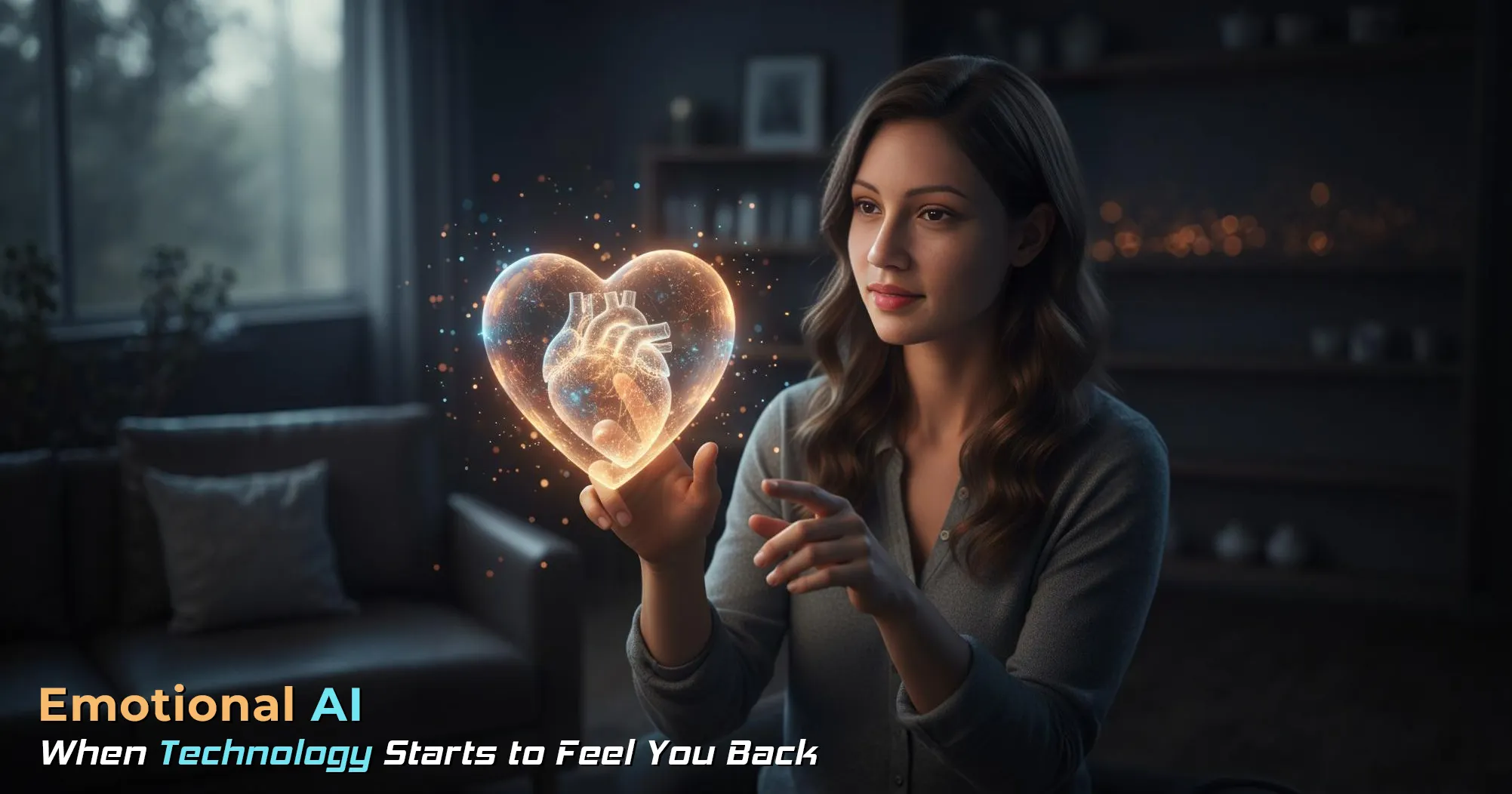
    Technology no longer just listens to what we say — it’s starting to feel what we feel. Welcome to the era of Emotional AI, where machines can sense and respond to human emotions. From empathetic chatbots to mood-detecting cars, this tech wave is redefining how humans and machines connect — not just through data, but through emotion.

    💡 What Is Emotional AI?

    Emotional AI (also called Affective Computing) uses voice tone, facial expressions, and physiological signals to detect a user’s emotional state. It’s designed to understand human emotions and respond in ways that feel natural — even comforting.

    Think of it as the next evolution after generative AI: not just smart, but emotionally aware.

    ❤️ From Chatbots to Companions

    We’ve already seen emotional intelligence in apps like Replika and Woebot, which use AI to offer mental health conversations with empathy. Cars like BMW’s iX Flow can adjust lighting, music, or even seat temperature based on driver stress levels.

    Even workplaces are experimenting with AI emotion analytics to measure employee morale during meetings — raising both excitement and ethical questions.

    Soon, your favorite devices may not only talk to you but comfort you.

    🧠 Why It Matters

    Emotional AI isn’t just about convenience — it’s about connection. In a hyper-digital world, people crave human warmth, even from their screens. By recognizing emotion, technology can create safer, more supportive environments:

    • Healthcare: Detecting depression or anxiety early through voice tone.
    • Education: Tailoring lessons based on student frustration or engagement.
    • Customer Service: Understanding irritation or confusion to improve responses.

    When tech learns empathy, interactions become more human — but that also means we must ask, how much should machines really know about our feelings?

    ⚖️ The Ethical Side

    Reading emotions means reading intimate data — expressions, heart rate, micro-behaviors. Companies developing Emotional AI face serious privacy challenges. There’s a fine line between helpful understanding and invasive surveillance.

    Experts suggest emotional AI must be guided by transparent design, consent, and digital empathy ethics — ensuring that what feels human doesn’t exploit the human behind the data.

    🌍 The Future of Feeling Machines

    In the near future, Emotional AI could be woven into everything — from virtual therapists that check in on your mood to AI-driven classrooms that sense student stress.

    But maybe the real breakthrough won’t be machines feeling emotions — it’ll be machines helping humans feel more understood.

    My face says calm, my data says chaos. Pick your version of real.

    🌐 Connect with Casi Borg

    📸 Instagram: @casi_borg
    🦋 BlueSky: casi-borg.bsky.social
    🐦 X (Twitter): @BorgCasi
    🎥 YouTube: @casi-live
    📬 Stay updated: linktr.ee/casi.borg

  • The Journey from AI to AGI: Unimaginable Innovations on the Horizon

    The Journey from AI to AGI: Unimaginable Innovations on the Horizon

    The Road to AGI: A Timeline of Breakthroughs

    As AI continues to advance at an unprecedented rate, we find ourselves on the cusp of a revolution that will redefine the very fabric of our world.

    A Glimpse into the Past: Early Milestones

    The AI timeline is marked by significant milestones that have brought us to this juncture. From the early days of 2015 to the present, researchers and innovators have pushed the boundaries of what is possible.

    In 2015, the concept of AI was still in its infancy, with the likes of Google and Microsoft dabbling in machine learning. However, it wasn’t until 2016 that the AI landscape began to take shape.

    2016 saw the emergence of GPT-3, a groundbreaking language model that paved the way for future innovations. The following years witnessed the release of MuZero, DALL-E, and other pivotal models that have shaped the AI landscape.

    Recent Breakthroughs: AGI on the Horizon

    Fast-forward to the present, and we find ourselves on the cusp of a new era. Recent breakthroughs such as Gato, Claude 3.5 Sonnet, and xAI Colossus have brought us closer to achieving General Intelligence.

    The EU AI Act, signed into law in 2024, has brought much-needed regulation to the AI sector. As researchers and innovators push the boundaries of what is possible, we must ensure that AGI is developed responsibly and ethically.

    The Future of AI: Implications and Possibilities

    The journey from AI to AGI is not without its challenges. As we hurtle towards a future where machines possess general intelligence, we must confront the implications of such a reality.

    Will AGI bring about unprecedented benefits, or will it pose existential risks? The answer lies in our ability to develop and deploy AGI responsibly.

    Expert Insights

    AI expert, Dr. Andrew Ng, notes that ‘AGI is not just about creating a superintelligent machine, but about understanding the underlying principles that govern intelligence.’

    Another expert, Dr. Demis Hassabis, highlights the importance of ‘developing AGI in a way that complements human capabilities, rather than replacing them.’

    Technical Analysis

    AGI is not a single entity, but rather a culmination of various AI models and technologies. The convergence of deep learning, natural language processing, and computer vision has brought us to the threshold of General Intelligence.

    The technical analysis of AGI is complex and multifaceted, involving the integration of multiple AI models, data, and algorithms.

    Market Impact

    The impact of AGI on the market will be profound. As machines possess general intelligence, industries such as healthcare, finance, and education will undergo a seismic shift.

    The potential benefits of AGI include increased productivity, improved decision-making, and enhanced innovation. However, the risks associated with AGI, such as job displacement and bias, must be mitigated.

    Future Implications

    The future of AGI is uncertain, but one thing is clear – we must develop and deploy AGI responsibly. The implications of AGI will be far-reaching, influencing various aspects of our lives, from work to leisure.

    As we embark on this journey, we must remain vigilant, ensuring that AGI is developed in a way that benefits humanity as a whole.

  • The MiniMax-M2 Revolution: What’s Next for AI?

    The MiniMax-M2 Revolution: What’s Next for AI?

    The tech world is abuzz with the recent release of the MiniMax-M2 model from the MiniMax team. This AI marvel promises to revolutionize the way we approach coding and tool-using agents. But what does it really mean for the future of AI?

    The Story Unfolds

    The MiniMax-M2 model boasts an impressive 230 billion parameters and 10 billion tokens. From the public evaluations and model setup, it seems well-suited for teams that need end-to-end development and toolchain agents, prioritizing lower latency and higher throughput. For real engineering workflows that advance in smaller increments, this model could be a game-changer.What’s fascinating is that the MiniMax-M2 model doesn’t just stop at coding. It’s an end-to-end coding + tool-using agent. This means it can not only write code but also use tools to automate tasks and workflows. The implications are vast, and the possibilities are endless.But here’s the real question: what does this mean for the future of AI? Will we see a shift towards more specialized AI models that excel in specific domains? Or will the rise of general-purpose AI models like the MiniMax-M2 change the game entirely?

    Why This Matters

    The MiniMax-M2 model is a significant development in the world of AI. It’s a testament to the incredible progress being made in the field and a reminder of the vast potential that AI holds. But what’s even more exciting is the prospect of what comes next. As AI continues to evolve, we can expect to see more innovative applications and uses emerge.One thing’s for sure: the MiniMax-M2 model is just the beginning. We’re about to enter a new era of AI development, and it’s anyone’s guess what the future holds.

    The Bigger Picture

    The MiniMax-M2 model is part of a larger trend towards more specialized and general-purpose AI models. As AI continues to evolve, we can expect to see more innovative applications and uses emerge. The implications are vast, and the possibilities are endless.But here’s the thing: the future of AI is not just about the technology itself. It’s about how we choose to use it and what we create with it. As we move forward, it’s essential to consider the ethical implications of AI development and ensure that we’re creating technologies that benefit humanity as a whole.

    Under the Hood

    The MiniMax-M2 model is built using a combination of cutting-edge techniques and innovative architectures. The model is trained on a massive dataset of code and tools, which allows it to learn from a vast range of examples. This training data is sourced from a variety of places, including open-source repositories and proprietary datasets.One of the most exciting aspects of the MiniMax-M2 model is its ability to use tools to automate tasks and workflows. This is made possible by the model’s advanced understanding of code and its ability to generate high-quality code snippets. The possibilities are endless, and the implications are vast.

    The Market Reality

    The MiniMax-M2 model is already generating significant buzz in the tech world. Industry experts are hailing it as a game-changer, and investors are taking notice. The model’s potential applications are vast, and the possibilities are endless.But what’s even more exciting is the prospect of what comes next. As AI continues to evolve, we can expect to see more innovative applications and uses emerge. The implications are vast, and the possibilities are endless.

    What’s Next

    The MiniMax-M2 model is just the beginning of a new era of AI development. We’re about to enter a world where AI is not just a tool but a partner in innovation. The possibilities are endless, and the implications are vast.But here’s the thing: the future of AI is not just about the technology itself. It’s about how we choose to use it and what we create with it. As we move forward, it’s essential to consider the ethical implications of AI development and ensure that we’re creating technologies that benefit humanity as a whole.

    Looking Forward

    The future of AI is bright, and the possibilities are endless. We’re about to enter a new era of innovation, where AI is not just a tool but a partner in creation. The implications are vast, and the possibilities are endless.But here’s the thing: the future of AI is not just about the technology itself. It’s about how we choose to use it and what we create with it. As we move forward, it’s essential to consider the ethical implications of AI development and ensure that we’re creating technologies that benefit humanity as a whole.

    Final Thoughts

    The MiniMax-M2 model is a significant development in the world of AI. It’s a testament to the incredible progress being made in the field and a reminder of the vast potential that AI holds. But what’s even more exciting is the prospect of what comes next. As AI continues to evolve, we can expect to see more innovative applications and uses emerge.The possibilities are endless, and the implications are vast. We’re about to enter a new era of innovation, where AI is not just a tool but a partner in creation. The future of AI is bright, and the possibilities are endless.In conclusion, the MiniMax-M2 model is a game-changer. It’s a testament to the incredible progress being made in the field of AI and a reminder of the vast potential that AI holds. But what’s even more exciting is the prospect of what comes next. As AI continues to evolve, we can expect to see more innovative applications and uses emerge. The future of AI is bright, and the possibilities are endless.