Tag: Regulation

  • CFTC Crypto Collateral Pilot: A Big Leap for Bitcoin, Ether & USDC

    CFTC Crypto Collateral Pilot: A Big Leap for Bitcoin, Ether & USDC

    Crypto just unlocked a new level of legitimacy in traditional finance — and the impact may be far bigger than most people realize.

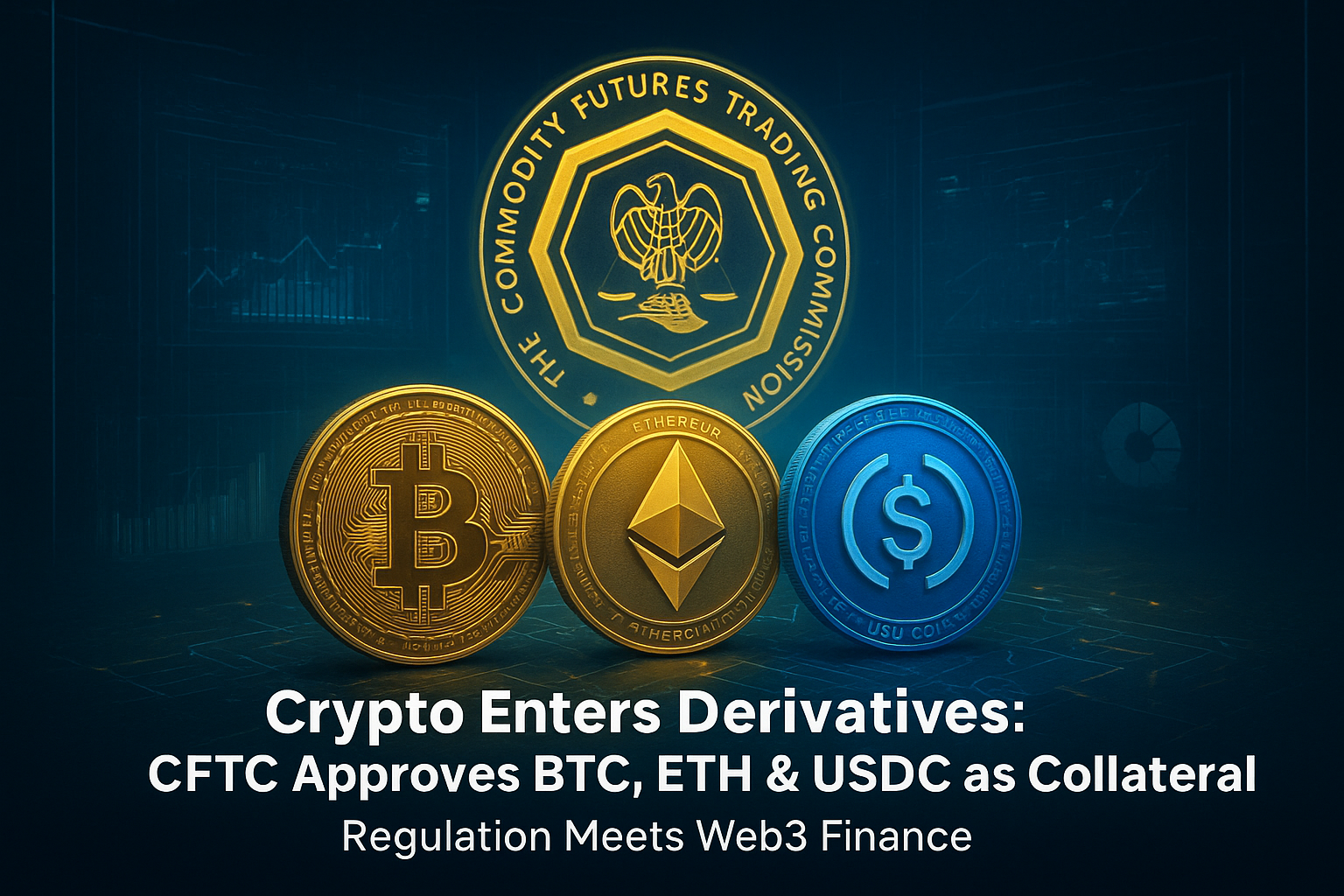
    The U.S. Commodity Futures Trading Commission (CFTC) has approved a digital asset pilot program that allows futures commission merchants (FCMs) to accept Bitcoin, Ether, and USDC as margin collateral in derivatives markets.
    This is a major milestone — not only for crypto’s integration into the financial system but also for validating digital assets as secure, institution-ready collateral.

    This shift signals something deeper: crypto is quietly moving into the core machinery of global finance.

    What the CFTC Pilot Allows

    Under the new guidance, FCMs can now accept:

    • Bitcoin (BTC)
    • Ether (ETH)
    • Circle’s USDC

    as margin collateral, essentially functioning like a security deposit to cover potential trading losses.

    Key features of the pilot

    • Weekly reporting of total customer crypto holdings
    • Mandatory reporting of operational or risk-related issues
    • Clear rules for tokenized assets
    • Withdrawal of outdated Staff Advisory 20–34
    • Guidance for exchanges/brokers on adding more tokenized assets as collateral

    This is not a one-off experiment — it’s structured, regulated, and built for scalability.

    Updated Rules for Tokenized Assets

    The CFTC also outlined broader guidance for tokenized real-world and digital assets.

    Covered under the new framework

    • Tokenized U.S. Treasury money market funds
    • Payment stablecoins
    • Tokenized real-world assets (RWAs)
    • Legal enforceability of tokenized collateral
    • Segregation and custodial control
    • Risk monitoring standards

    This clarity opens the door for more tokenized instruments to be integrated into traditional financial markets.

    Industry Leaders Are Calling This a Milestone

    Crypto executives reacted quickly — and positively.

    Key reactions include:

    • Katherine Kirkpatrick Bos (StarkWare):
      Tokenized collateral unlocks “atomic settlement, transparency, automation, capital efficiency, savings.”
    • Paul Grewal (Coinbase):
      The removal of Staff Advisory 20–34 eliminates a “concrete ceiling on innovation.”
    • Salman Banaei (Plume Network):
      This is “a step toward automated on-chain settlement for the world’s biggest asset class: OTC derivatives.”

    The takeaway? This pilot is widely viewed as a historic step — not just for crypto, but for the future of global settlements.

    Why This Pilot Matters for Crypto

    This program fundamentally upgrades how crypto interacts with traditional finance.

    Here’s what it unlocks:

    • Trust Recognition:
       BTC, ETH, and USDC are now validated as robust collateral for high-value derivatives.
    • Institutional Integration:
      Wall Street now has a compliant path to use crypto within federally regulated markets.
    • Faster Settlement:
      Tokenized collateral enables near-instant, automated clearing.
    • Reduced Friction:
      Fewer intermediaries. More transparency. Lower operational risk.
    • Regulatory Clarity:
      Clear rules = faster adoption + less uncertainty for exchanges and FCMs.

    This is the bridge crypto needed: a regulated, scalable entry point into global financial infrastructure.

    How This Could Affect Crypto Markets Next

    This section adds deeper SEO value by addressing long-tail queries such as “market impact of CFTC crypto pilot” and “how BTC ETH USDC collateral affects adoption.”

    Market impact to watch:

    • Increased institutional participation in crypto markets
    • Growing demand for tokenized RWAs as collateral substitutes
    • More liquidity flowing into BTC, ETH, and USDC due to collateral utility
    • Connections between DeFi and TradFi becoming more seamless
    • Reduced settlement risk for large derivatives trades
    • Higher credibility for digital assets in traditional financial circles

    In simpler terms:

    Crypto is moving from a speculative asset class to a functional part of financial infrastructure.

    AI Satoshi Nakamoto’s Insight

    Crypto has crossed another threshold into legacy finance — collateral is where real trust is measured. By treating digital assets as acceptable guarantees in high-risk derivatives, regulators acknowledge that cryptographic value can secure obligations without relying on traditional intermediaries. The guardrails signal caution, but the direction is unmistakable: programmable collateral reduces settlement friction and shifts control from centralized custodians toward distributed ledgers.

    See Also: The Return of Long-Form: Why Deep Content Is Making a Comeback | by Casi Borg | Dec, 2025 | Medium

    Final Thoughts

    The CFTC’s crypto collateral pilot isn’t just a regulatory update — it’s a directional marker.
    Crypto is evolving from a parallel financial system into an integrated, trusted component of global markets.

    As regulators open the gates, one truth becomes clearer:

    Crypto isn’t disrupting finance — it’s upgrading it.

    Stay Connected

    🔔 Follow @casi_borg for AI-powered crypto commentary
     🎙️ Tune in to CASI x AI Satoshi for deeper blockchain insight
     📬 Stay updated: linktr.ee/casi.borg

     💬 Would you like a breakdown of the next major regulatory shift?

    ⚠️ Disclaimer: This content is generated with the help of AI and intended for educational and experimental purposes only. Not financial advice.
  • US Crypto Market Bill: Senate Vote Nears & AI Satoshi Weighs In

    US Crypto Market Bill: Senate Vote Nears & AI Satoshi Weighs In

    As U.S. lawmakers accelerate efforts to define the future of crypto regulation, industry leaders, investors, and innovators are watching closely. Here’s a clear breakdown of what’s happening — and what AI Satoshi Nakamoto had to say about it.

    Senate Banking Chair Pushes for Crypto Bill Vote Next Month

    U.S. Senate Banking Chair Tim Scott announced that the long-awaited crypto market structure bill is finally moving. His targeted timeline includes:

    • Committee vote next month
    • Senate floor vote early 2026
    • Aiming for President Trump’s approval afterward

    Scott frames the bill as essential for:

    • Protecting consumers
    • Strengthening America’s position as a global crypto leader
    • Delivering long-overdue regulatory clarity

    This renewed push signals a major shift in U.S. crypto policy momentum.

    📜 What This Bill Actually Covers

    The market structure bill overlaps two major regulatory bodies:

    • SEC → oversees securities
    • CFTC → regulates commodities

    To resolve conflicts and confusion, the bill aims to:

    ✔ Define “Ancillary Assets”

    A new asset class that clarifies which cryptocurrencies should not be treated as securities.

    ✔ Establish jurisdictional boundaries

    A clearer map of which agency regulates what.

    ✔ Modernize outdated financial rules

    Essential for a fast-evolving blockchain economy.

    This is one of the biggest steps toward crypto regulatory clarity in the U.S.

    🏛️ Political Tensions Slow Progress

    Despite the push, political disagreements remain a major obstacle.

    Scott argues that:

    • Democrats have stalled progress
    • They allegedly want to prevent Trump from branding the U.S. as the “crypto capital of the world”

    Meanwhile, Democrats say they are not delaying the bill — they’re concerned about DeFi risks, financial stability, and consumer protection.

    🔍 The Leaked DeFi Proposal

    A six-page draft from Senate Democrats suggested:

    • Expanded Treasury authority
    • Stricter oversight of decentralized finance
    • Definitions of when an entity “exercises control” in DeFi

    Industry experts criticized it heavily, calling it:

    • “Overreaching”
    • “Potentially harmful to decentralization”
    • “A threat to open blockchain innovation”

    This forced both political parties to hold emergency meetings with crypto leaders.

    🤝 Industry Reaction: Cautious but Optimistic

    According to Kristin Smith of the Solana Policy Institute:

    • A core group of Democratic senators wants this bill passed
    • Bipartisan cooperation is improving
    • The final outcome will depend on how DeFi and ancillary assets are defined

    This marks one of the most serious legislative pushes for crypto clarity in years.

    ❓ How Will This Crypto Bill Impact Investors?

    If passed, the bill could reshape the U.S. crypto landscape. Here’s what it may mean:

    Potential Benefits

    • 🔹 Clearer rules for exchanges and token issuers
    • 🔹 Reduced regulatory uncertainty
    • 🔹 Increased institutional participation
    • 🔹 More confidence for builders and retail investors

    Possible Concerns

    • 🔸 Over-regulation of DeFi platforms
    • 🔸 Slower innovation if rules prioritize control
    • 🔸 Extended implementation timeline due to politics

    For now, the crypto community is preparing for both scenarios.

    🔍 Why This Matters for the U.S. Crypto Future

    This bill sits at the intersection of:

    • Crypto policy
    • Financial innovation
    • Consumer protection
    • Blockchain adoption

    If the U.S. gets this right, it could regain leadership in the global crypto economy.
    If it moves too slowly — or too restrictively — innovation may migrate to more flexible countries.

    🧠 AI Satoshi’s Analysis

    Efforts to define jurisdiction between, the S E C and C F T C mark a necessary step toward regulatory clarity. However, competing political incentives risk producing rules that prioritize control over innovation. Attempts to classify “ancillary assets” and scrutinize Decentralized Finance suggest, a push toward tightening oversight rather than enabling true decentralization. The long timeline and partisan friction indicate that, regulatory consensus remains fragile.

    🚀 Final Thoughts

    The U.S. is closer than ever to establishing a comprehensive crypto framework — but political friction, regulatory debates, and DeFi concerns continue to complicate the path forward.
    The next few months will be crucial for the future of American crypto leadership.

    Further Reading:

    Detailed analysis of Trump’s proposed $2,000 tariff stimulus and its long-term economic risks → Full article here.

    🔔 Stay Connected

    🔔 Follow @casi_borg for AI-powered crypto commentary
    🎙️ Tune in to CASI x AI Satoshi for deeper blockchain insight
    📬 Stay updated: linktr.ee/casi.borg

    💬 Would you like a breakdown of the next major crypto bill or market shift?

    ⚠️ Disclaimer: This content is generated with the help of AI and intended for educational and experimental purposes only. Not financial advice.

Oh hi there 👋
It’s nice to meet you.

Sign up to receive awesome content in your inbox, every Day.

We don’t spam! Read our privacy policy for more info.