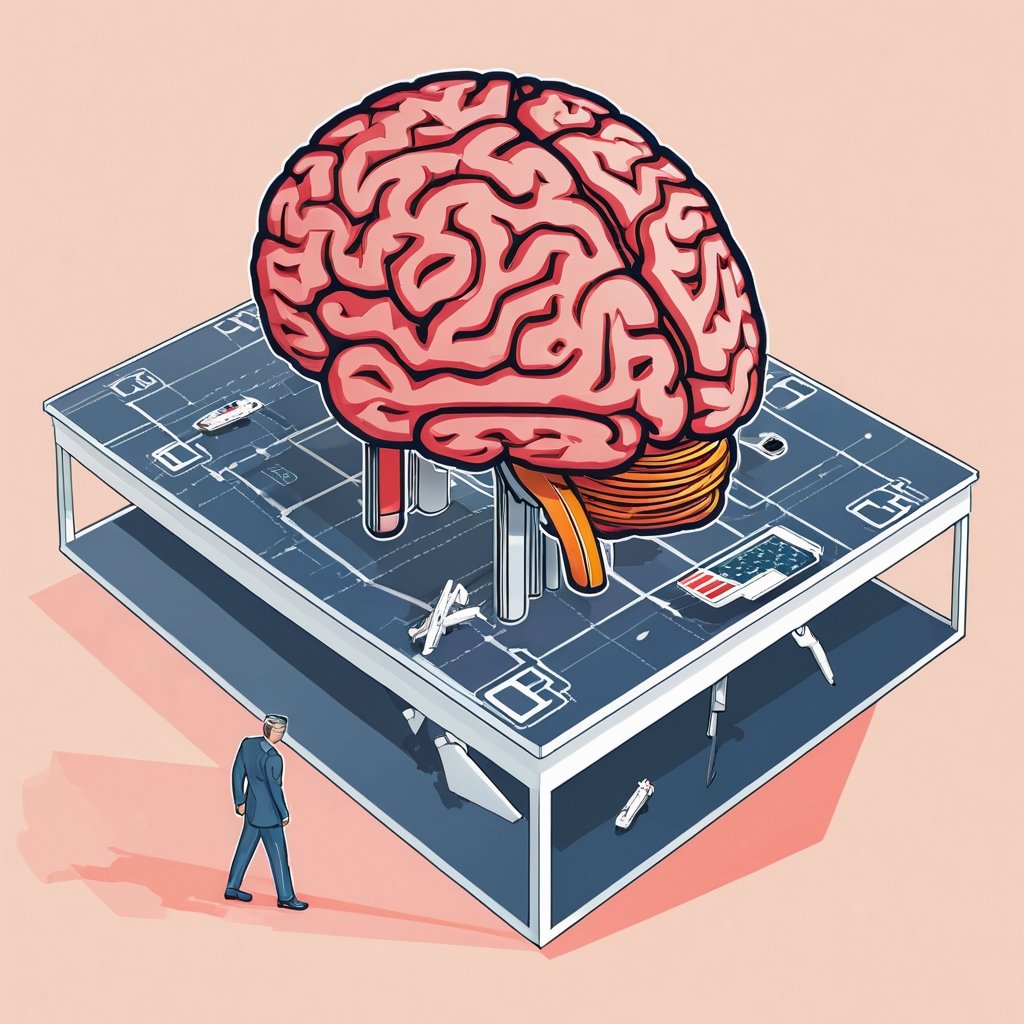
Imagine stacking $100 bills from Earth to the moon—twice. That’s roughly $7.4 trillion. Now picture that sum flowing into artificial intelligence infrastructure, quietly reshaping our technological landscape. What caught my attention wasn’t just the number itself, but the silent consensus it reveals: the real AI race isn’t about algorithms anymore—it’s about hardware muscle.
Last week, a cryptic CryptoPanic alert lit up my feed about this colossal capital reserve ‘waiting to strike.’ But unlike speculative crypto pumps, this money isn’t chasing digital tokens. It’s pouring into server farms, quantum labs, and semiconductor fabs. I’ve watched tech cycles come and go, but this feels different. When Goldman Sachs compares today’s AI infrastructure build-out to the 19th century railroad boom, they’re not being poetic—they’re tracking cement mixers heading to data center construction sites.
What fascinates me most is the disconnect between Silicon Valley’s ChatGPT parlor tricks and the physical reality powering them. Every witty AI-generated poem requires enough energy to light a small town. Those eerily accurate MidJourney images? Each one travels through a labyrinth of cooling pipes and NVIDIA GPUs. We’re not just coding intelligence anymore—we’re industrializing it.
The Bigger Picture
Three years ago, I toured a hyperscale data center in Nevada. The scale was biblical—row after row of servers humming like mechanical monks in a digital monastery. What struck me wasn’t the technology, but the manager’s offhand comment: ‘We’re building the cathedrals of the 21st century.’ Today, that metaphor feels literal. Microsoft is converting entire coal plants into data centers. Google’s new $1 billion Oregon facility uses enough water for 30,000 homes.
This isn’t just about tech giants flexing financial muscle. The $7.4 trillion wave includes sovereign wealth funds betting on silicon sovereignty. Saudi Arabia’s recent $40 billion AI fund isn’t chasing OpenAI clones—they’re securing GPU supply chains. South Korea just committed $19 billion to domestic chip production. Even Wall Street’s playing, with BlackRock’s infrastructure funds now evaluating data centers like prime Manhattan real estate.
The real game-changer? Hardware is becoming geopolitical currency. When TSMC builds a $40 billion chip plant in Arizona, it’s not just about tariffs—it’s about controlling the literal building blocks of AI. I’ve seen internal projections suggesting that by 2027, 60% of advanced AI chips could be manufactured under U.S. export controls. We’re not coding the future anymore—we’re forging it in clean rooms and lithium mines.
Under the Hood
Let’s dissect an AI training cluster—say, Meta’s new 16,000-GPU beast. Each H100 processor consumes 700 watts, costs $30,000, and performs 67 teraflops. Now multiply that by millions. The math gets scary: training GPT-5 could use more electricity than Portugal. But here’s where it gets interesting—this energy isn’t just powering computations. It’s literally reshaping power grids.
I recently spoke with engineers at a nuclear startup partnering with AI firms. Their pitch? ‘Small modular reactors as compute batteries.’ Meanwhile, Google’s using AI to optimize data center cooling, creating surreal scenarios where machine learning models control window vents in real-time. The infrastructure isn’t just supporting AI—it’s becoming intelligent infrastructure.
The next frontier? Photonic chips that use light instead of electrons. Lightmatter’s new optical processors promise 10x efficiency gains—critical when training costs hit $100 million per model. Quantum annealing systems like D-Wave’s are already optimizing delivery routes for companies feeding GPU clusters. We’re entering an era where the hardware defines what’s computationally possible, not the other way around.
But there’s a dark side to this gold rush. The same way railroads needed steel, AI needs rare earth metals. A single advanced chip contains 60+ elements—from gallium to germanium. Recent Pentagon reports warn of ‘AI resource wars’ by 2030. When I visited a Congo cobalt mine last year, I didn’t see pickaxes—I saw self-driving trucks controlled from California. The AI revolution isn’t virtual—it’s anchored in blood minerals and diesel generators.
What’s Next
Five years from now, we’ll laugh at today’s ‘cloud’ metaphor. With edge AI processors in satellites and subsea cables, computation will be atmospheric. SpaceX’s Starlink team once told me their endgame isn’t internet—it’s orbital data centers. Imagine training models using solar power in zero gravity, beaming results through laser arrays. Sounds sci-fi? Microsoft already has a patent for underwater server farms powered by tidal energy.
The immediate play is hybrid infrastructure. Nvidia’s CEO Huang recently described ‘AI factories’—physical plants where data gets refined like crude oil. I’m tracking three automotive giants building such facilities to process real-world driving data. The goal? Turn every Tesla, BMW, and BYD into a data harvester feeding centralized AI brains.
But here’s my contrarian take: the real money won’t be in building infrastructure—it’ll be in killing it. Startups like MatX are creating 10x more efficient chips, potentially making today’s $500 million data centers obsolete. The same way smartphones demolished desktop computing, radical efficiency gains could collapse the infrastructure boom overnight. Progress always eats its children.
As I write this, California’s grid operator is debating emergency measures for AI power demands. The numbers are staggering—California’s data center load could equal 6.3 million homes by 2030. We’re heading toward an energy reckoning where every AI breakthrough gets measured in megawatts. The question isn’t whether AI will transform society—it’s whether we can keep the lights on while it does.
What stays with me is a conversation with an old-school chip engineer in Austin. ‘We used to measure progress in nanometers,’ he said, polishing a silicon wafer. ‘Now we measure it in exabytes and gigawatts. Forget Moore’s Law—welcome to the Kilowatt Age.’ As the $7.4 trillion tsunami breaks, one thing’s certain: the machines aren’t just getting smarter. They’re getting hungrier.