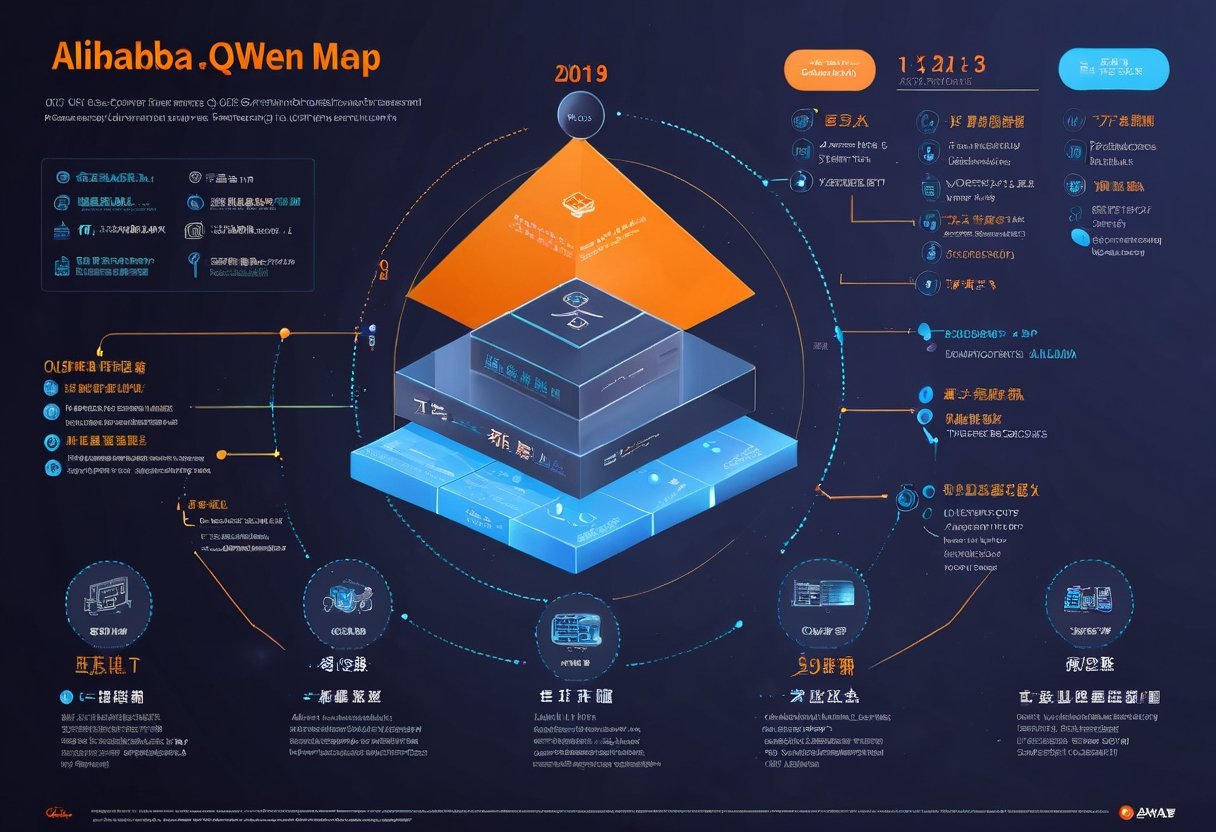
What caught my attention wasn’t the announcement itself, but the timing. Alibaba’s unveiling of their Qwen roadmap marked a significant milestone in the world of deep tech hardware and infrastructure. With two big bets – unified multi-modal models and extreme scaling across every dimension – the company is pushing the boundaries of what’s possible. But here’s the real question: what does this mean for the future of AI and deep learning?
Alibaba’s ambition is staggering. They’re talking about scaling up their models to handle 100 million tokens, with parameters reaching a whopping ten trillion scale. Test-time compute is expected to skyrocket from 64k to 1 million scaling, while data storage is expected to grow from 10 trillion to 100 trillion tokens. What’s fascinating is that they’re not just stopping at scaling up their models, but also exploring the use of synthetic data generation.
The Qwen roadmap is a testament to the rapid progress being made in the field of deep learning. With advancements in hardware and infrastructure, we’re seeing unprecedented growth in the capabilities of AI models. But what’s often overlooked is the human aspect of this growth. The reality is that these models are being built by humans, and it’s our creativity, ingenuity, and perseverance that’s driving this progress.
But here’s where it gets interesting. Alibaba’s foray into synthetic data generation holds the key to unlocking new possibilities in the field of AI. By generating high-quality, realistic data, they’re enabling the development of more accurate and robust models. And it’s not just about the technology – it’s about the potential applications that this has in fields like healthcare, finance, and education.
The Bigger Picture
The Qwen roadmap is a reminder that the field of deep tech is rapidly evolving, and we’re at the cusp of a new era in AI and deep learning. What’s likely to happen in the next few years is a fundamental shift in the way we think about AI, from a narrow focus on tasks to a more holistic approach that takes into account the complexities of human behavior. And at the heart of this shift is the ability to generate high-quality, realistic data that can be used to train more accurate and robust models.
But there’s a deeper game being played here. The Qwen roadmap is just the tip of the iceberg, and what we’re seeing is a battle for dominance in the field of deep tech. The players involved are not just tech giants, but also researchers, entrepreneurs, and policymakers who are vying for influence and control. And at the heart of this battle is the ability to generate high-quality, realistic data that can be used to train more accurate and robust models.
Under the Hood
One of the key areas where Alibaba is pushing the boundaries is in the use of unified multi-modal models. What’s fascinating is that these models are being developed to handle multiple tasks simultaneously, from natural language processing to computer vision. And what’s even more impressive is that they’re being trained on massive datasets that are being generated synthetically. What strikes me is that this approach has the potential to unlock new possibilities in the field of AI, from more accurate and robust models to more efficient and scalable processing.
But here’s the reality. The Qwen roadmap is not just about the technology – it’s about the human aspect of this growth. The people behind Alibaba are driven by a passion for innovation, a desire to push the boundaries of what’s possible. And what’s inspiring is that this passion is contagious, spreading to other researchers, entrepreneurs, and policymakers who are working on similar projects.
The Market Reality
The market impact of the Qwen roadmap is likely to be significant, with far-reaching implications for the field of AI and deep learning. What’s likely to happen in the next few years is a surge in demand for high-quality, realistic data that can be used to train more accurate and robust models. And at the heart of this demand is the ability to generate massive datasets that can be used to train these models. What’s fascinating is that this demand is not just limited to tech giants, but also to researchers, entrepreneurs, and policymakers who are working on similar projects.
But here’s the challenge. The generation of high-quality, realistic data is a complex task that requires significant expertise and resources. What’s daunting is that the current state of the art in data generation is not sufficient to meet the growing demand for high-quality data. And what’s worrying is that this gap in expertise and resources is likely to create a bottleneck in the field of AI and deep learning.
What’s Next
The future implications of the Qwen roadmap are far-reaching, with potential applications in fields like healthcare, finance, and education. What’s inspiring is that this growth has the potential to unlock new possibilities in the field of AI, from more accurate and robust models to more efficient and scalable processing. And what’s exciting is that this growth is not just limited to tech giants, but also to researchers, entrepreneurs, and policymakers who are working on similar projects.
But here’s the reality. The future is uncertain, and what’s likely to happen in the next few years is a fundamental shift in the way we think about AI and deep learning. What’s likely to happen is that the field will become more complex, with multiple players vying for influence and control. And at the heart of this complexity is the ability to generate high-quality, realistic data that can be used to train more accurate and robust models.
Final Thoughts
The Qwen roadmap is a testament to the rapid progress being made in the field of deep learning. With advancements in hardware and infrastructure, we’re seeing unprecedented growth in the capabilities of AI models. And what’s fascinating is that this growth has the potential to unlock new possibilities in the field of AI, from more accurate and robust models to more efficient and scalable processing. But here’s the reality – the future is uncertain, and what’s likely to happen in the next few years is a fundamental shift in the way we think about AI and deep learning.